
BibTeX Bibliography (.bib)
A BibTeX bibliography with three real citations (Lovelace, Knuth, Shannon) across article, book, and inproceedings types — for testing BibTeX parsers, reference managers, and citation converters.
@article{lovelace1843notes,
  author  = {Lovelace, Ada},
  title   = {Notes on the Analytical Engine},
  journal = {Taylor's Scientific Memoirs},
  year    = {1843},
  volume  = {3},
  pages   = {666--731}
}

@book{knuth1997taocp,
  author    = {Knuth, Donald E.},
  title     = {The Art of Computer Programming},
  publisher = {Addison-Wesley},
  year      = {1997},
  edition   = {Third},
  isbn      = {978-0201896831}
}

@inproceedings{shannon1948communication,
  author    = {Shannon, Claude E.},
  title     = {A Mathematical Theory of Communication},
  booktitle = {The Bell System Technical Journal},
  year      = {1948},
  volume    = {27},
  pages     = {379--423}
}
Specifications
- Format
- BibTeX
- Entries
- 3
- Types
- article, book, inproceedings
What is a .bib file?
BibTeX (.bib) is a plain-text bibliography database used with LaTeX and reference managers. Each entry has a type (@article, @book, @inproceedings), a citation key, and tagged fields like author, title, year, and journal. It is the standard citation format in academic writing.
How to use this file
Use an example .bib file to test BibTeX and BibLaTeX parsers, reference managers (Zotero, Mendeley, JabRef), and citation-format converters (for example BibTeX to RIS or CSL-JSON).
How to use this file for testing
“BibTeX Bibliography (.bib)” is a deterministic Novus Examples fixture for Scientific data, Editor testing. Citation catalogs (BibTeX, RIS), chemistry structures (MDL Molfile, PDB), and gridded binary data (NetCDF, FITS) — for testing reference managers, molecule viewers, and scientific-data loaders.
Documented properties for this file: 3 entries · BibTeX. Compare results against paired or grouped companions on this page when present (clean↔damaged, searchable↔scanned, or format twins) so scores stay reproducible across runs.
Download the file once, keep the path stable in CI or local scripts, and treat the spec table as the contract: dimensions, seeds, field lists, and roles are intentional. Corrupt or invalid samples are labelled as such — expect parsers to fail loudly rather than silently accept them.
Data fixtures document their exact quirks — delimiters, encodings, null handling, schema, and row counts — in the spec table. Point your parser or importer at the file and assert it handles the documented edge cases; clean and deliberately-messy siblings make before/after diffs straightforward.
Code examples
import bibtexparser  # pip install bibtexparser

lib = bibtexparser.parse_file("references.bib")
for e in lib.entries[:5]:
    print(e.key, "-", e.fields_dict.get("title"))
Related files
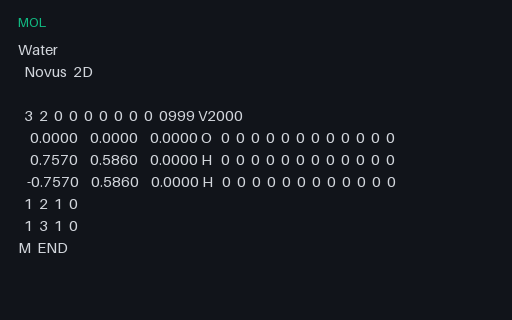
- molMDL Molfile — Water (.mol)An MDL Molfile (V2000) of a water molecule with standard geometry — a counts line, atom block with 2D coordinates, and bond block — for testing cheminformatics parsers and MOL/SDF converters.
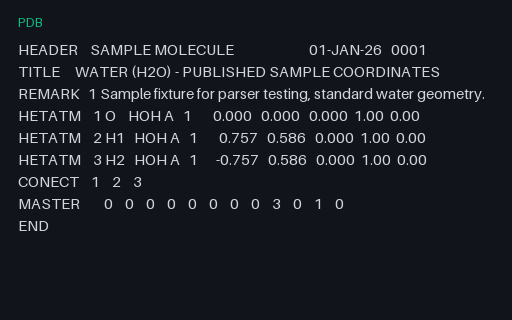
- pdbPDB Structure — Water (.pdb)The same water molecule in PDB format with fixed-column HETATM coordinate records and a CONECT bond record — for testing molecular-structure parsers and viewers and PDB/MOL conversion.
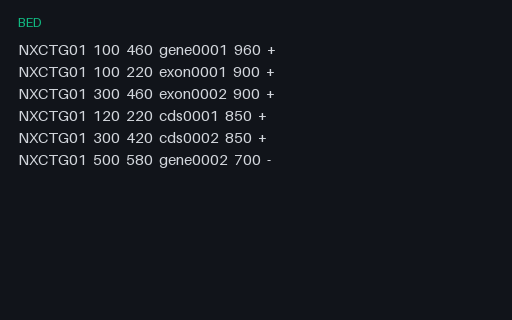
- bedBED6 Intervals — 0-Based Half-Open Coordinates (.bed)The same six features as the GFF3 file expressed in BED's 0-based half-open coordinates, where the start is one lower and the end is unchanged. Confusing the two conventions shifts every interval by a base, and this pair makes that shift a visible diff.
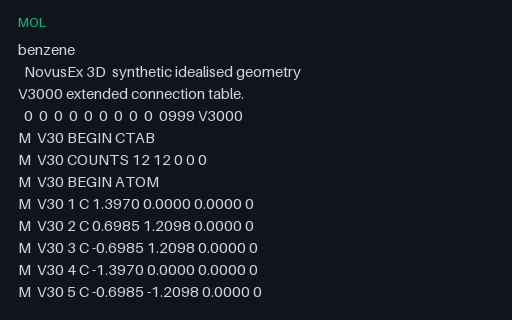
- molBenzene — Molfile V3000 Extended Connection Table (.mol)Benzene written in the V3000 extended format, where the legacy counts line reports zero atoms and the real counts live in an M V30 COUNTS record. A parser that trusts the old counts line reads an empty molecule and reports no error whatsoever.
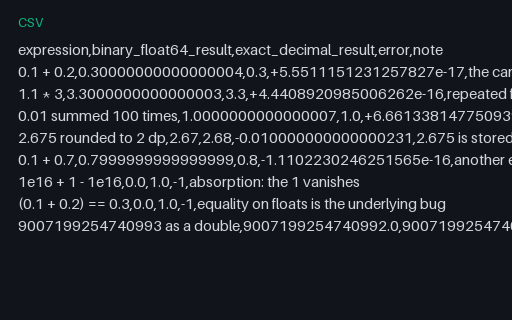
- csvBinary versus Decimal Arithmetic — Where Floats Disagree (.csv)Eight arithmetic expressions where binary floating point and exact decimal disagree, with both answers and the signed error side by side. Adding one cent a hundred times does not give one, and this file says by exactly how much.
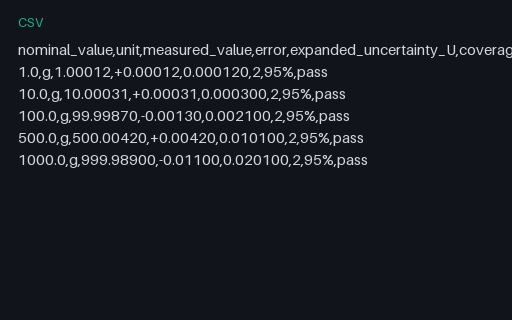
- csvCalibration Certificate — Error and Expanded Uncertainty (.csv)Five calibration points with the nominal value, the measured value, the signed error and the expanded uncertainty at k=2 with its confidence level stated. It is a synthetic illustration of the layout, not an accredited certificate, and nothing in it refers to a real instrument or laboratory.
Generated by generation/sci_data.py. Free for any use, no attribution required — license.