
API Problem+JSON — Not Acceptable (406)
RFC 7807 SAMPLE problem document for HTTP 406 (Not Acceptable) client tests.
{
  "type": "https://api.sample.example/problems/not-acceptable",
  "title": "Not Acceptable",
  "status": 406,
  "detail": "No representation matches Accept header.",
  "instance": "/orders/ORD-SAMPLE-406",
  "sample": true
}
Specifications
- Status
- 406
- Rfc
- 7807
- Wave
- I
- Sample Only
- true
Testing contract
Expected to pass- Scenario
- Exercise API Problem+JSON — Not Acceptable (406) in its api workflow. RFC 7807 SAMPLE problem document for HTTP 406 (Not Acceptable) client tests.
- Expected result
- top-level keys are type, title, status, detail, instance, sample; selected values: {"type": "https://api.sample.example/problems/not-acceptable", "status": 406, "sample": true}. Declared feature checks: status=406; rfc=7807.
What is a .json file?
JSON (JavaScript Object Notation) is a lightweight, text-based data-interchange format representing objects, arrays, strings, numbers, booleans, and null. It is language-independent, human-readable, and the dominant format for web APIs and configuration. It requires a single well-formed root value.
How to use this file
Use an example JSON file to test parsers and serializers, schema validation, Unicode and number-precision handling, and API request or response processing.
How to use this file for testing
“API Problem+JSON — Not Acceptable (406)” is a deterministic Novus Examples fixture for JSON parsing, Error handling, Schema / OpenAPI testing. Flat, deeply nested, JSON Lines, and intentionally invalid JSON for testing parsers and error handling.
Documented properties for this file: JSON · 235 bytes. Compare results against paired or grouped companions on this page when present (clean↔damaged, searchable↔scanned, or format twins) so scores stay reproducible across runs.
Download the file once, keep the path stable in CI or local scripts, and treat the spec table as the contract: dimensions, seeds, field lists, and roles are intentional. Corrupt or invalid samples are labelled as such, expect parsers to fail loudly rather than silently accept them.
Data fixtures document their exact quirks (delimiters, encodings, null handling, schema, and row counts) in the spec table. Point your parser or importer at the file and assert it handles the documented edge cases; clean and deliberately-messy siblings make before/after diffs straightforward.
Feed the file to your parser and assert it handles the documented quirks, quoted delimiters, embedded newlines, ragged rows, or invalid syntax; the valid↔invalid distinction is labelled in the title.
Code examples
import json

with open("error-not-acceptable.json") as f:
    data = json.load(f)
print(type(data), len(data))
Related files
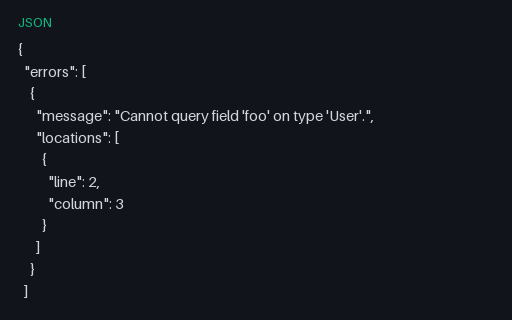
- jsonGraphQL Error Response (JSON)GraphQL error response with message and location — negative case for GraphQL clients.
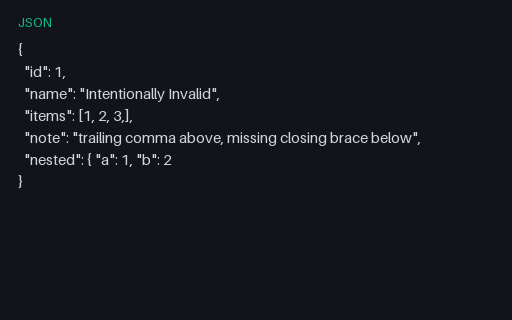
- jsonIntentionally Invalid JSONAn intentionally invalid JSON file with a trailing comma and a missing closing brace — for testing parser error handling and messages. Not valid JSON by design.
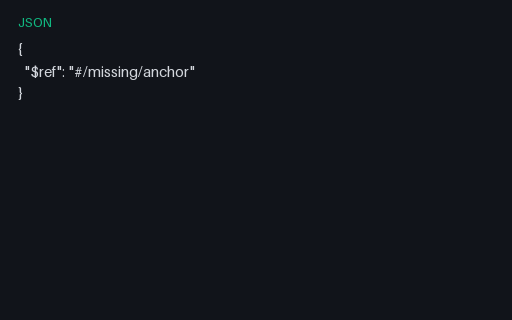
- jsonInvalid JSON Schema — Json Schema Bad RefIntentionally invalid JSON Schema (json-schema-bad-ref) for negative validator tests.
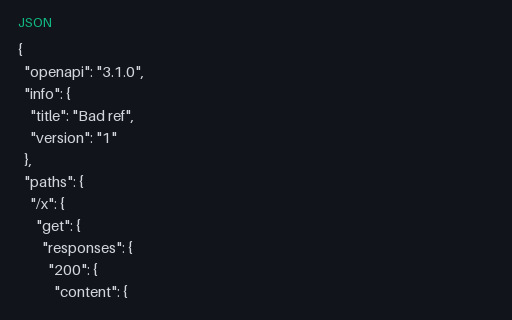
- jsonInvalid OpenAPI — Openapi Broken RefOpenAPI with a response schema $ref pointing at a missing component — tests broken-reference detection.
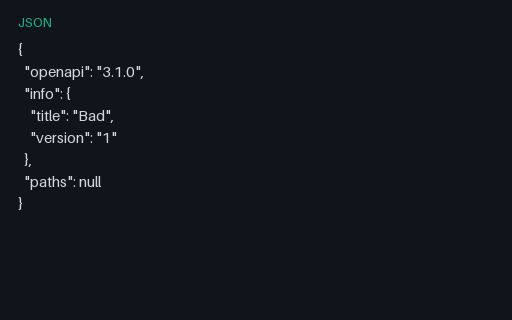
- jsonInvalid OpenAPI — Openapi Missing PathsOpenAPI document with paths set to null — intentionally invalid for negative schema tests.
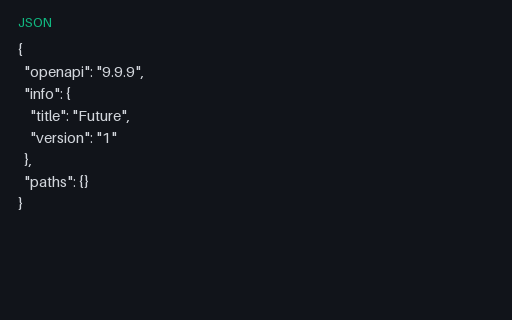
- jsonInvalid OpenAPI — Openapi Wrong VersionOpenAPI with an unsupported openapi version string — negative case for version validators.
Generated by generation/pad_wave_i.py. Free for any use, no attribution required, license.