
zip
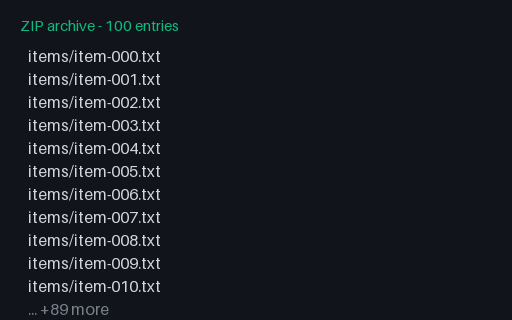
12.7 KBZIP - Many Small Files
A ZIP archive — 100 tiny files for throughput testing. Deterministic (fixed member timestamps) and safe to extract anywhere.
- File
- ZIP · Zip · 100 members
- Use case
- Conversion testing
Find files, editable templates and browser test targets by what you need to make or test. Explore complete business kits for connected records, templates and expected results.
Page 220 of 221; 24 results per page.
A ZIP archive — 100 tiny files for throughput testing. Deterministic (fixed member timestamps) and safe to extract anywhere.
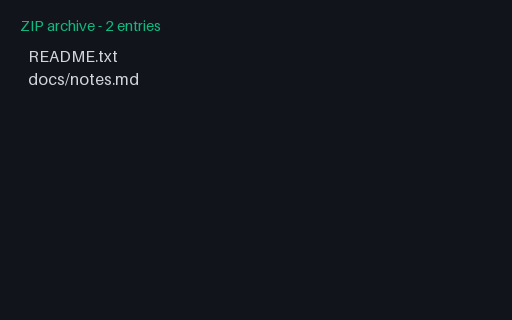
The last segment of a two-part spanned set: its end record says this is disk 1, that the central directory lives on disk 1, and that 2 of the archive's 4 entries are here. The bytes are well-formed - this is not a corrupt file - but a reader given it alone must say so rather than silently reporting a 2-entry archive. The .z01 first segment is deliberately absent, because .z01 is not a format this catalog registers.
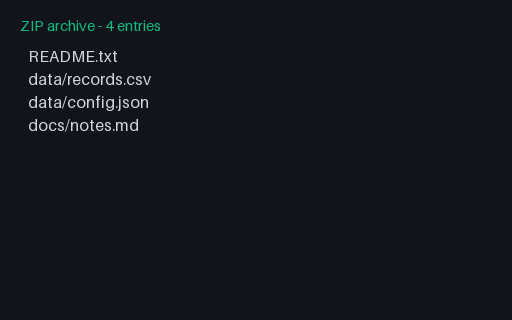
A ZIP archive — files organised into data/ and docs/ subfolders. Deterministic (fixed member timestamps) and safe to extract anywhere.
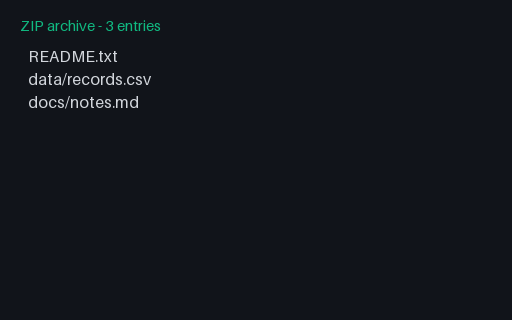
Two of three members carry a central-directory file comment and the third carries none. Comments exist only in the central directory, so a reader that walks local headers to build its listing loses them entirely; a rewriter that drops them loses them permanently.
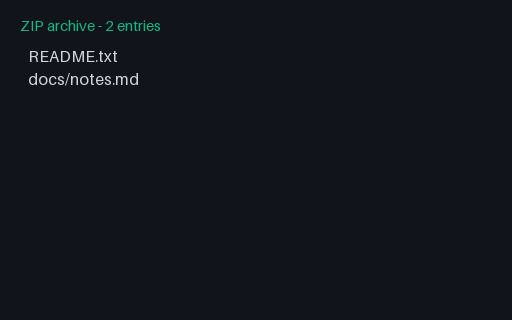
A complete, extractable ZIP that begins with the four-byte PK00 marker a splitting writer emits when the archive fitted into a single segment after all. The marker shifts every local header four bytes forward, so a reader that assumes the first local header sits at offset 0 misparses a file it is perfectly capable of reading.
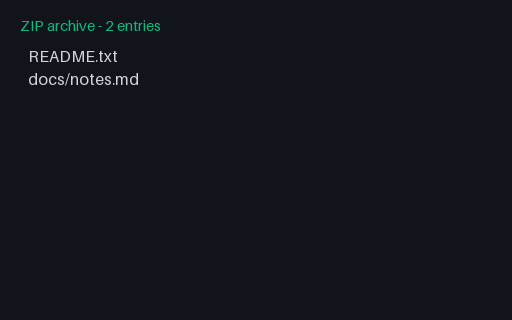
A complete ZIP prefixed with the 0x08074B50 spanning signature. That value is also the data descriptor signature, so a reader scanning the byte stream for descriptors finds one before the first local header — a genuine ambiguity in the format, reproduced here in a file that is otherwise entirely ordinary.
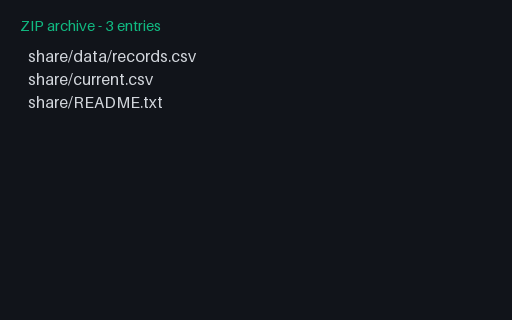
share/current.csv is a symbolic link, stored the Info-ZIP way: the external attributes carry S_IFLNK and the member payload is the 16-byte target path rather than file content. The target is relative and resolves inside the archive, so extracting without symlink support produces a harmless text file instead of a dangling or escaping link.
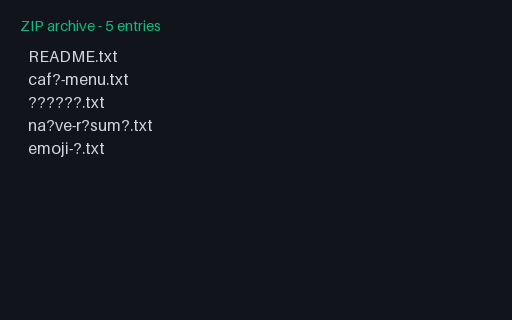
A ZIP archive — UTF-8 filenames: accents, Japanese, emoji. Deterministic (fixed member timestamps) and safe to extract anywhere.
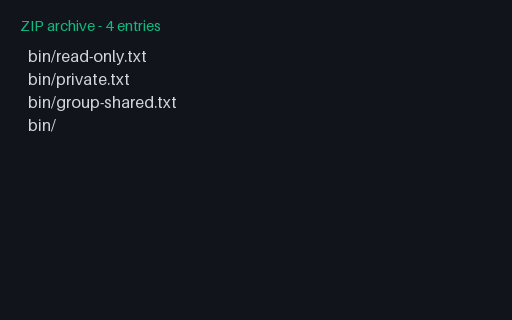
Unix permissions ride in the top 16 bits of the ZIP external attributes field, and are only meaningful when the version-made-by byte says Unix. This archive carries 0444, 0600, 0664 and a 0750 directory, plus the MS-DOS read-only bit on the 0444 member so the two conventions can be seen disagreeing. Nothing here is marked executable.
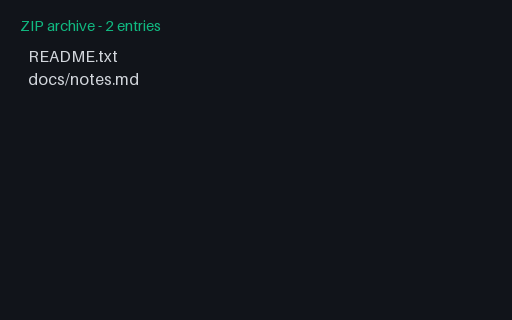
An extra field with header ID 0x9901, which is assigned to nothing, sits alongside a recognised extended-timestamp field in a different order in each header. The extra-field area is a length-prefixed chain, so the only correct behaviour is to skip unknown IDs by their declared length and keep walking.
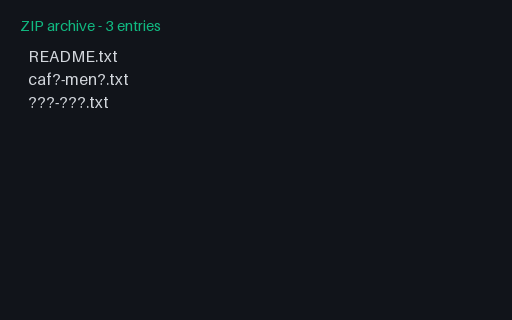
Member names stored as UTF-8 with general-purpose bit 11 (the language-encoding flag) set, which is the modern, unambiguous way to carry a non-ASCII filename in a ZIP. Its CP437 twin encodes the same archive the legacy way, so a reader's encoding heuristic can be compared against a case where the answer is declared.
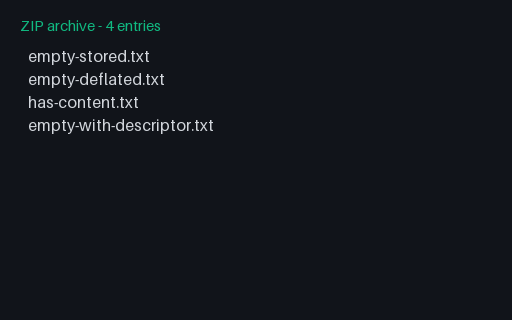
Three empty files stored three ways - stored, deflated, and deflated behind a data descriptor - beside one real member. An empty deflate stream is still two bytes on disk with CRC 0, so readers that treat compressed size 0 as 'no data' and readers that treat CRC 0 as 'not computed' both go wrong here.
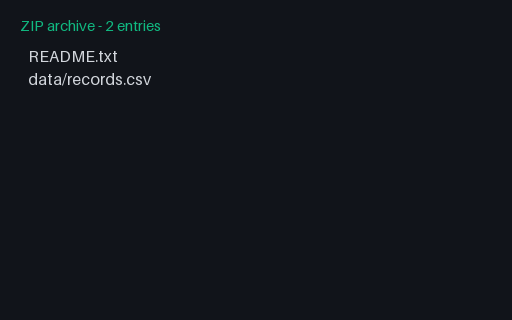
Ordinary 32-bit member records terminated by a ZIP64 end-of-central-directory record, its locator, and then a normal 32-bit end record — the belt-and-braces trailer some writers always emit. A reader must find the classic end record first, notice the locator in front of it, and reconcile two directories that agree.
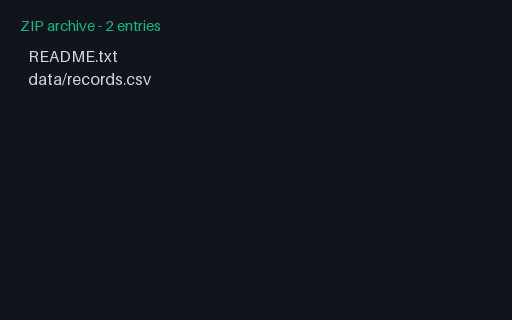
Both the local file headers and the central directory carry a ZIP64 extended information extra field (0x0001), with the 32-bit size fields set to 0xFFFFFFFF as the spec requires. The payload is a few hundred bytes: ZIP64 is present because the writer could not seek, not because the data is large, which is precisely the case size-based heuristics miss.
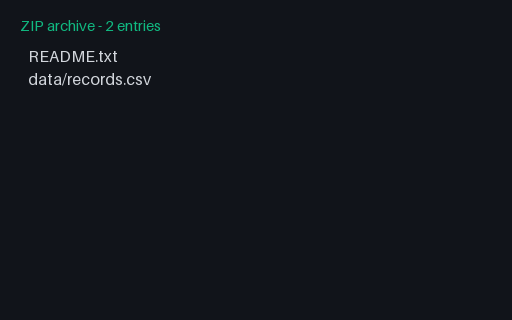
The local headers are plain 32-bit while the central directory carries the ZIP64 extra field. This is legal and common: a writer that streams cannot know at local-header time whether it will need ZIP64, so it commits to the wide fields only when it writes the directory.
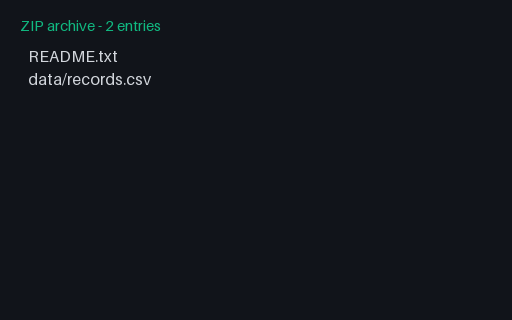
A central directory whose ZIP64 extra field carries the relative local-header offset as well as the sizes. The ZIP64 extra is variable length and its members appear in a fixed order, so a reader that assumes a 16-byte or 24-byte block reads the offset out of the wrong slot.
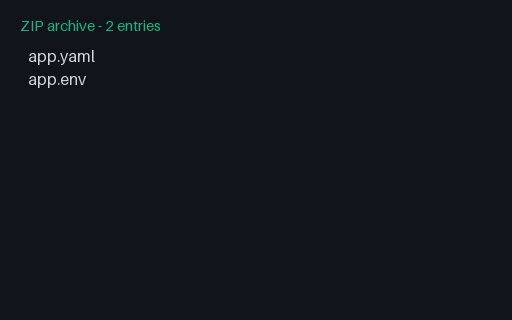
Small ZIP SAMPLE (config-bundle.zip) for extractor and listing tests.

Small ZIP SAMPLE (data-bundle.zip) for extractor and listing tests.
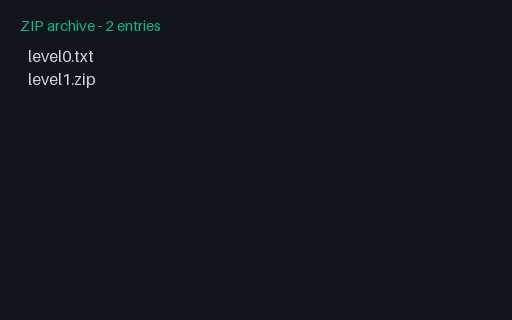
Three-level nested ZIP SAMPLE for deep recursive extraction tests.
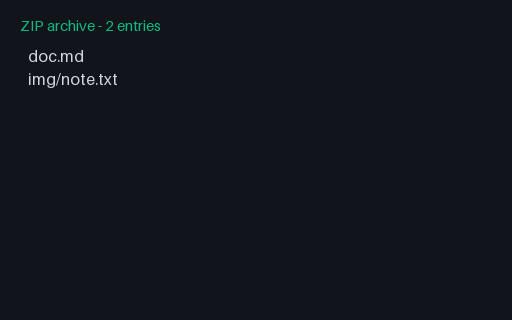
Small ZIP SAMPLE (docs-bundle.zip) for extractor and listing tests.

Small ZIP SAMPLE (empty-dirs.zip) for extractor and listing tests.
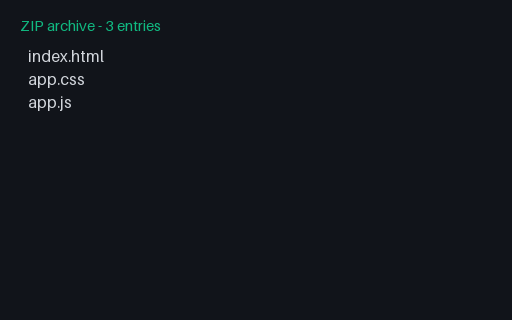
Small ZIP SAMPLE (html-site-slice.zip) for extractor and listing tests.
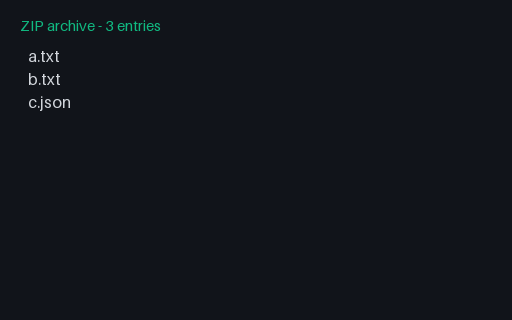
Small ZIP SAMPLE (mixed-compression.zip) for extractor and listing tests.
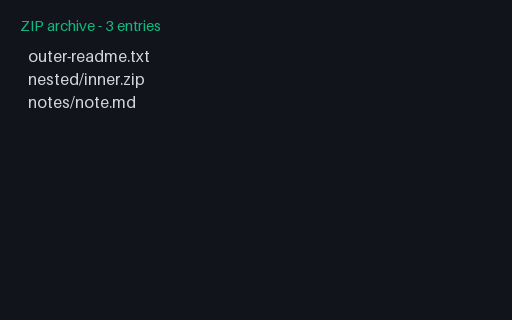
ZIP containing another ZIP plus text — for recursive extractors.
We use Google Analytics and show ads via Adsterra. Non-essential cookies and ad scripts run only after you allow the matching categories. See our cookie policy.