
csv
51 BCSV Edge — Mixed Quoting
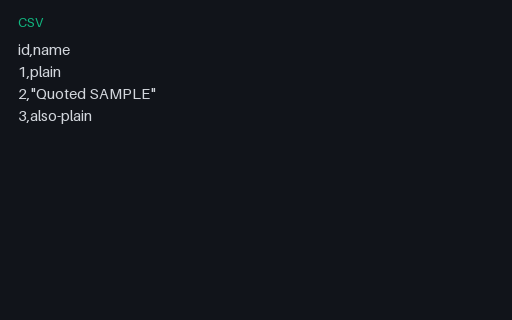
Tiny SAMPLE CSV (mixed-quoting) exercising delimiter/quoting edge behaviour.
- File
- CSV · CSV
- Use case
- CSV parsingError handling+1· Conversion set
Search files, editable visual templates, and live browser targets from one registry-backed directory. Filtered query views stay crawlable for links but are deliberately noindex; the stable taxonomy pages below remain the canonical search surfaces.
Page 5 of 18; 24 results per page.
Tiny SAMPLE CSV (mixed-quoting) exercising delimiter/quoting edge behaviour.
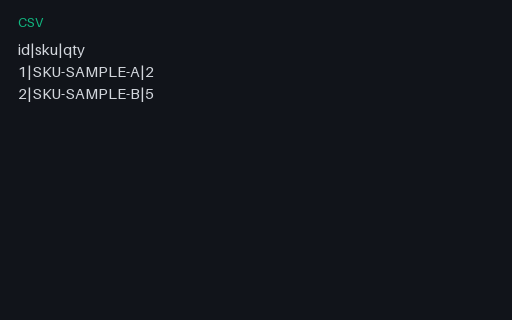
Tiny SAMPLE CSV (pipe-delimited) exercising delimiter/quoting edge behaviour.
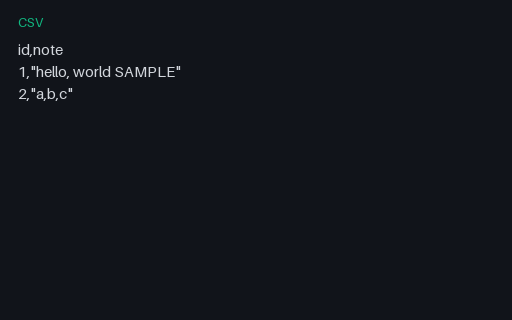
Tiny SAMPLE CSV (quoted-embedded-comma) exercising delimiter/quoting edge behaviour.
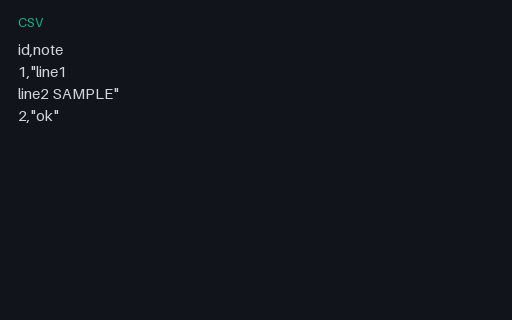
Tiny SAMPLE CSV (quoted-embedded-newline) exercising delimiter/quoting edge behaviour.
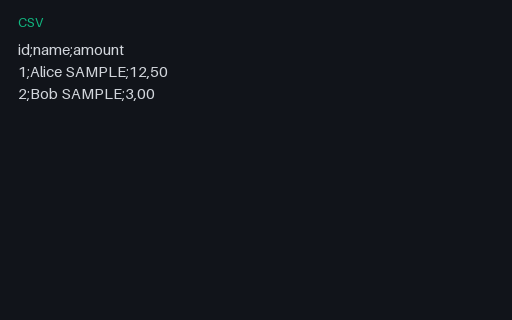
Tiny SAMPLE CSV (semicolon-eu) exercising delimiter/quoting edge behaviour.
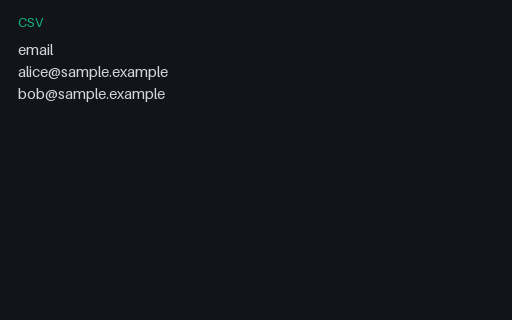
Tiny SAMPLE CSV (single-column) exercising delimiter/quoting edge behaviour.
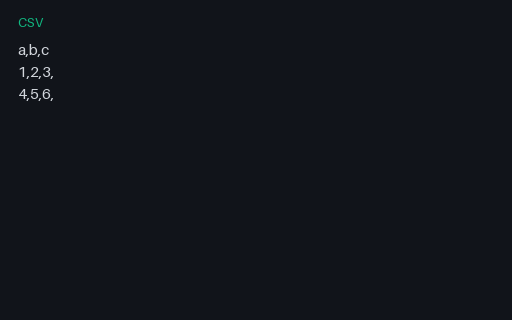
Tiny SAMPLE CSV (trailing-comma) exercising delimiter/quoting edge behaviour.
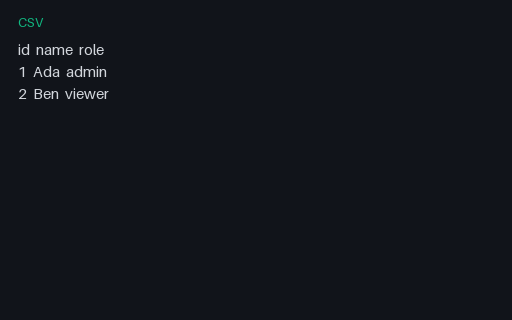
A .csv file whose content is tab-delimited — tests whether importers sniff delimiters or trust the extension.
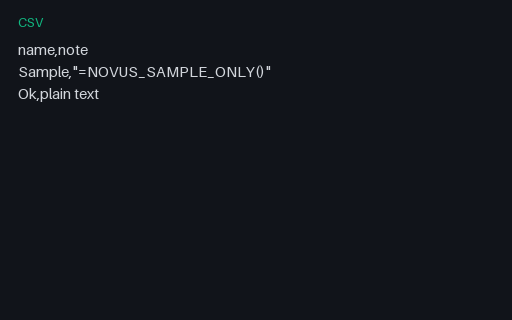
A sanitization-test CSV with one equals-prefixed cell clearly labelled sample-only. Use it to verify importers neutralize spreadsheet formulas — not an attack list.
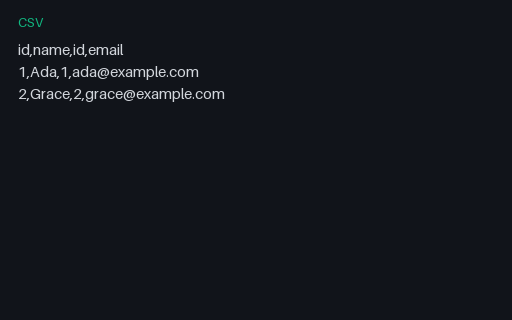
A small CSV whose header row repeats the column name id — a common importer failure mode.
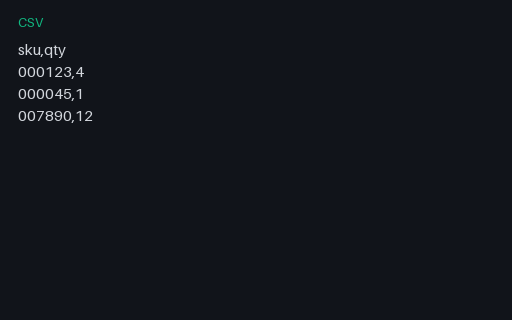
SKU identifiers that start with zeros. Spreadsheet tools often coerce these to numbers and drop the zeros — keep them as text.
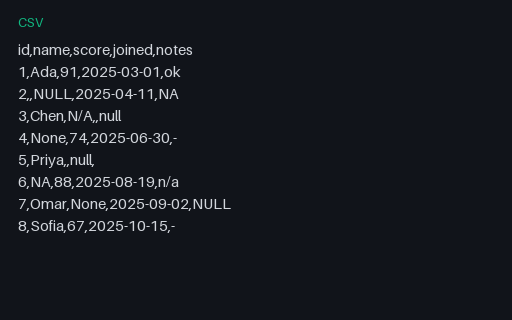
A CSV where missing values are written seven different ways — empty string, NULL, NA, N/A, null, None, and a dash — across text and numeric columns. A fixture for testing null-detection and coercion in CSV importers.
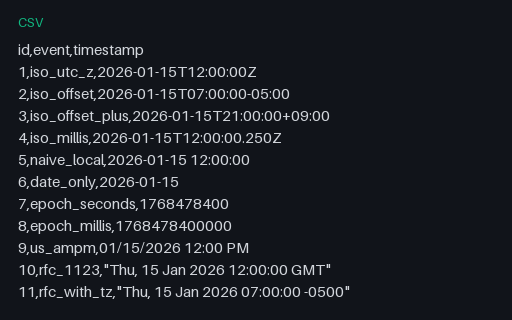
A CSV listing timestamps in eleven formats — ISO 8601 with Z and numeric offsets, millisecond precision, naive local, date-only, Unix epoch in seconds and milliseconds, US AM/PM, and RFC 1123. A fixture for testing date parsing and timezone normalisation.
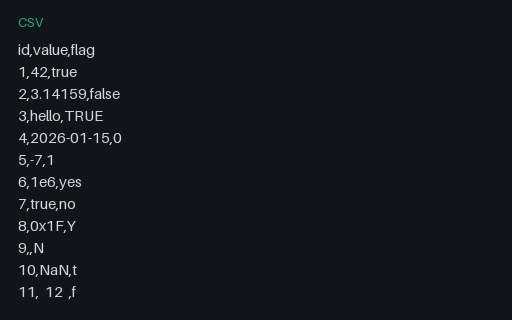
A CSV whose 'value' column mixes integers, floats, scientific notation, dates, hex, thousands separators, and whitespace, and whose 'flag' column mixes a dozen boolean spellings. A torture test for type inference and schema detection.
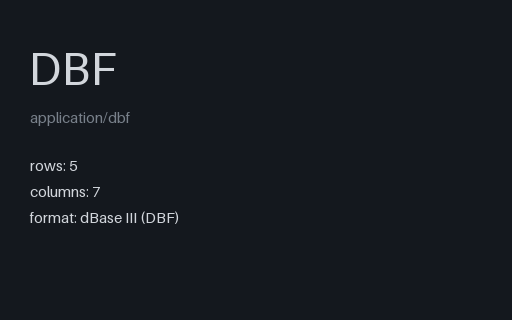
The employee table as a dBase (DBF) file — the venerable xBase table format still emitted by GIS tools and legacy databases. For testing DBF readers and DBF→CSV conversion.
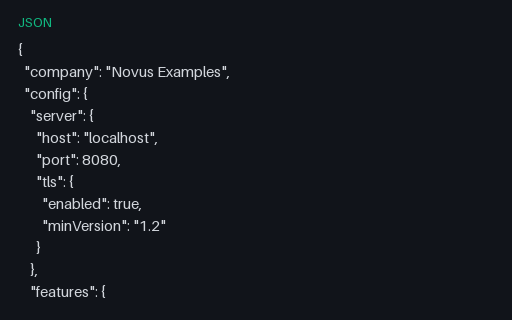
A deeply nested JSON document with objects inside arrays inside objects — for testing recursive parsing and path access.
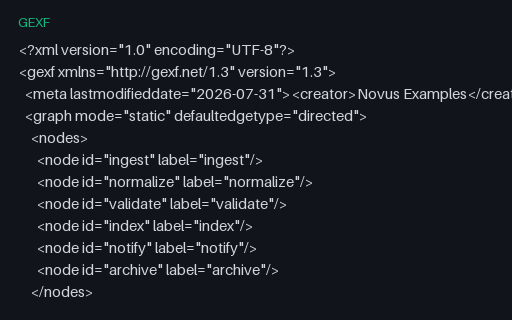
A six-stage software pipeline DAG for testing dependency import, cycle checks and reproducible topological sorting. This GEXF 1.3 member carries the same node IDs, edge IDs, directions and weights as its two format twins.
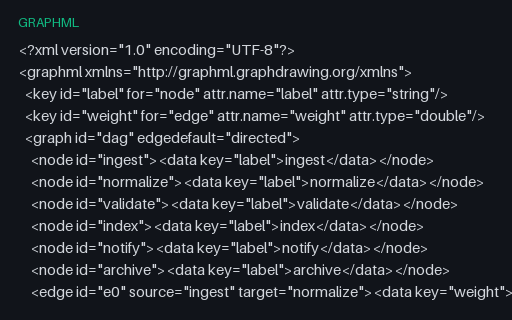
A six-stage software pipeline DAG for testing dependency import, cycle checks and reproducible topological sorting. This GraphML member carries the same node IDs, edge IDs, directions and weights as its two format twins.
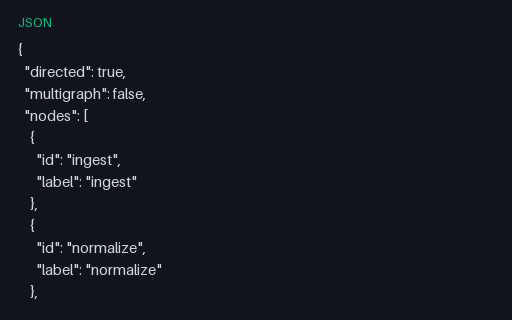
A six-stage software pipeline DAG for testing dependency import, cycle checks and reproducible topological sorting. This JSON edge list member carries the same node IDs, edge IDs, directions and weights as its two format twins.
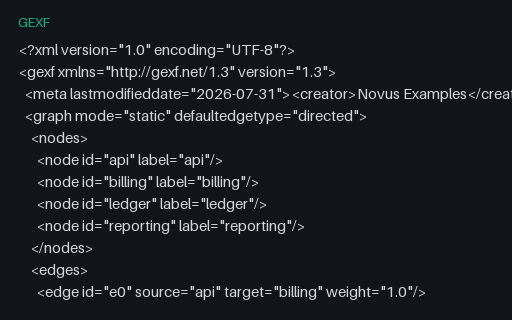
A four-service directed cycle whose only valid topological result is failure, for dependency-analysis regression tests. This GEXF 1.3 member carries the same node IDs, edge IDs, directions and weights as its two format twins.
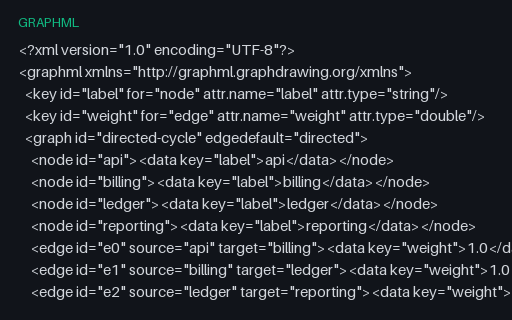
A four-service directed cycle whose only valid topological result is failure, for dependency-analysis regression tests. This GraphML member carries the same node IDs, edge IDs, directions and weights as its two format twins.
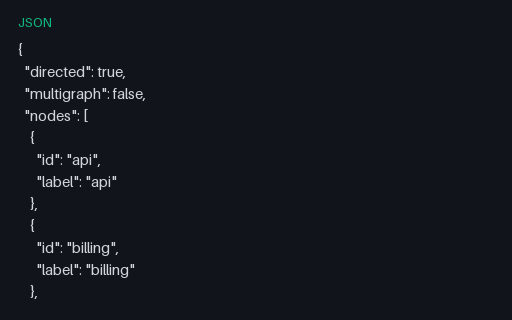
A four-service directed cycle whose only valid topological result is failure, for dependency-analysis regression tests. This JSON edge list member carries the same node IDs, edge IDs, directions and weights as its two format twins.
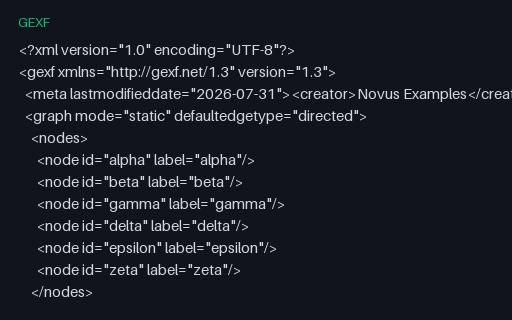
A directed graph with two linked islands and one isolated node, designed for weak-component and isolated-node tests. This GEXF 1.3 member carries the same node IDs, edge IDs, directions and weights as its two format twins.
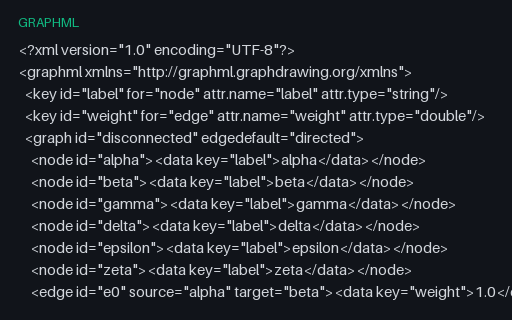
A directed graph with two linked islands and one isolated node, designed for weak-component and isolated-node tests. This GraphML member carries the same node IDs, edge IDs, directions and weights as its two format twins.
We use Google Analytics and show ads via Adsterra. Non-essential cookies and ad scripts run only after you allow the matching categories. See our cookie policy.