
JSON-LD LocalBusiness with opening hours
A valid LocalBusiness (as a SportingGoodsStore subtype) with a postal address, geo coordinates, weekday and Saturday opening hours, and a 00:00-00:00 specification marking a holiday closure. For testing opening-hours parsing and the closed-all-day convention.
{
  "@context": "https://schema.org",
  "@type": "SportingGoodsStore",
  "@id": "https://www.example.com/stores/berlin#store",
  "name": "Example Outdoors Berlin",
  "description": "Sample local-business record. Fictional address and hours.",
  "image": "https://cdn.example.net/img/store-berlin.jpg",
  "telephone": "+49-30-0000000",
  "priceRange": "EUR 20 - EUR 400",
  "address": {
    "@type": "PostalAddress",
    "streetAddress": "1 Sample Street",
    "addressLocality": "Berlin",
    "addressRegion": "BE",
    "postalCode": "10000",
    "addressCountry": "DE"
  },
  "geo": {
    "@type": "GeoCoordinates",
    "latitude": 52.5,
    "longitude": 13.4
  },
  "openingHoursSpecification": [
    {
      "@type": "OpeningHoursSpecification",
      "dayOfWeek": [
        "https://schema.org/Monday",
        "https://schema.org/Tuesday",
        "https://schema.org/Wednesday",
        "https://schema.org/Thursday",
        "https://schema.org/Friday"
      ],
      "opens": "09:00",
      "closes": "19:00"
    },
    {
      "@type": "OpeningHoursSpecification",
      "dayOfWeek": "https://schema.org/Saturday",
      "opens": "10:00",
      "closes": "16:00"
    },
    {
      "@type": "OpeningHoursSpecification",
      "opens": "00:00",
      "closes": "00:00",
      "validFrom": "2026-12-24",
      "validThrough": "2026-12-26"
    }
  ],
"areaServed": {Specifications
- Seed
- 70400
- Site
- example.com (fictional)
- Format
- JSON-LD (schema.org)
- Encoding
- UTF-8
- Types
- SportingGoodsStore, PostalAddress, OpeningHoursSpecification
- Hours Specs
- 3
- Closure Window
- true
Testing contract
Expected to pass- Scenario
- Ask whether the store is open on a Saturday afternoon and on 25 December 2026.
- Expected result
- Saturday 14:00 resolves to open (10:00-16:00), and 25 December resolves to closed because the dated specification with opens equal to closes marks the whole day shut.
What is a .json file?
JSON (JavaScript Object Notation) is a lightweight, text-based data-interchange format representing objects, arrays, strings, numbers, booleans, and null. It is language-independent, human-readable, and the dominant format for web APIs and configuration. It requires a single well-formed root value.
How to use this file
Use an example JSON file to test parsers and serializers, schema validation, Unicode and number-precision handling, and API request or response processing.
How to use this file for testing
“JSON-LD LocalBusiness with opening hours” is a deterministic Novus Examples fixture for Web assets, JSON parsing, Schema validation, Metadata testing. Favicons, web app manifests, service workers, robots and sitemap files, Open Graph images, and .well-known resources — for testing web tooling, crawlers, PWA installers, and asset pipelines.
Documented properties for this file: seed 70400 · UTF-8 · JSON-LD (schema.org). Compare results against paired or grouped companions on this page when present (clean↔damaged, searchable↔scanned, or format twins) so scores stay reproducible across runs.
Download the file once, keep the path stable in CI or local scripts, and treat the spec table as the contract: dimensions, seeds, field lists, and roles are intentional. Corrupt or invalid samples are labelled as such — expect parsers to fail loudly rather than silently accept them.
Web-platform fixtures are standards-compliant samples against fictional example.com data. Test crawlers, PWA installers and manifest validators, favicon/icon pipelines, service-worker registration, or .well-known parsers against the documented structure.
Code examples
import json

with open("jsonld-local-business.json") as f:
    data = json.load(f)
print(type(data), len(data))
Related files
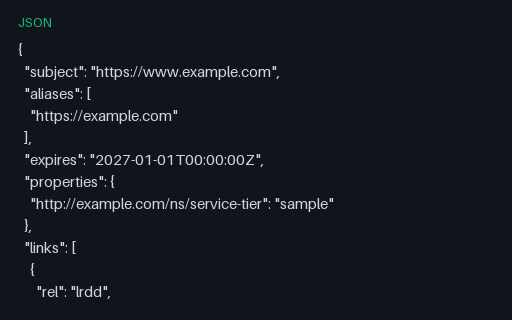
- jsonhost-meta.json (JRD, JSON form)The JSON Resource Descriptor twin of the XRD host-meta: identical subject, alias, expiry, property and three links, expressed with lower-case JSON member names. For testing XRD-to-JRD conversion against a known answer.
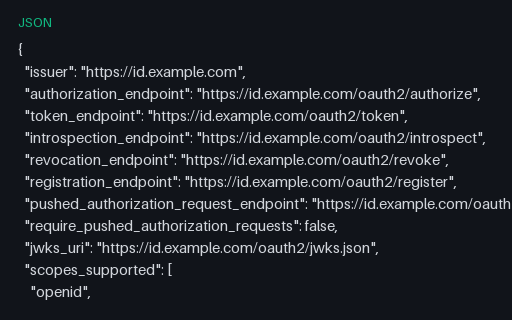
- jsonoauth-authorization-server metadata (RFC 8414)A fully populated RFC 8414 authorization-server metadata document for a fictional issuer: seven endpoints including PAR, introspection and dynamic registration, PKCE and DPoP algorithm lists, and policy URIs. Distinct from the minimal OpenID configuration already in this category.
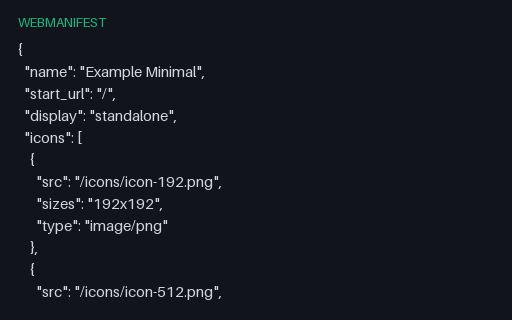
- webmanifestWeb app manifest - minimal installable setThe smallest manifest that still satisfies a browser's install criteria: name, start_url, a standalone display mode and two PNG icons, with every optional member left out. For testing installability checks against the floor rather than a fully populated document.
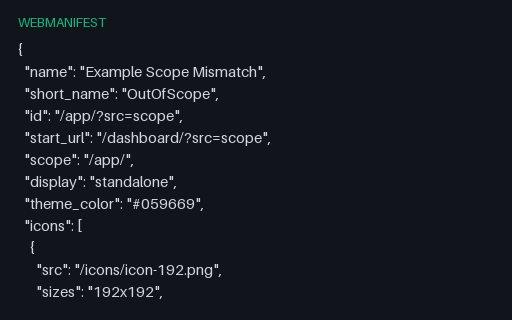
- webmanifestWeb app manifest whose start_url is outside its scope (deliberately invalid)A deliberately invalid manifest: start_url sits at /dashboard/ while scope is /app/, and a shortcut points at another origin entirely. Both are the kind of mistake that makes an installed app open in a browser tab. For testing scope-containment validation.
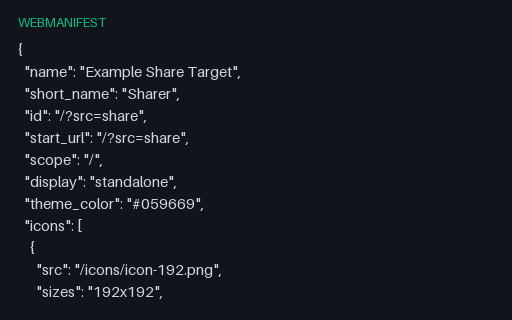
- webmanifestWeb app manifest with a share_targetA manifest declaring a Web Share Target that accepts a POST of multipart form data, including two file parameters with MIME-type and extension accept lists. For testing share-target registration and the parameter renaming a share handler must perform.
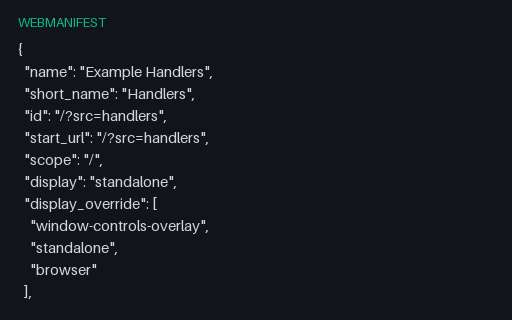
- webmanifestWeb app manifest with file, protocol and launch handlersA manifest registering the desktop-integration members: two file handlers with MIME and extension accept maps, a custom web+ protocol handler alongside mailto, a launch_handler client mode list, an Edge side-panel width and handle_links. For testing OS integration and manifest members a validator may not know.
Generated by generation/web_p7.py. Free for any use, no attribution required — license.