
Stabilisation Input — pan-city, High-frequency jitter
High-frequency jitter camera shake applied to the locked-off pan-city plate: up to 2.5 px of translation and 0.5° of roll at 23.0 Hz, seed 5193. Small, fast jitter near the frame rate — vibration from a vehicle or a drone motor. Aliases against the sampling rate, so naive low-pass smoothing of the path leaves it almost untouched. Uncovered edges are filled black rather than padded, so the crop a stabiliser needs is visible in the input.
Browser-playable test video · 2 seconds
Specifications
- Resolution
- 640x360
- Fps
- 24
- Shake Amplitude Px
- 2.5
- Shake Rotation Deg
- 0.5
- Shake Frequency Hz
- 23
- Seed
- 5193
- Edge Fill
- black — uncovered edges are not padded
- Role
- stabilisation input
- Reference
- vid-stab-pan-city-gt
- Crf
- 19
- Base Plate
- pan-city
Testing contract
Expected to pass- Scenario
- Stabilise the clip and compare the recovered camera path against the unshaken ground truth.
- Expected result
- Shake was applied from fixed seed 5193 at 2.5 px amplitude, 0.5 degrees of rotation and 23 Hz, over the pan-city plate at 640x360 24 fps; the reference is vid-stab-pan-city-gt. Uncovered edges are filled black and not padded, so a stabiliser that crops must report how much it cropped - a result that matches the reference only after an unreported zoom has not stabilised, it has hidden the evidence.
What is a .mp4 file?
MP4 (MPEG-4 Part 14) is the dominant container for digital video, holding video, audio, subtitle, and metadata tracks in a tree of typed boxes. `ftyp` declares the brand, `moov` carries the sample tables that make seeking possible, and `mdat` holds the media; when an encoder writes `moov` last, playback cannot begin until the file has fully downloaded, which a faststart remux fixes. It derives from Apple's QuickTime format, generalized by ISO into the ISOBMFF base that MOV, 3GP, and HEIF share.
How to use this file
Use an example MP4 to test box parsing and track detection, seeking, range-request streaming, and transcode or thumbnail pipelines: verifying that a file with a trailing `moov` box is still handled, and that codec support is checked per track rather than inferred from the extension.
How to use this file for testing
“Stabilisation Input — pan-city, High-frequency jitter” is a deterministic Novus Examples fixture for Video stabilisation, Video QA. Camera shake applied with a recorded motion path over a static original, so a stabiliser's residual motion can be measured rather than estimated.
Documented properties for this file: seed 5193 · stabilisation input · 24 fps. Compare results against paired or grouped companions on this page when present (clean↔damaged, searchable↔scanned, or format twins) so scores stay reproducible across runs.
Download the file once, keep the path stable in CI or local scripts, and treat the spec table as the contract: dimensions, seeds, field lists, and roles are intentional. Corrupt or invalid samples are labelled as such, expect parsers to fail loudly rather than silently accept them.
Media fixtures are short and synthetic by design. Prefer waveform or transcript ground truth in the same group when measuring ASR, trim, upscale, or sync tools; do not assume broadcast-quality masters.
Code examples
<video controls preload="metadata" width="640" src="pan-city-highfreq.mp4"></video>Related files
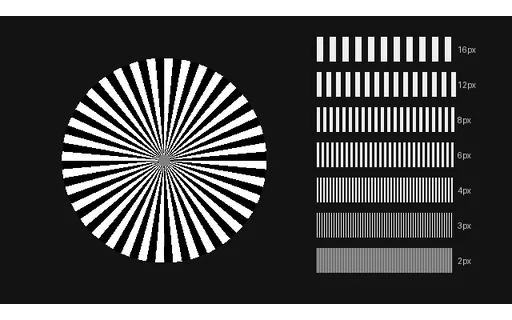
- mp4Stabilisation Ground Truth — detail-chart, Locked OffThe locked-off reference for the detail-chart stabilisation set — any motion in this clip is subject motion, not camera motion. The shaky clips in this group are this footage with a recorded synthetic camera path applied, so residual motion after stabilisation can be measured against zero rather than eyeballed.
- mp4Stabilisation Ground Truth — text-motion, Locked OffThe locked-off reference for the text-motion stabilisation set — any motion in this clip is subject motion, not camera motion. The shaky clips in this group are this footage with a recorded synthetic camera path applied, so residual motion after stabilisation can be measured against zero rather than eyeballed.

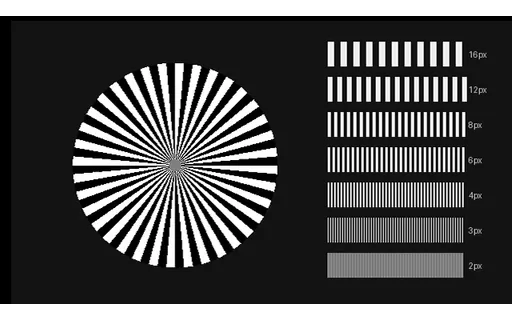
- mp4Stabilisation Input — detail-chart, Heavy handheldHeavy handheld camera shake applied to the locked-off detail-chart plate: up to 12.0 px of translation at 6.5 Hz, seed 5131. Twelve-pixel excursions at a slower, larger cadence: running, or a long lens. Requires real trajectory smoothing rather than frame-to-frame alignment. Uncovered edges are filled black rather than padded, so the crop a stabiliser needs is visible in the input.
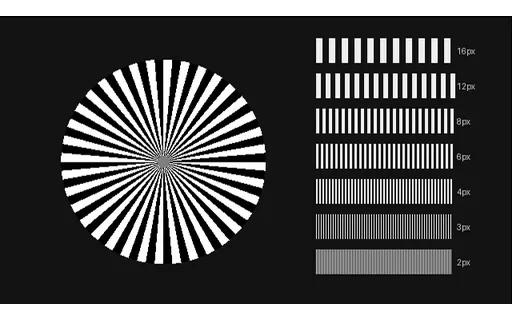
- mp4Stabilisation Input — detail-chart, High-frequency jitterHigh-frequency jitter camera shake applied to the locked-off detail-chart plate: up to 2.5 px of translation and 0.5° of roll at 23.0 Hz, seed 5193. Small, fast jitter near the frame rate — vibration from a vehicle or a drone motor. Aliases against the sampling rate, so naive low-pass smoothing of the path leaves it almost untouched. Uncovered edges are filled black rather than padded, so the crop a stabiliser needs is visible in the input.
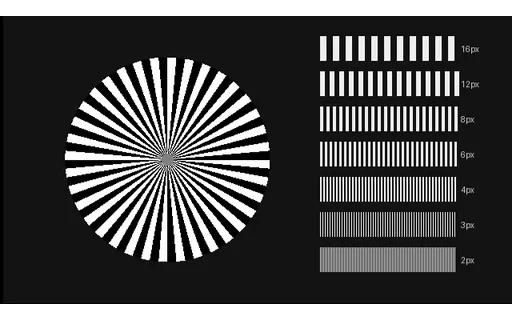
- mp4Stabilisation Input — detail-chart, Light handheldLight handheld camera shake applied to the locked-off detail-chart plate: up to 3.0 px of translation at 11.0 Hz, seed 5100. Sub-pixel-to-3-pixel translation at walking cadence — the residual wobble left after in-body stabilisation. Easy to correct, and the case where over-correction visibly crops the frame for nothing. Uncovered edges are filled black rather than padded, so the crop a stabiliser needs is visible in the input.
- mp4Stabilisation Input — detail-chart, Rotational rollRotational roll camera shake applied to the locked-off detail-chart plate: up to 4.0 px of translation and 1.6° of roll at 8.0 Hz, seed 5162. Translation plus up to 1.6° of roll. Translation-only stabilisers cannot fix roll at all, so this immediately separates 2-DOF from full-affine implementations. Uncovered edges are filled black rather than padded, so the crop a stabiliser needs is visible in the input.
Generated by generation/video_ai_suites.py. Free for any use, no attribution required, license.