
Gemfile.lock (Bundler)
A Bundler lockfile in its indentation-significant block format — specs nested under GEM, transitive requirements nested one level deeper, and the BUNDLED WITH version on its own indented line. Every package, version, hash and licence is fictional — the tree describes nothing real.
GEM
  remote: https://gems.orchard.example/
  specs:
    example-cache (0.9.2)
      example-yaml-lite (~> 1.1)
    example-crypto-shim (1.2.0)
    example-http-core (1.8.0)
      example-logger (~> 3.4)
      example-json-path (~> 2.0)
    example-json-path (2.0.5)
    example-logger (3.4.1)
    example-metrics (4.0.0)
      example-logger (~> 3.4)
    example-retry (1.0.4)
    example-router (2.1.3)
      example-logger (~> 3.4)
      example-retry (~> 1.0)
    example-yaml-lite (1.1.7)
      example-json-path (~> 2.0)

PLATFORMS
  ruby
  x86_64-linux

DEPENDENCIES
  example-cache (~> 0.9)
  example-crypto-shim (~> 1.2)
  example-http-core (~> 1.8)
  example-metrics (~> 4.0)
  example-router (~> 2.1)

BUNDLED WITH
   2.5.6
Specifications
- Seed
- 51200
- Sample Only
- true
- Ecosystem
- Bundler
- Gems
- 9
- Sections
- GEM, PLATFORMS, DEPENDENCIES, BUNDLED WITH
- Indentation
- significant
- Line Endings
- LF
Testing contract
Expected to pass- Scenario
- Parse a lockfile where nesting depth, not punctuation, carries the graph.
- Expected result
- Reader distinguishes the 9 specs from their nested requirement lines and reports 5 top-level DEPENDENCIES.
What is a .lock file?
A .lock file pins the exact dependency graph a package manager resolved, so a later install reproduces it byte for byte. Cargo.lock and Poetry's poetry.lock use TOML, Gemfile.lock and yarn.lock use their own line-oriented grammars, and all of them record resolved versions, source registries, integrity hashes, and the transitive edges between packages. It is committed alongside the human-edited manifest, which states ranges rather than exact versions.
How to use this file
Use an example .lock file to test dependency parsers, SBOM generators, and vulnerability scanners, verifying that transitive dependencies and integrity hashes are read correctly and that a pinned version is never confused with the range declared in the manifest.
How to use this file for testing
“Gemfile.lock (Bundler)” is a deterministic Novus Examples fixture for Config parsing, Conversion testing, Error handling. TOML and INI configuration files with nested sections and typed values — for testing config parsers and loaders.
Documented properties for this file: seed 51200 · LF. Compare results against paired or grouped companions on this page when present (clean↔damaged, searchable↔scanned, or format twins) so scores stay reproducible across runs.
Download the file once, keep the path stable in CI or local scripts, and treat the spec table as the contract: dimensions, seeds, field lists, and roles are intentional. Corrupt or invalid samples are labelled as such — expect parsers to fail loudly rather than silently accept them.
SBOM, lockfile, provenance, and advisory fixtures describe the same fabricated component tree across formats, so a converter or scanner can be diffed against a known answer. Every package name, version, hash, and advisory ID is invented — never treat a finding here as real.
Point your config loader at the file and assert it reads the documented sections and typed values, including any deliberately-tricky nesting or comments.
Related files
- txtRelease SHA256SUMS ManifestThe oldest supply-chain artifact there is: a sha256sum manifest with the exact two-space separator the tool emits, listing a fictional release tarball and its nine dependency archives. Every package, version, hash and licence is fictional — the tree describes nothing real.
- lockCargo.lock (version 3, Legacy)The same fictional Rust tree pinned by a version 3 Cargo.lock, for testing that a reader keys on the declared version rather than assuming the newest format. Every package, version, hash and licence is fictional — the tree describes nothing real.
- lockCargo.lock (version 4)A Rust Cargo.lock in the version 4 format — TOML [[package]] tables with a registry source, a sha256-shaped checksum and a name-only dependencies array that resolves against the other tables. Every package, version, hash and licence is fictional — the tree describes nothing real.
- lockCargo.lock, Truncated — Intentionally CorruptAn intentionally corrupt Cargo.lock: a valid version 4 lockfile cut off inside a [[package]] table so the final key/value pair is incomplete. Small on purpose. Every package, version, hash and licence is fictional — the tree describes nothing real.
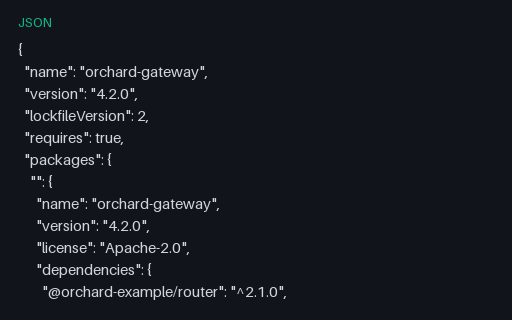
- jsonnpm package-lock.json (lockfileVersion 2, Dual Layout)The transitional npm v2 lockfile, which carries BOTH the v3 packages map and the legacy nested dependencies tree describing the same fictional install — the case where a parser must not double-count. Every package, version, hash and licence is fictional — the tree describes nothing real.
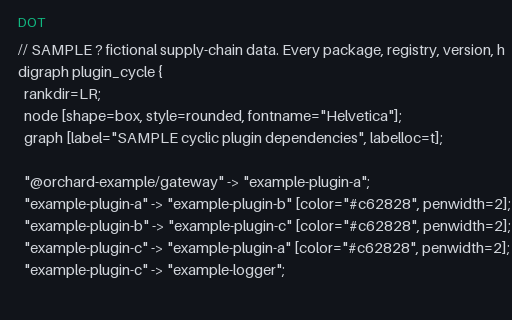
- dotDependency Graph With a Cycle (Graphviz DOT)The cyclic plugin graph as DOT, with the three cycle edges highlighted. Graphviz renders it happily, which is exactly why a topological sort must be the thing that rejects it. Every package, version, hash and licence is fictional — the tree describes nothing real.
Generated by generation/supply_chain.py. Free for any use, no attribution required — license.