SAMPLE PKCS#7 Certificate Bundle (DER)
Binary DER form of the same three-certificate PKCS#7 bundle, the encoding a .p7b download actually uses. Use it to test importers that never see the PEM armour.
| Field | Value |
|---|---|
| Type | PKCS#7 certs-only (DER) |
| Certificates | 3 |
| 1 | CN=leaf.pki.sample.example,O=Novus Examples SAMPLE PKI,C=ZZ |
| 2 | CN=Novus Examples SAMPLE Issuing CA I2,O=Novus Examples SAMPLE PKI,C=ZZ |
| 3 | CN=Novus Examples SAMPLE Root CA R1,O=Novus Examples SAMPLE PKI,C=ZZ |
| Private keys | none |
| Bytes | 4090 |
Specifications
- Format
- PKCS#7 / CMS degenerate certs-only (DER)
- Certs
- 3
- Contains
- leaf, intermediate, root
- Sample Only
- true
- Seed
- 70117
Testing contract
Expected to pass- Scenario
- Convert the DER bundle to PEM and compare the extracted certificates with the PEM twin.
- Expected result
- Conversion yields the identical three certificates in the same order.
What is a .der file?
DER (Distinguished Encoding Rules) is the binary encoding of an X.509 certificate (or other ASN.1 structure) — the same data a PEM file Base64-wraps, without the text armour. A .der certificate is compact and byte-exact, common in Java keystores and Windows tooling.
How to use this file
Use an example .der certificate to test binary X.509 parsers, ASN.1 decoders, and DER-to-PEM converters, or to confirm a tool reads raw certificate bytes. Published sample certificate, not a real identity.
How to use this file for testing
“SAMPLE PKCS#7 Certificate Bundle (DER)” is a deterministic Novus Examples fixture for Certificate & key testing, Conversion testing. Self-signed X.509 certificates (PEM, CRT, DER), a CSR, RSA and Ed25519 keys, an SSH public key, a PKCS#12 bundle, and an htpasswd file — all published sample-only material, for testing certificate parsers, TLS tooling, keystore importers, and PEM/DER decoders.
Documented properties for this file: seed 70117 · PKCS#7 / CMS degenerate certs-only (DER). Compare results against paired or grouped companions on this page when present (clean↔damaged, searchable↔scanned, or format twins) so scores stay reproducible across runs.
Download the file once, keep the path stable in CI or local scripts, and treat the spec table as the contract: dimensions, seeds, field lists, and roles are intentional. Corrupt or invalid samples are labelled as such — expect parsers to fail loudly rather than silently accept them.
This is published, SAMPLE-only security material — never a real secret. Point certificate, key, or token parsers at it, test PEM/DER decoding and PKCS handling, and confirm your tooling reads the documented fields; any sample password is printed on this page.
This is a published, sample-only certificate/key. Parse it, verify the chain or signature, and test PEM↔DER conversion — never deploy it anywhere real.
Related files
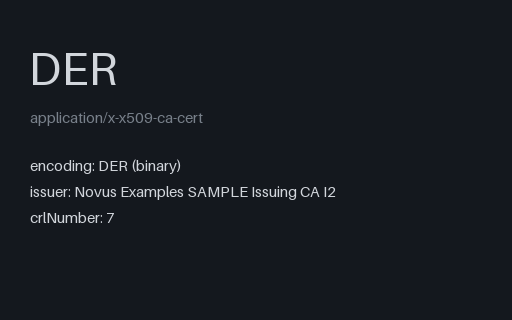
- derSAMPLE Certificate Revocation List (DER)Binary DER twin of the SAMPLE CRL — the exact encoding a CRL distribution point serves over HTTP. Use it to test binary CRL fetching and caching paths that never see PEM armour.
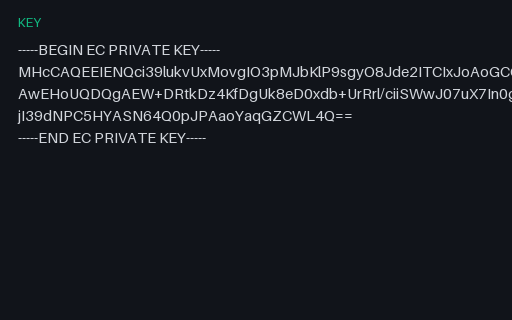
- keySAMPLE EC P-256 Private Key — SEC 1The same P-256 scalar in the SEC 1 container (BEGIN EC PRIVATE KEY), which names the curve inline instead of through a PKCS#8 algorithm identifier. Some deployment tools accept only one of the two.
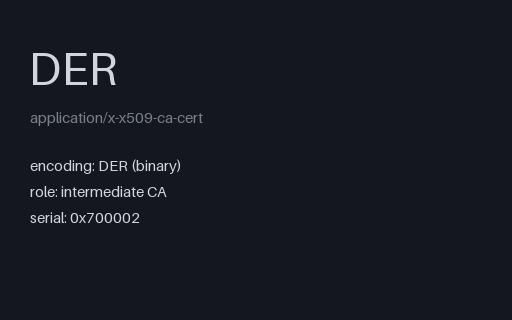
- derSAMPLE Intermediate CA Certificate (DER)Binary DER encoding of the SAMPLE intermediate CA certificate — the same bytes the PEM twin Base64-wraps. Feed it to ASN.1 decoders, Java keystores, and DER-to-PEM converters.
- derSAMPLE Leaf Certificate (DER)Binary DER encoding of the SAMPLE leaf certificate — the same bytes the PEM twin Base64-wraps. Feed it to ASN.1 decoders, Java keystores, and DER-to-PEM converters.
- derSAMPLE Root CA Certificate (DER)Binary DER encoding of the SAMPLE root CA certificate — the same bytes the PEM twin Base64-wraps. Feed it to ASN.1 decoders, Java keystores, and DER-to-PEM converters.
- keySAMPLE RSA Private Key — PKCS#1, UnencryptedThe identical key material wrapped in the legacy PKCS#1 container (BEGIN RSA PRIVATE KEY), which omits the algorithm OID that PKCS#8 carries. Diff it against its PKCS#8 twin to see exactly what a container migration changes.
Generated by generation/security_p7.py. Free for any use, no attribution required — license.