
Json Decoded-Result Reference For The Hdf5 Hierarchy And Its Normalisation Invariant
JSON decoded-result reference for the HDF5 hierarchy and its normalisation invariant, kept beside the binary source for semantic rather than byte-level comparison. Stable P8 artifact p8-convert-hdf5-expected.
{
  "datasets": [
    {
      "path": "/raw/detector_counts",
      "shape": [
        32,
        8
      ],
      "units": "counts"
    },
    {
      "path": "/raw/timestamp_s",
      "shape": [
        32
      ],
      "units": "s"
    },
    {
      "path": "/processed/normalised",
      "shape": [
        32,
        8
      ],
      "units": "1"
    },
    {
      "path": "/metadata/channel_index",
      "shape": [
        8
      ],
      "units": "1"
    }
  ],
  "groups": [
    "/raw",
    "/processed",
    "/metadata"
  ],
  "normalisation": "processed/normalised = raw/detector_counts / 1000"
}
Specifications
- Source Format
- h5
- Delivery Mode
- download-only
- Provider
- converter-v2
- Provenance
- Synthetic deterministic P8 fixture generated by generation/p8_content.py; seed namespace 2026082300
- Fixture Reserve
- convert-v2
Testing contract
Reference control- Scenario
- Validate the decoded HDF5 result against this JSON artifact.
- Expected result
- Three named groups, four datasets, and the divide-by-1000 normalisation rule remain explicit and machine-checkable.
What is a .json file?
JSON (JavaScript Object Notation) is a lightweight, text-based data-interchange format representing objects, arrays, strings, numbers, booleans, and null. It is language-independent, human-readable, and the dominant format for web APIs and configuration. It requires a single well-formed root value.
How to use this file
Use an example JSON file to test parsers and serializers, schema validation, Unicode and number-precision handling, and API request or response processing.
How to use this file for testing
“Json Decoded-Result Reference For The Hdf5 Hierarchy And Its Normalisation Invariant” is a deterministic Novus Examples fixture for Conversion testing, Scientific data, Schema validation. The same content exported across many formats and linked as a group, so you can convert one and diff against the expected twin.
Documented properties for this file: JSON · 614 bytes. Compare results against paired or grouped companions on this page when present (clean↔damaged, searchable↔scanned, or format twins) so scores stay reproducible across runs.
Download the file once, keep the path stable in CI or local scripts, and treat the spec table as the contract: dimensions, seeds, field lists, and roles are intentional. Corrupt or invalid samples are labelled as such — expect parsers to fail loudly rather than silently accept them.
Scientific fixtures are small, valid, and fully synthetic — no real organism, patient, sample, or observation. Point your parser or loader at the file and check it reads the documented records, variables, or headers; binary formats ship a readable twin or metadata listing for comparison.
Code examples
import json

with open("experiment-hierarchy-expected.json") as f:
    data = json.load(f)
print(type(data), len(data))
Related files
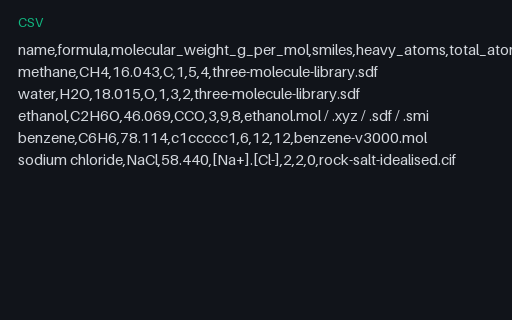
- csvChemistry Fixture Molecule Index (.csv)One row per molecule used across the chemistry fixtures, with formula, molecular weight, SMILES and the atom and bond counts each file should yield. It is the oracle a cheminformatics toolkit can be scored against without needing a second toolkit to generate the answers.
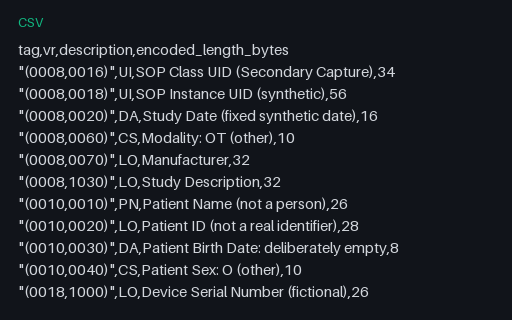
- csvDICOM-Shaped Dataset — Element Table Reference (.csv)Every element of the synthetic phantom dataset as tag, value representation, meaning and encoded length, in the ascending tag order the standard mandates. Diff a parser's element list against it to check both the ordering rule and the two different length encodings.
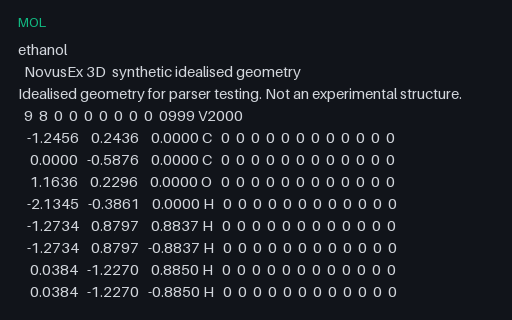
- molEthanol — MDL Molfile V2000 (.mol)Ethanol as a V2000 molfile with fixed-column 3D coordinates, a nine-atom counts line and an eight-bond block. The column widths are part of the format rather than a convention, so it is a genuine test of fixed-width parsing rather than of whitespace splitting.
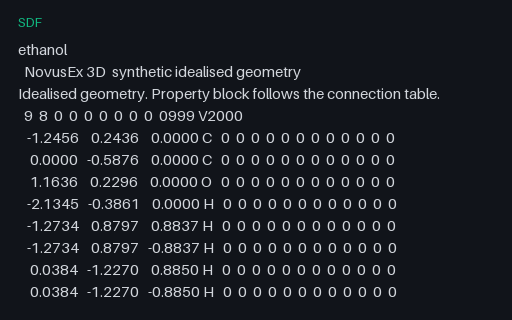
- sdfEthanol — SDfile With Data Fields (.sdf)An SDfile wrapping the identical ethanol molfile plus five tagged data fields and the mandatory $$$$ terminator. The property block syntax — a header line, a value and a blank line — is where SDfile parsers usually diverge from molfile parsers.
- smiEthanol — SMILES String (.smi)Ethanol as a single tab-delimited SMILES record, the most compressed member of this family: three heavy atoms with every hydrogen implicit and no geometry whatsoever. Round-tripping molfile to SMILES and back is the classic lossy conversion, and this pair is the reference for it.

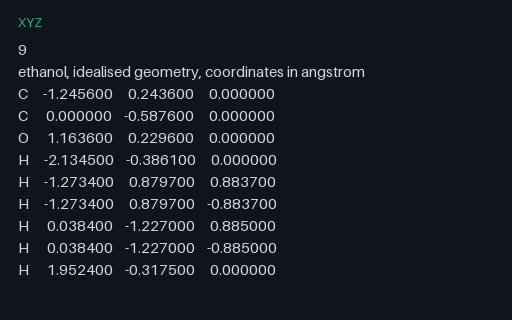
- xyzEthanol — XYZ Cartesian Coordinates (.xyz)The same ethanol geometry in XYZ format: an atom count, a free-text comment line and one line of element and coordinates per atom. XYZ carries no connectivity at all, so converting to it from the molfile is a lossy operation that this pair makes measurable.
Generated by generation/p8_content.py. Free for any use, no attribution required — license.