
Intentionally Corrupt NetCDF — Truncated Mid-Header (.nc)
An intentionally corrupt NetCDF file, cut to its first 512 bytes so the magic number and part of the header survive but the variable table and every data value do not. It is the fixture for the failure path where format detection succeeds and reading must not.
| Field | Value |
|---|---|
| Damage | intentionally corrupt — truncated to 512 bytes |
| Original size | 1524 bytes |
| Magic bytes | intact ('CDF' + 0x01), so sniffing succeeds |
| Header | cut off part-way through the variable table |
| Expected behaviour | a clear parse error, not a crash and not silent zeros |
Specifications
- Intentionally Corrupt
- true
- Damage
- truncated to the first 512 bytes
- Original Bytes
- 1524
- Kept Bytes
- 512
- Magic Intact
- true
- Data Present
- false
Testing contract
Expected to fail- Scenario
- Open the file with a NetCDF reader and attempt to list its variables and read tas.
- Expected result
- Format sniffing recognises CDF-1 but the open or the first read raises a explicit truncation or malformed-header error rather than returning zeros, an empty variable list, or a segfault.
What is a .nc file?
NetCDF (.nc, Network Common Data Form) is a binary, self-describing format for array-oriented scientific data. It stores multidimensional variables (like temperature over latitude, longitude, and time) with named dimensions, units, and metadata attributes, and is a standard in climate, ocean, and geoscience.
How to use this file
Use an example .nc file to test NetCDF readers (netCDF4, xarray, Panoply), CF-convention validators, and gridded-data pipelines, or to verify dimension and variable extraction.
How to use this file for testing
“Intentionally Corrupt NetCDF — Truncated Mid-Header (.nc)” is a deterministic Novus Examples fixture for Scientific data, Error handling. Citation catalogs (BibTeX, RIS), chemistry structures (MDL Molfile, PDB), and gridded binary data (NetCDF, FITS) — for testing reference managers, molecule viewers, and scientific-data loaders.
Documented properties for this file: damage: truncated to the first 512 bytes · intentionally corrupt. Compare results against paired or grouped companions on this page when present (clean↔damaged, searchable↔scanned, or format twins) so scores stay reproducible across runs.
Download the file once, keep the path stable in CI or local scripts, and treat the spec table as the contract: dimensions, seeds, field lists, and roles are intentional. Corrupt or invalid samples are labelled as such — expect parsers to fail loudly rather than silently accept them.
Scientific fixtures are small, valid, and fully synthetic — no real organism, patient, sample, or observation. Point your parser or loader at the file and check it reads the documented records, variables, or headers; binary formats ship a readable twin or metadata listing for comparison.
Related files
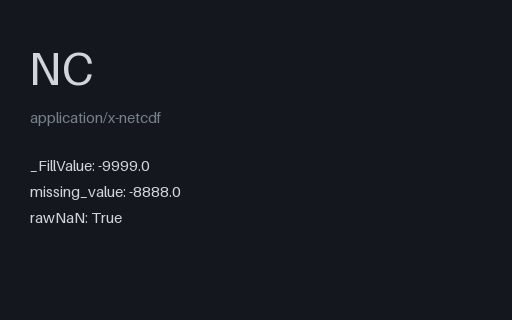
- ncNetCDF _FillValue, missing_value and NaN Together (.nc)One variable that hides absent data three different ways at once: two _FillValue cells, one legacy missing_value cell and one raw NaN, with valid_min and valid_max also declared. Averaging the raw array without honouring all three gives roughly -60 K instead of a real mean.
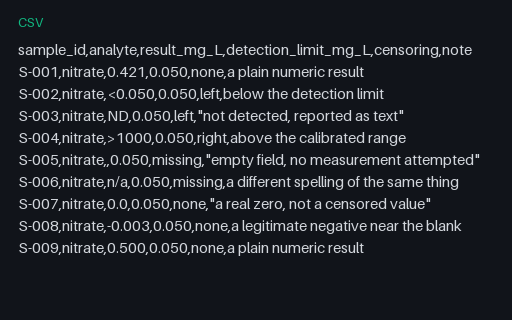
- csvCensored Values and Detection Limits — Non-Numeric Results (.csv)Nine laboratory results where only four are plain numbers: two are below the detection limit, one is above range, two are missing in different spellings, and one is a legitimate small negative near the blank. Coercing the censored strings to numbers or to NaN both bias the summary, and the file distinguishes every case explicitly.
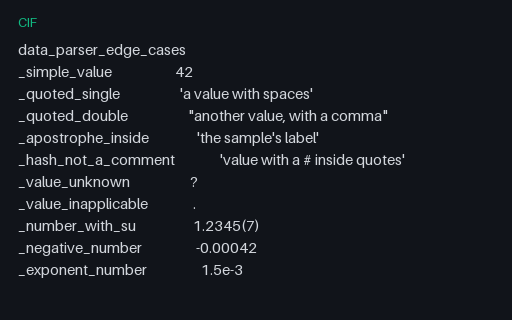
- cifCIF Parser Edge Cases — Quotes, Text Fields and Wrapped Loops (.cif)A CIF built entirely out of the constructs that break naive parsers: quoted values containing apostrophes and hashes, a semicolon-delimited multi-line text field, the distinct '?' and '.' markers, a standard uncertainty written as 1.2345(7), and a loop whose rows wrap across lines. Every one of them is legal CIF.
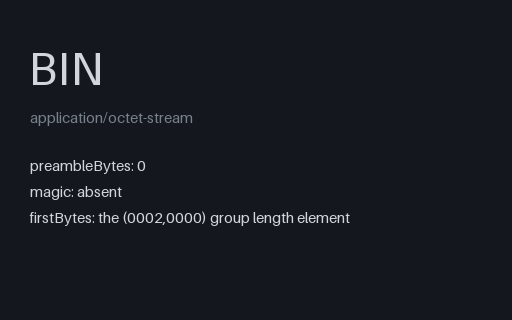
- binDICOM-Shaped Stream — No Preamble, No DICM Magic (.bin)The identical element stream with the 128-byte preamble and the DICM magic stripped, which is how DICOM often arrives out of a network transfer or a database blob column. It is not a conformant Part 10 file and its content is entirely recoverable, so a reader should fall back rather than reject.
- fitsFITS BLANK — Undefined Integer Pixels (.fits)Integer FITS images mark undefined pixels with the BLANK keyword, and BLANK is compared against the stored value before BZERO and BSCALE are applied. Scale first and the four undefined pixels turn into a perfectly plausible zero, which is the ordering bug this file exists to expose.
- fitsFITS Header-Only — Valid File With No Pixels (.fits)A completely valid FITS file consisting of one 2880-byte header block and no data unit, which the standard permits whenever NAXIS is 0. It separates readers that model the data array as optional from readers that treat 'no pixels' as corruption.
Generated by generation/scientific.py. Free for any use, no attribution required — license.