
YAML Non-ASCII Keys and Values
Non-ASCII keys and values across Latin, Cyrillic, Arabic, CJK and emoji, plus a key containing a zero-width space and a value distinguishing a combining acute from the precomposed character. Written as UTF-8 with no BOM.
# Non-ASCII keys and values, written as UTF-8 with no BOM. Keys are not required to be ASCII,
# and a parser that assumes they are will mangle or drop them. The zero-width space is written
# as a double-quoted escape so the byte sequence is unambiguous in the source.
"日本語": ビルド
"ключ": значение
"مفتاح": قيمة
"clé-accentuée": valeur
"Grüße": "Straße"
"emoji-🚀": launch
"zero-widthspace": present
"combining-é": "e with a combining acute, not U+00E9"
naive_plain_key: café
nested:
日本語:
ステージ: ビルド
順序: 1
list:
- 東京
- Ísafjörður
- Kraków
mixed_script_value: "Latin, Кириллица, 漢字, العربية in one scalar"
Specifications
- Encoding
- UTF-8, no BOM
- Scripts
- Latin, Cyrillic, Arabic, CJK, emoji
- Non Ascii Keys
- 9
- Has Zero Width Space
- true
- Has Combining Mark
- true
Testing contract
Expected to pass- Scenario
- Load YAML whose mapping keys are non-ASCII, including a zero-width space and a combining mark
- Expected result
- All nine non-ASCII keys round-trip byte-identically, and the combining-mark value is not silently normalised to its precomposed form
What is a .yaml file?
YAML (YAML Ain't Markup Language) is a human-readable data-serialization format using indentation, key-value pairs, and lists, and is a superset of JSON. It supports comments, anchors, and multiple documents per file, favoring readability for configuration. Its indentation sensitivity makes it error-prone to hand-edit.
How to use this file
Use an example YAML file to test config parsers, indentation and anchor handling, multi-document streams, and safe-loading to avoid arbitrary object construction.
How to use this file for testing
“YAML Non-ASCII Keys and Values” is a deterministic Novus Examples fixture for Config parsing, Encoding detection, Editor testing. TOML and INI configuration files with nested sections and typed values — for testing config parsers and loaders.
Documented properties for this file: UTF-8, no BOM. Compare results against paired or grouped companions on this page when present (clean↔damaged, searchable↔scanned, or format twins) so scores stay reproducible across runs.
Download the file once, keep the path stable in CI or local scripts, and treat the spec table as the contract: dimensions, seeds, field lists, and roles are intentional. Corrupt or invalid samples are labelled as such — expect parsers to fail loudly rather than silently accept them.
Pipeline and infrastructure fixtures are inert configuration: steps reference fictional images and scripts, and nothing here executes. Run your linter, schema validator, migrator, or policy engine against them, and expect the deprecated-syntax and intentionally invalid variants to be rejected.
Point your config loader at the file and assert it reads the documented sections and typed values, including any deliberately-tricky nesting or comments.
Code examples
import yaml  # pip install pyyaml

with open("unicode-keys.yaml") as f:
    data = yaml.safe_load(f)
print(data)
Related files
- yamlYAML Anchors and AliasesAnchors and aliases across mapping, sequence and scalar nodes, including an anchor nested inside another anchored node. The point most tooling misses: an alias is a reference to the same node, so a shallow-loading parser can share mutable state between jobs.
- yamlYAML Block Scalars and Chomping IndicatorsEvery block-scalar variation in one file: literal and folded styles, all three chomping indicators, an explicit indentation indicator, a folded block with a paragraph break, and an embedded shell-shaped script whose own indentation must survive.
- yamlYAML Bounded Anchor ReuseNested anchor reuse kept deliberately small: two anchors, six references, thirty-one expanded nodes. It is here to test alias resolution and expansion accounting on a safe input, and is explicitly not a billion-laughs expansion bomb.
- yamlYAML Directives and CommentsA two-document stream where each document declares its own %YAML directive and the second adds a %TAG handle used by a local tag. Comments appear in every position they are legal, and every one of them is lost by a non-round-tripping loader.
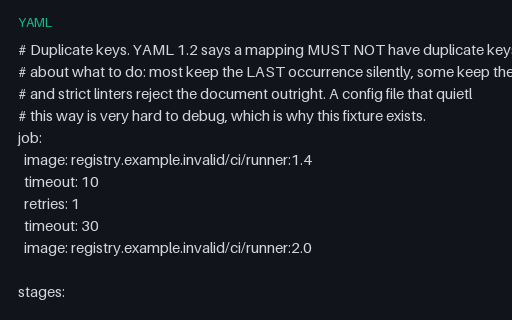
- yamlYAML Duplicate KeysDuplicate keys at three nesting levels, including a duplicated top-level sequence. The spec forbids them; most loaders keep the last silently, a few keep the first, and strict linters reject the document. The file publishes the last-wins answer.
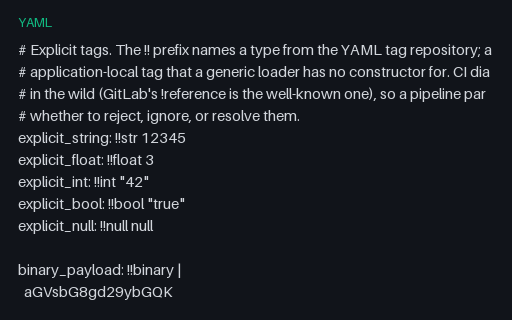
- yamlYAML Explicit and Local TagsExplicit tags across the standard set — !!str, !!float, !!int, !!bool, !!null, !!binary, !!timestamp, !!omap, !!set — alongside two application-local ! tags. CI dialects use local tags in the wild, so a pipeline parser has to decide whether to reject, ignore, or resolve them.
Generated by generation/pipelines.py. Free for any use, no attribution required — license.