
gradle.properties with Escapes and Continuations
A gradle.properties exercising the .properties grammar rather than Gradle: a \uXXXX escape, a backslash line continuation, all three key/value separator forms, and a key containing escaped separator characters.
# Gradle properties. A .properties file is ISO 8859-1 by convention with \uXXXX escapes for
# anything outside it, which is the encoding trap this fixture exists to expose.
org.gradle.jvmargs=-Xmx2g -XX:MaxMetaspaceSize=512m
org.gradle.parallel=true
org.gradle.caching=true
org.gradle.configuration-cache=true

version=1.4.0
group=com.example.orders

# Escaped non-ASCII: this value is the word "café" written as a Unicode escape.
project.displayName=Orders caf\u00e9 service

# A line continuation: the backslash joins this value with the next line, and the leading
# whitespace on the continuation line is stripped.
project.summary=Fictional orders service used as a \
                build-file parsing fixture.

# Keys may be separated by =, :, or whitespace. All three appear below and mean the same thing.
build.channel:stable
build.owner example-platform-team

# Escaped separators inside a key.
path\:to\=value=escaped key characters
Specifications
- Entries
- 12
- Unicode Escapes
- 1
- Line Continuations
- 1
- Separator Forms
- =, :, whitespace
- Escaped Key Characters
- 1
Testing contract
Expected to pass- Scenario
- Parse a .properties file that uses all three separator forms and a line continuation
- Expected result
- The \u00e9 escape decodes to é, the continued value joins into one string with the continuation indentation stripped, and build.channel parses identically whether separated by : or =
What is a .properties file?
A .properties file is the Java configuration format: one `key=value` or `key:value` pair per line, with `#` or `!` comments, backslash line continuations, and escapes for spaces, colons, and equals signs inside keys. Keys are conventionally dot-separated to imply hierarchy, though the format itself is flat. In its original definition the file is ISO-8859-1 with `\uXXXX` escapes for anything else; modern Java tooling also reads UTF-8.
How to use this file
Use an example .properties file to test configuration and resource-bundle loaders, checking continuation lines, escaped separators inside keys, duplicate-key precedence, and correct decoding of `\uXXXX` escapes and non-ASCII values.
How to use this file for testing
“gradle.properties with Escapes and Continuations” is a deterministic Novus Examples fixture for Config parsing, Syntax highlighting, Editor testing. TOML and INI configuration files with nested sections and typed values — for testing config parsers and loaders.
Documented properties for this file: 12 entries. Compare results against paired or grouped companions on this page when present (clean↔damaged, searchable↔scanned, or format twins) so scores stay reproducible across runs.
Download the file once, keep the path stable in CI or local scripts, and treat the spec table as the contract: dimensions, seeds, field lists, and roles are intentional. Corrupt or invalid samples are labelled as such — expect parsers to fail loudly rather than silently accept them.
Pipeline and infrastructure fixtures are inert configuration: steps reference fictional images and scripts, and nothing here executes. Run your linter, schema validator, migrator, or policy engine against them, and expect the deprecated-syntax and intentionally invalid variants to be rejected.
Point your config loader at the file and assert it reads the documented sections and typed values, including any deliberately-tricky nesting or comments.
Related files
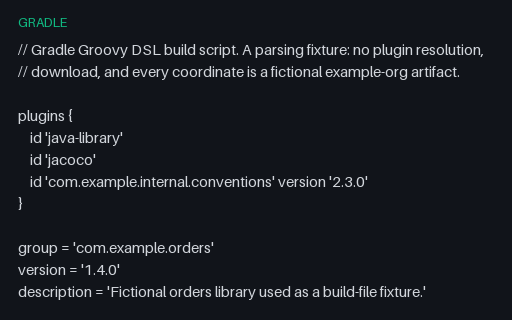
- gradleGradle Build Script (Groovy DSL)A Gradle Groovy DSL build script with a plugins block, a Java toolchain, five dependency configurations, task configuration via named() and a registered task. Every coordinate and repository is fictional, so nothing resolves.
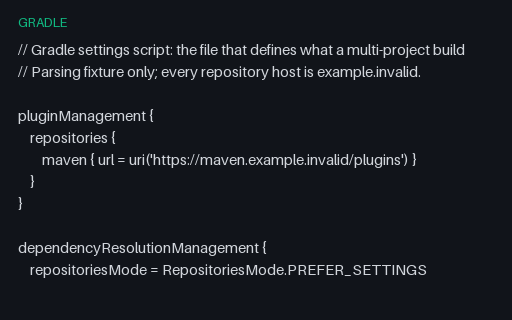
- gradleGradle Settings Script with Version CatalogA Gradle settings script — the file that actually defines a multi-project build — with pluginManagement, a repositories mode, a version catalog declaring libraries, a bundle and a plugin, and one project remapped to a custom directory.
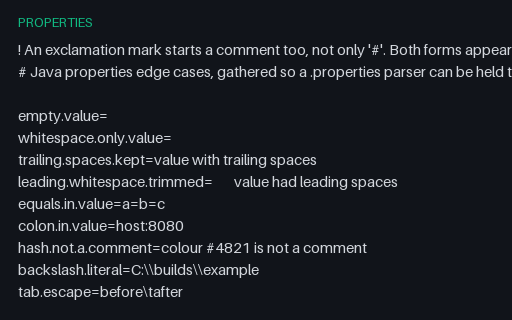
- propertiesJava Properties Parser Edge CasesThe .properties edge cases collected in one file: both comment markers, empty values, a value whose trailing spaces are significant, unescaped = and : inside values, a # that is not a comment, escape sequences, an escaped space in a key, and a duplicate key.
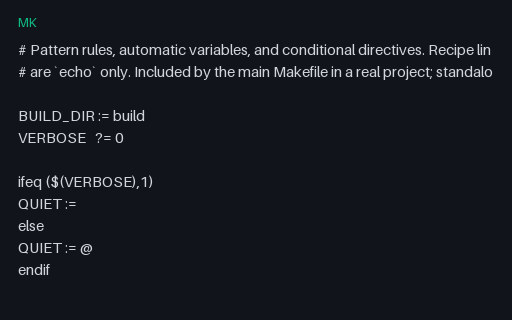
- mkMakefile Pattern Rules and ConditionalsPattern rules with the automatic variables $@, $<, $^ and $*, ifeq/ifdef conditional directives, a vpath search path, and a define block invoked through $(call). All recipe lines are TAB-indented and echo-only.
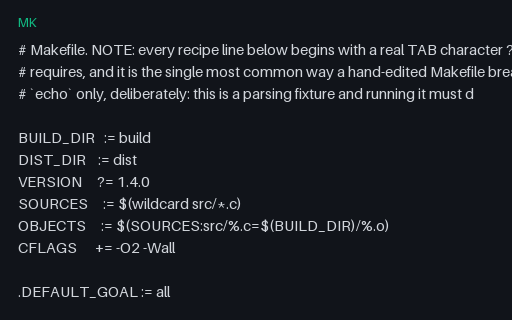
- mkMakefile Targets and TAB IndentationA Makefile whose recipe lines are indented with real TAB characters, as make requires. Covers simple, conditional, appended and substitution-reference variables, .PHONY, and .DEFAULT_GOAL. Every recipe is echo-only, so running it does nothing.
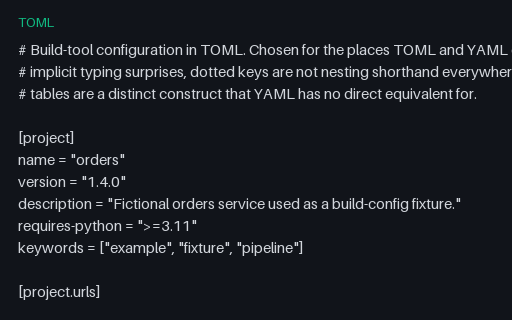
- tomlTOML Build Configuration with Array of TablesA build-tool configuration in TOML, chosen for the constructs YAML has no direct equivalent for: three [[build.step]] array-of-tables entries carrying an ordered pipeline, a quoted glob key, and all three TOML date-time flavours.
Generated by generation/pipelines.py. Free for any use, no attribution required — license.