
Trace Span Table — Flat CSV Export (csv)
The same 13 spans flattened to a CSV table — span and parent IDs, service, name, kind, start timestamp, duration and status. The shape a trace store exports for spreadsheet analysis, and a readable ground truth to diff the three JSON twins against.
span_id,parent_span_id,service,name,kind,start_unix_us,duration_us,status
00f067aa0ba902b7,,checkout-api,POST /api/checkout,SERVER,1773738872850000,148200,UNSET
1a2b3c4d5e6f7081,00f067aa0ba902b7,checkout-api,auth.verify_token,INTERNAL,1773738872850900,4100,UNSET
2b3c4d5e6f708192,00f067aa0ba902b7,checkout-api,GET /cart/{cartId},CLIENT,1773738872855600,21400,UNSET
3c4d5e6f708192a3,2b3c4d5e6f708192,cart-api,GET /cart/{cartId},SERVER,1773738872856200,20100,UNSET
4d5e6f708192a3b4,3c4d5e6f708192a3,cart-api,SELECT shop.carts,CLIENT,1773738872857300,17800,UNSET
5e6f708192a3b4c5,00f067aa0ba902b7,checkout-api,POST /inventory/reserve,CLIENT,1773738872878000,39500,UNSET
6f708192a3b4c5d6,5e6f708192a3b4c5,inventory-api,POST /inventory/reserve,SERVER,1773738872878700,38200,UNSET
708192a3b4c5d6e7,6f708192a3b4c5d6,inventory-api,UPDATE shop.inventory,CLIENT,1773738872880100,34900,UNSET
8192a3b4c5d6e7f8,00f067aa0ba902b7,checkout-api,payments.authorize,CLIENT,1773738872919000,71200,UNSET
92a3b4c5d6e7f809,8192a3b4c5d6e7f8,payments-api,payments.authorize,SERVER,1773738872919800,70100,UNSET
a3b4c5d6e7f8091a,92a3b4c5d6e7f809,payments-api,POST /v1/charges,CLIENT,1773738872921500,66900,UNSET
b4c5d6e7f8091a2b,00f067aa0ba902b7,checkout-api,orders.created publish,PRODUCER,1773738872991900,3100,UNSET
c5d6e7f8091a2b3c,00f067aa0ba902b7,checkout-api,cache.get order-token,INTERNAL,1773738872995600,900,UNSET
Specifications
- Rows
- 13
- Columns
- 8
- Time Unit
- microseconds
- Header
- true
- Trace Id
- 4bf92f3577b34da6a3ce929d0e0e4736
- Same Trace As
- OTLP/Jaeger/Zipkin twins
Testing contract
Reference control- Scenario
- Flatten any of the three JSON twins to rows and diff against this table.
- Expected result
- 13 rows match on span_id, parent_span_id, service, name, kind, start_unix_us and duration_us, with exactly one row whose parent_span_id is empty.
What is a .csv file?
CSV (Comma-Separated Values) is a plain-text tabular format where rows are lines and fields are separated by commas, with quoting rules for values that contain delimiters, quotes, or newlines. It has no formal type system and depends on encoding and dialect conventions. It is the most portable format for tabular data exchange.
How to use this file
Use an example CSV to test parsers against quoting and embedded-delimiter edge cases, header handling, encoding detection, and import pipelines into databases or spreadsheets.
How to use this file for testing
“Trace Span Table — Flat CSV Export (csv)” is a deterministic Novus Examples fixture for Observability, CSV parsing, Conversion testing. Structured and plain-text telemetry with known timestamps, levels, request identifiers, and error states for testing log ingestion, correlation, dashboards, and alert pipelines.
Documented properties for this file: 13 rows · 8 columns. Compare results against paired or grouped companions on this page when present (clean↔damaged, searchable↔scanned, or format twins) so scores stay reproducible across runs.
Download the file once, keep the path stable in CI or local scripts, and treat the spec table as the contract: dimensions, seeds, field lists, and roles are intentional. Corrupt or invalid samples are labelled as such — expect parsers to fail loudly rather than silently accept them.
Telemetry fixtures use fixed trace IDs, span IDs, and timestamps so ingestion is reproducible run to run. Point your collector, parser, or query layer at the file and assert the documented span tree, metric families, or severity mix; service and host names are invented.
Code examples
import pandas as pd

df = pd.read_csv("trace-spans-export.csv")
print(df.head())
print(df.dtypes)
Related files
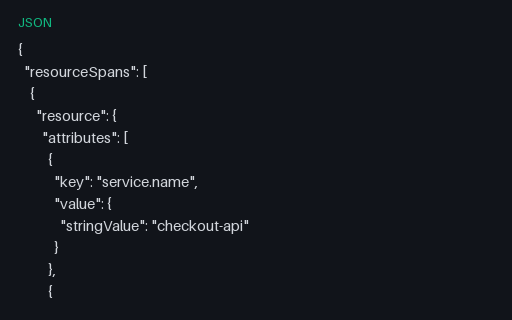
- jsonOTLP Trace — Legacy HTTP Semantic Conventions (json)One HTTP server span using the old OpenTelemetry attribute names — http.method, http.url, http.status_code, net.peer.ip — and the old low-cardinality span name. Paired with its modern twin so a migration shim can be tested against a known before-and-after.
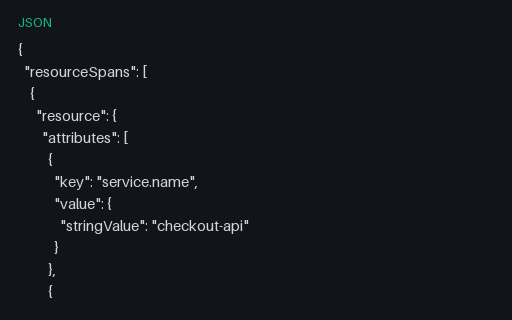
- jsonOTLP Trace — Stable HTTP Semantic Conventions (json)The same HTTP server span written with the stable attribute names — http.request.method, url.path, http.response.status_code, client.address — and the route-templated span name the stable conventions require. The target state for a migration shim.
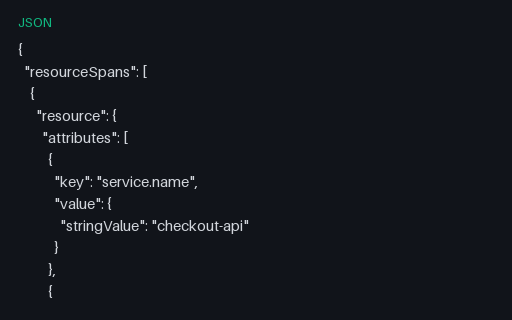
- jsonOTLP Trace — Stock proto3 JSON Encoding (base64 IDs) (json)The same 13-span trace serialised the way a stock proto3 JSON marshaller writes it: trace and span IDs base64-encoded and span kind and status as enum names rather than numbers. Paired with the hex/numeric OTLP/JSON twin so a receiver can be tested against both encodings of one payload.
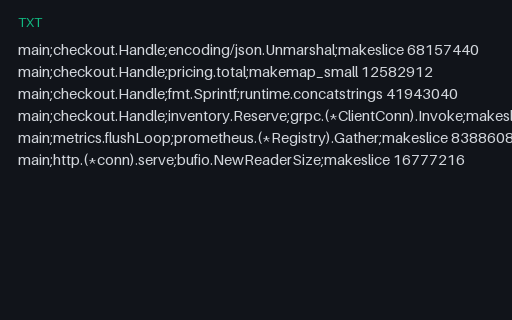
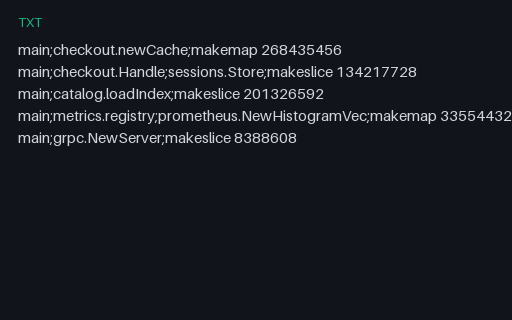
- txtAllocation Profile — Folded Stacks Weighted in Bytes (txt)An allocation profile in the same folded syntax as the CPU profiles, but weighted in bytes rather than samples. The format carries no unit, so a viewer that assumes samples renders 65 MB of allocation as 68 million samples — which is what this fixture is for.
- txtHeap Profile — In-Use Bytes by Allocation Site (txt)A heap profile measuring bytes still live at the sample point, not bytes ever allocated — which is why its shape differs from the allocation profile of the same process. 620 MB retained across five sites, with an unbounded session cache at the top.
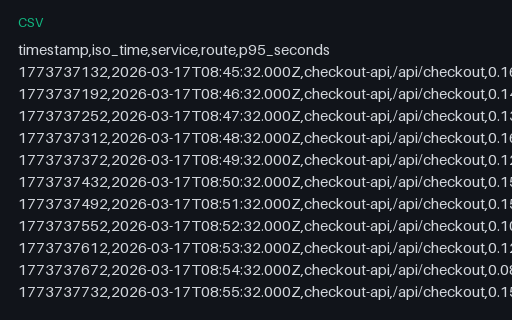
- csvMetric Range Export — Long (Tidy) CSV (csv)The same 90 samples as the query_range response, exported one row per observation with both epoch and ISO 8601 timestamps. The long layout every dataframe library prefers, and half of a reshaping pair.
Generated by generation/observability.py. Free for any use, no attribution required — license.