
OTLP Trace — Legacy HTTP Semantic Conventions (json)
One HTTP server span using the old OpenTelemetry attribute names — http.method, http.url, http.status_code, net.peer.ip — and the old low-cardinality span name. Paired with its modern twin so a migration shim can be tested against a known before-and-after.
{
  "resourceSpans": [
    {
      "resource": {
        "attributes": [
          {
            "key": "service.name",
            "value": {
              "stringValue": "checkout-api"
            }
          },
          {
            "key": "service.namespace",
            "value": {
              "stringValue": "shop"
            }
          },
          {
            "key": "service.version",
            "value": {
              "stringValue": "1.14.2"
            }
          },
          {
            "key": "service.instance.id",
            "value": {
              "stringValue": "checkout-api-7d9f4c-2xk"
            }
          },
          {
            "key": "deployment.environment.name",
            "value": {
              "stringValue": "staging"
            }
          },
          {
            "key": "host.name",
            "value": {
              "stringValue": "node-a1"
            }
          },
          {
            "key": "host.ip",
            "value": {
              "stringValue": "192.0.2.11"
            }
          },
          {
            "key": "cloud.region",
"value": {Specifications
- Spans
- 1
- Attributes
- 11
- Convention Era
- pre-1.21 (http.method era)
- Span Name Style
- HTTP POST
- Deprecated
- true
Testing contract
Reference control- Scenario
- Run your semantic-convention migration over this span.
- Expected result
- All 11 legacy attributes map onto the modern names in the paired fixture, with http.status_code becoming an integer http.response.status_code and net.peer.ip becoming client.address.
What is a .json file?
JSON (JavaScript Object Notation) is a lightweight, text-based data-interchange format representing objects, arrays, strings, numbers, booleans, and null. It is language-independent, human-readable, and the dominant format for web APIs and configuration. It requires a single well-formed root value.
How to use this file
Use an example JSON file to test parsers and serializers, schema validation, Unicode and number-precision handling, and API request or response processing.
How to use this file for testing
“OTLP Trace — Legacy HTTP Semantic Conventions (json)” is a deterministic Novus Examples fixture for Observability, Conversion testing, Metadata testing. Structured and plain-text telemetry with known timestamps, levels, request identifiers, and error states for testing log ingestion, correlation, dashboards, and alert pipelines.
Documented properties for this file: JSON · 4,650 bytes. Compare results against paired or grouped companions on this page when present (clean↔damaged, searchable↔scanned, or format twins) so scores stay reproducible across runs.
Download the file once, keep the path stable in CI or local scripts, and treat the spec table as the contract: dimensions, seeds, field lists, and roles are intentional. Corrupt or invalid samples are labelled as such — expect parsers to fail loudly rather than silently accept them.
Telemetry fixtures use fixed trace IDs, span IDs, and timestamps so ingestion is reproducible run to run. Point your collector, parser, or query layer at the file and assert the documented span tree, metric families, or severity mix; service and host names are invented.
Code examples
import json

with open("otlp-trace-semconv-legacy.json") as f:
    data = json.load(f)
print(type(data), len(data))
Related files
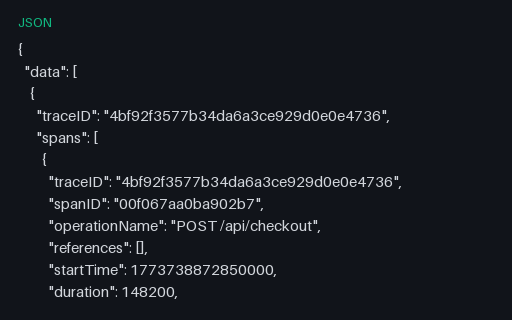
- jsonJaeger JSON Trace — Same 13-Span Checkout (json)The checkout trace in the Jaeger query-API shape — a data array holding one trace, spans carrying microsecond startTime and duration, CHILD_OF references, typed tags and a per-service processes map. The same span tree as the OTLP and Zipkin twins, so a converter can be scored exactly.
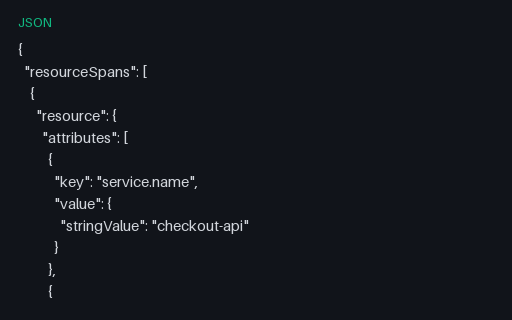
- jsonOTLP Trace — Stock proto3 JSON Encoding (base64 IDs) (json)The same 13-span trace serialised the way a stock proto3 JSON marshaller writes it: trace and span IDs base64-encoded and span kind and status as enum names rather than numbers. Paired with the hex/numeric OTLP/JSON twin so a receiver can be tested against both encodings of one payload.
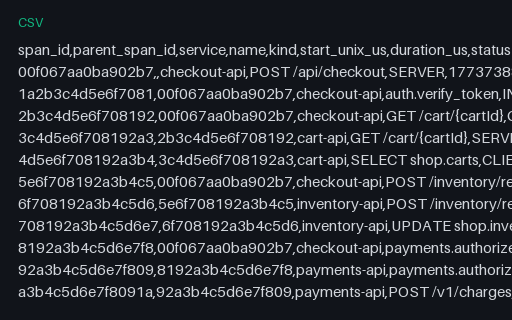
- csvTrace Span Table — Flat CSV Export (csv)The same 13 spans flattened to a CSV table — span and parent IDs, service, name, kind, start timestamp, duration and status. The shape a trace store exports for spreadsheet analysis, and a readable ground truth to diff the three JSON twins against.
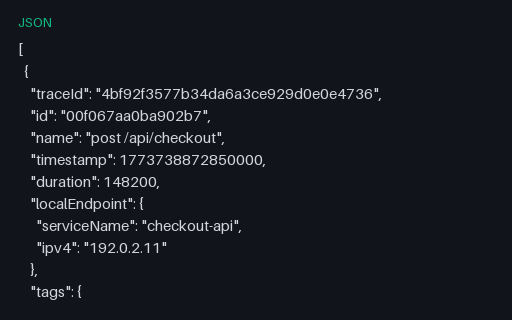
- jsonZipkin v2 JSON Trace — Same 13-Span Checkout (json)The checkout trace as a flat Zipkin v2 span list with localEndpoint, string-only tags and annotations. Two conversions are deliberately visible: Zipkin has no INTERNAL kind, so those two spans omit kind, and every typed attribute is stringified.
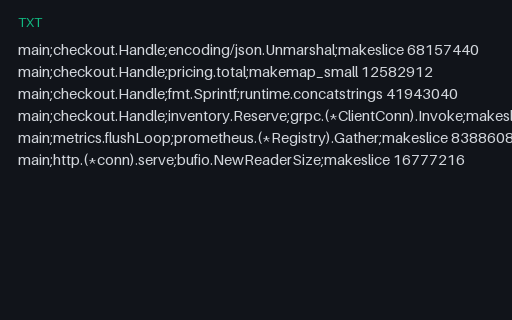
- txtAllocation Profile — Folded Stacks Weighted in Bytes (txt)An allocation profile in the same folded syntax as the CPU profiles, but weighted in bytes rather than samples. The format carries no unit, so a viewer that assumes samples renders 65 MB of allocation as 68 million samples — which is what this fixture is for.
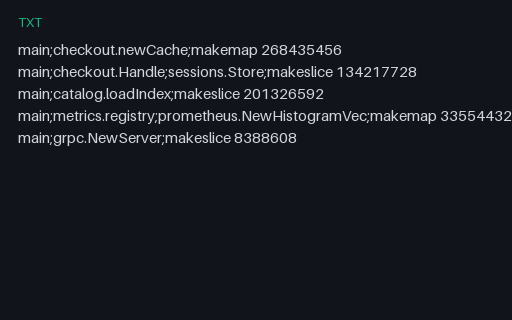
- txtHeap Profile — In-Use Bytes by Allocation Site (txt)A heap profile measuring bytes still live at the sample point, not bytes ever allocated — which is why its shape differs from the allocation profile of the same process. 620 MB retained across five sites, with an unbounded session cache at the top.
Generated by generation/observability.py. Free for any use, no attribution required — license.