
GLB — Clean Reference Cube
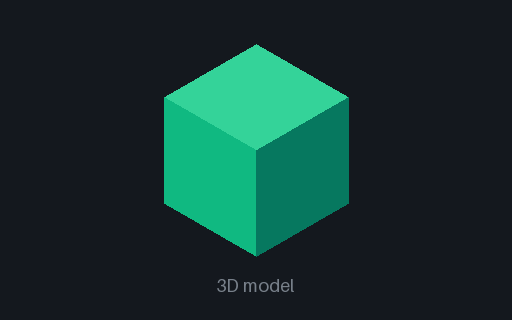
The clean reference cube as a GLB, so the same baseline is available to glTF tooling and to the site's 3D preview. Identical topology to the OBJ twin in this group.
Specifications
- Format
- glTF 2.0 binary (GLB)
- Vertices
- 8
- Triangles
- 12
- Manifold
- true
- Normals
- smooth (area-averaged)
- Role
- reference
Testing contract
Reference control- Scenario
- Compare vertex and triangle counts against the OBJ twin after import.
- Expected result
- 8 vertices and 12 triangles from both; an importer that silently splits vertices reports 24 or 36 and needs its weld settings checked.
What is a .glb file?
GLB is the binary form of glTF, packaging 3D scene geometry, materials, textures, animations, and node hierarchy into a single self-contained file. It is optimized for efficient runtime loading and is often called the JPEG of 3D. It is widely used in web, AR, and real-time 3D applications.
How to use this file
Use an example GLB to test glTF loaders, embedded-texture and animation handling, and real-time rendering pipelines in web or game engines.
How to use this file for testing
“GLB — Clean Reference Cube” is a deterministic Novus Examples fixture for Mesh repair testing, Mesh processing QA. A watertight mesh paired with a deliberately broken twin (holes, missing faces, open ends) — the input and intended result for a mesh-repair / hole-filling tool.
Documented properties for this file: reference · glTF 2.0 binary (GLB). Compare results against paired or grouped companions on this page when present (clean↔damaged, searchable↔scanned, or format twins) so scores stay reproducible across runs.
Download the file once, keep the path stable in CI or local scripts, and treat the spec table as the contract: dimensions, seeds, field lists, and roles are intentional. Corrupt or invalid samples are labelled as such — expect parsers to fail loudly rather than silently accept them.
3D and CAD fixtures carry one small, documented solid or scene. Convert and inspect against the known geometry, units, and structure; format twins let you diff interchange fidelity, and the 3D viewer previews the actual mesh.
Code examples
import trimesh  # pip install trimesh

mesh = trimesh.load("clean-reference.glb")
print(mesh.bounds, mesh.faces.shape)
Related files
- glbGLB — Duplicate Vertices, Split SeamThe duplicated-corner cube as a GLB. Because glTF stores every attribute per vertex, the duplication doubles the position and normal buffers for a shape that needs eight corners — the cheapest optimisation an asset pipeline can make, and the one this fixture measures.
- glbGLB — Inverted Normals / Mixed WindingThe mixed-winding cube as a GLB with a default single-sided material, so the reversed faces are culled and you can see straight through the model. Turning on doubleSided hides the defect without fixing it, which is the trap this fixture is for.
- glbGLB — Non-manifold Edge (three faces on one edge)The finned cube as a GLB. It renders without complaint in any viewer — rasterisation never asks about adjacency — so this is the fixture that separates tools which actually analyse topology from tools which merely draw triangles.
- glbGLB — Zero-area TrianglesThe same four degenerate triangles inside a structurally valid GLB. The file passes every glTF schema check — nothing in the format forbids a zero-area face — so this is the fixture for geometry validation as opposed to document validation.
- objOBJ — Duplicate Vertices, Split SeamThe reference cube with all eight corners stored twice at bit-identical coordinates: the first six triangles use one copy, the last six use the other. It renders as a closed cube but is topologically two disconnected surface patches with a split seam, which is why smoothing, subdivision and boolean operations all misbehave on it.
- objOBJ — Inverted Normals / Mixed WindingThe reference cube with three of its six cube faces (six of its twelve triangles) wound clockwise instead of counter-clockwise, and `vn` records that follow the reversed winding into the solid. The classic symptom is a model that looks half-invisible with backface culling on and half-black with it off.
Generated by generation/models_p7.py. Free for any use, no attribution required — license.