
ICU Plural-Category Probe — Welsh (six categories, both kinds)
Welsh is the only CLDR locale that uses all six plural categories for cardinals AND all six for ordinals, which makes it the strongest single probe for a plural-rule engine. Each branch names its own category so the assertion is about selection, not wording, and the two rule sets disagree for n = 4, 5, 7, 8 and 9.
{
  "locale": "cy",
  "format": "icu-messageformat",
  "note": "In ICU MessageFormat, '#' inside a plural branch binds to the NEAREST enclosing plural argument, not the outermost one. Where an outer count must appear inside an inner plural, these messages use the explicit {name} form instead of '#'.",
  "messages": {
    "ordinalProbe": "{n, selectordinal, zero {#=zero} one {#=one} two {#=two} few {#=few} many {#=many} other {#=other}}",
    "cardinalProbe": "{n, plural, zero {#=zero} one {#=one} two {#=two} few {#=few} many {#=many} other {#=other}}"
  },
  "cases": [
    {
      "n": 0,
      "ordinal": "zero",
      "cardinal": "zero"
    },
    {
      "n": 1,
      "ordinal": "one",
      "cardinal": "one"
    },
    {
      "n": 2,
      "ordinal": "two",
      "cardinal": "two"
    },
    {
      "n": 3,
      "ordinal": "few",
      "cardinal": "few"
    },
    {
      "n": 4,
      "ordinal": "few",
      "cardinal": "other"
    },
    {
      "n": 5,
      "ordinal": "many",
      "cardinal": "other"
    },
    {
      "n": 6,
      "ordinal": "many",
      "cardinal": "many"
    },
    {
      "n": 7,
      "ordinal": "zero",
      "cardinal": "other"
    },
{Specifications
- Format
- ICU MessageFormat
- Locale
- cy
- Language
- Welsh
- Cardinal Categories
- zero, one, two, few, many, other
- Ordinal Categories
- zero, one, two, few, many, other
- Cases
- 12
- Seed
- 20260807
- Wave
- p7
- Line Endings
- LF
Testing contract
Expected to pass- Scenario
- Format `cardinalProbe` and `ordinalProbe` for n = 0 through 11.
- Expected result
- Each result is '<n>=<category>' matching the `cases` table — note that n = 6 is 'many' as a cardinal and 'many' as an ordinal, but n = 4 is 'other' as a cardinal and 'few' as an ordinal.
What is a .json file?
JSON (JavaScript Object Notation) is a lightweight, text-based data-interchange format representing objects, arrays, strings, numbers, booleans, and null. It is language-independent, human-readable, and the dominant format for web APIs and configuration. It requires a single well-formed root value.
How to use this file
Use an example JSON file to test parsers and serializers, schema validation, Unicode and number-precision handling, and API request or response processing.
How to use this file for testing
“ICU Plural-Category Probe — Welsh (six categories, both kinds)” is a deterministic Novus Examples fixture for Internationalization, Localization catalogs, JSON parsing. Parallel text and accented, multi-script content — for testing translation pipelines, Unicode handling, and localization tooling.
Documented properties for this file: seed 20260807 · Welsh · LF. Compare results against paired or grouped companions on this page when present (clean↔damaged, searchable↔scanned, or format twins) so scores stay reproducible across runs.
Download the file once, keep the path stable in CI or local scripts, and treat the spec table as the contract: dimensions, seeds, field lists, and roles are intentional. Corrupt or invalid samples are labelled as such — expect parsers to fail loudly rather than silently accept them.
Translation-catalog fixtures carry the same message set across formats, each with its native placeholder syntax. Test your i18n loader, catalog converter, or translation-memory tool, and use the RTL and CJK variants to check bidirectional text and Unicode handling.
Load the catalog with your i18n framework and verify placeholder interpolation and plural handling; the RTL and CJK variants exercise bidirectional text and font fallback.
Code examples
import json

with open("category-probe-cy.json") as f:
    data = json.load(f)
print(type(data), len(data))
Related files
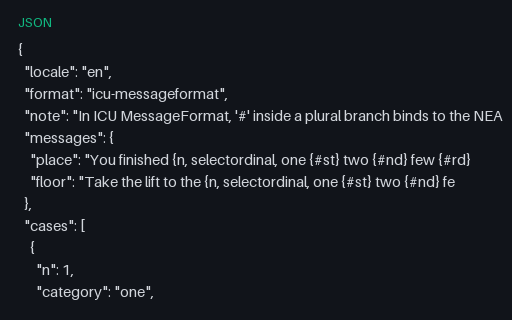
- jsonICU MessageFormat — Nested select/plural (Arabic)Arabic ICU MessageFormat catalog whose messages nest a select inside a plural branch and a plural inside a select branch, shipped with the argument bindings and the exact output each one must produce. Includes the '#' binding trap: inside a nested plural, '#' refers to the inner argument, so the outer count is written explicitly.
- jsonICU MessageFormat — Nested select/plural (English)English ICU MessageFormat catalog whose messages nest a select inside a plural branch and a plural inside a select branch, shipped with the argument bindings and the exact output each one must produce. Includes the '#' binding trap: inside a nested plural, '#' refers to the inner argument, so the outer count is written explicitly.
- jsonICU MessageFormat — Nested select/plural (Polish)Polish ICU MessageFormat catalog whose messages nest a select inside a plural branch and a plural inside a select branch, shipped with the argument bindings and the exact output each one must produce. Includes the '#' binding trap: inside a nested plural, '#' refers to the inner argument, so the outer count is written explicitly.
- jsonICU MessageFormat — Plural offset (English)The 'Rana and 5 others like this' pattern: ICU plural arguments with offset:1 and offset:2, where the explicit =0/=1/=2 selectors match the RAW value but '#' prints the value MINUS the offset. Ships every boundary case with its expected output.
- jsonICU selectordinal — English ordinal suffixesEnglish st/nd/rd/th suffixes done properly, via ICU selectordinal rather than a hand-written switch. The case list covers the teens (11th, 12th, 13th) and the wrap-around (21st, 102nd, 111th) that a naive n % 10 lookup gets wrong.
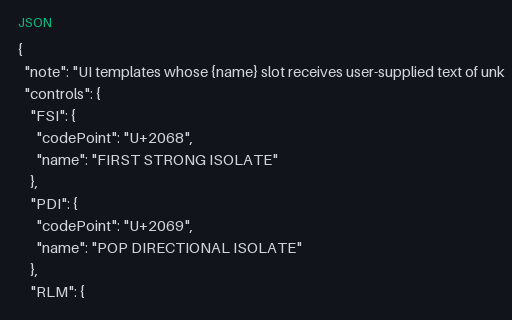
- jsonBidi Isolates — UI templates for user-supplied namesThree notification templates in English, Arabic and Hebrew, each given raw and with every interpolation slot wrapped in FSI…PDI, plus four argument sets covering an LTR name in an RTL sentence, an RTL name in an LTR sentence and a name beginning with a neutral character. This is the fixture for the bug where a display name reorders the sentence around it.
Generated by generation/localization_p7.py. Free for any use, no attribution required — license.