
Multipart Submission Body (TXT)
A complete multipart request dump for the multipart upload form: two file parts with placeholder payloads, a filename containing a space and parentheses, a repeated field name and the empty honeypot.
POST /forms/sample HTTP/1.1
Host: example.invalid
Content-Type: multipart/form-data; boundary=----NovusSampleBoundary7MA4YWxkTrZu0gW
Content-Length: 1200

------NovusSampleBoundary7MA4YWxkTrZu0gW
Content-Disposition: form-data; name="claim_ref"

CLM-SAMPLE-88
------NovusSampleBoundary7MA4YWxkTrZu0gW
Content-Disposition: form-data; name="incident_date"

2026-02-11
------NovusSampleBoundary7MA4YWxkTrZu0gW
Content-Disposition: form-data; name="narrative"

A fictional incident recorded for the sample claim fixture.
It runs to two lines, so the parser has to respect the boundary rather than the newline.
------NovusSampleBoundary7MA4YWxkTrZu0gW
Content-Disposition: form-data; name="photo_evidence"; filename="sample-photo.png"
Content-Type: image/png

[13 bytes of placeholder text stand in for the PNG payload]
------NovusSampleBoundary7MA4YWxkTrZu0gW
Content-Disposition: form-data; name="receipt"; filename="sample receipt (1).pdf"
Content-Type: application/pdf

[placeholder text stands in for the PDF payload]
------NovusSampleBoundary7MA4YWxkTrZu0gW
Content-Disposition: form-data; name="declarations"

accurate
------NovusSampleBoundary7MA4YWxkTrZu0gW
Content-Disposition: form-data; name="declarations"

copies
------NovusSampleBoundary7MA4YWxkTrZu0gW
Content-Disposition: form-data; name="website"


------NovusSampleBoundary7MA4YWxkTrZu0gW--

--
SAMPLE request dump for upload-multipart-encoding.html. The host is example.invalid, both file
parts carry placeholder text instead of real bytes, and nothing here was ever sent anywhere.

This file uses LF line endings for legibility; on the wire every boundary line is CRLF-delimited,
which is why the stated length above counts LF bytes and a live request would count more.

Notes for a parser under test:Specifications
- Content Type
- multipart/form-data
- Parts
- 8
- Encoding
- UTF-8
What is a .txt file?
TXT is a plain-text file containing unformatted character data with no styling or structure beyond line breaks. Its interpretation depends on character encoding, most commonly UTF-8, and on line-ending convention. It is the most universal and portable text container.
How to use this file
Use an example TXT to test encoding detection, line-ending (LF versus CRLF) handling, and any tool that reads or streams raw text input.
How to use this file for testing
“Multipart Submission Body (TXT)” is a deterministic Novus Examples fixture for Form parsing, Form testing, Web scraping. PDF AcroForms with documented fields and live HTML forms for testing form parsers and fillers.
Documented properties for this file: UTF-8. Compare results against paired or grouped companions on this page when present (clean↔damaged, searchable↔scanned, or format twins) so scores stay reproducible across runs.
Download the file once, keep the path stable in CI or local scripts, and treat the spec table as the contract: dimensions, seeds, field lists, and roles are intentional. Corrupt or invalid samples are labelled as such — expect parsers to fail loudly rather than silently accept them.
This form is fictional SAMPLE content for tooling tests (autofill, scrapers, PDF fillers). It is not an official government, bank, or clinic form. Open the HTML offline or fill the PDF in any viewer; the demo submit path never stores data.
Related files
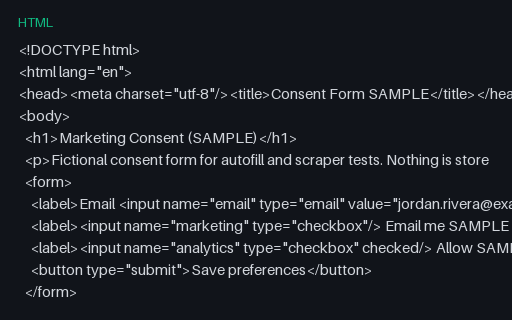
- htmlConsent Form Template (HTML, SAMPLE)A minimal fictional marketing-consent HTML form — for privacy UX and scraper tests.
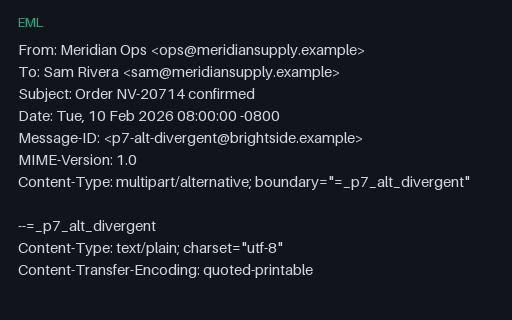
- emlEML — multipart/alternative Whose Parts DisagreeText and HTML alternatives that state different totals and different delivery dates. The spec says the parts must be alternative renderings of the same content, so this fixture shows what a tool extracts when they are not — the answer depends entirely on which part it picks.
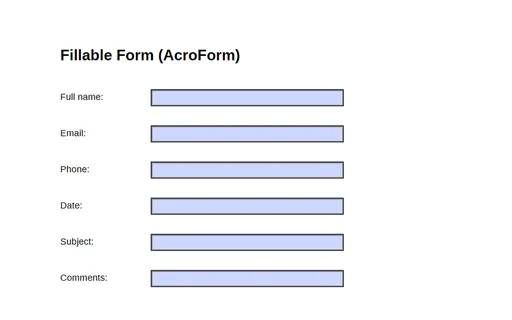
- pdfFillable Form (AcroForm)A one-page PDF with a six-field AcroForm (full_name, email, phone, date, subject, comments) — a fixture for testing form fillers, parsers, and field extraction.
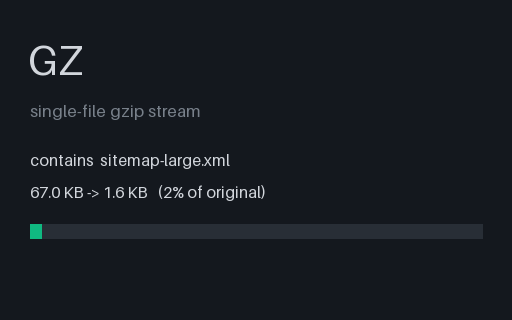
- gzGzipped sitemap (500 URLs, .xml.gz)A 500-URL sitemap served the way large sites serve them - gzip-compressed as sitemap-large.xml.gz. The gzip header carries mtime 0 and no embedded filename, so the bytes are stable across regenerations. For testing that a crawler decompresses .xml.gz sitemaps before parsing.
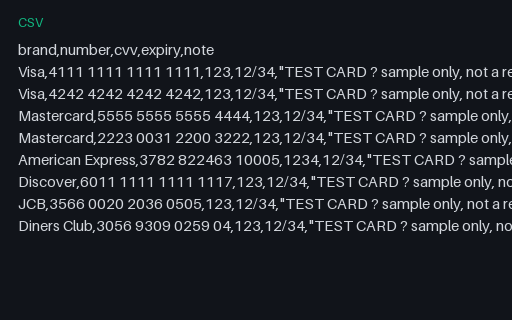
- csvPayment Test Cards (CSV)A reference list of well-known payment TEST card numbers (Visa, Mastercard, Amex, Discover, JCB, Diners) with sample CVV and expiry. These are published test values that pass the Luhn check but are not real accounts — for testing payment forms and card validators. Never use real card data.
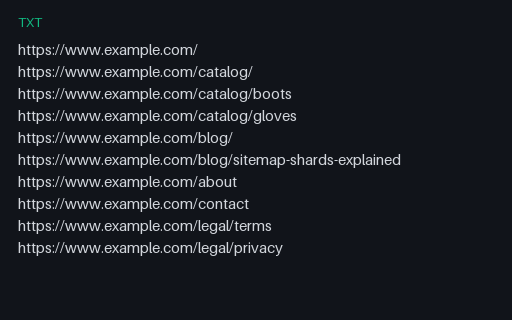
- txtPlain-text sitemap (one URL per line)The plain-text sitemap format the sitemaps.org protocol also accepts: one absolute URL per line, no markup, UTF-8 encoded. For testing that a crawler supports the text form as well as XML.
Generated by generation/forms_p7.py. Free for any use, no attribution required — license.