
EML — CID Inline Image
A multipart/related message with an HTML body referencing a CID-inline PNG — for email client and MIME parser tests.
Content-Type: multipart/related; boundary="=_cid_related_0001"
MIME-Version: 1.0
From: Brightside Cafe <news@brightside.example>
To: Sam Rivera <sam@meridiansupply.example>
Subject: Your loyalty badge
Date: Tue, 06 Jan 2026 10:00:00 -0800
Message-ID: <cid-badge@brightside.example>

--=_cid_related_0001
Content-Type: multipart/alternative; boundary="=_cid_alt_0001"
MIME-Version: 1.0

--=_cid_alt_0001
Content-Type: text/plain; charset="utf-8"
MIME-Version: 1.0
Content-Transfer-Encoding: base64

WW91ciBsb3lhbHR5IGJhZGdlIGlzIGF0dGFjaGVkIGlubGluZS4K

--=_cid_alt_0001
Content-Type: text/html; charset="utf-8"
MIME-Version: 1.0
Content-Transfer-Encoding: base64

PGh0bWw+PGJvZHk+PHA+WW91ciBsb3lhbHR5IGJhZGdlOjwvcD48aW1nIHNyYz0iY2lkOmJhZGdl
QGJyaWdodHNpZGUuZXhhbXBsZSIgYWx0PSJiYWRnZSIgd2lkdGg9IjY0IiBoZWlnaHQ9IjY0Ii8+
PC9ib2R5PjwvaHRtbD4=

--=_cid_alt_0001--

--=_cid_related_0001
Content-Type: image/png
MIME-Version: 1.0
Content-Transfer-Encoding: base64
Content-ID: <badge@brightside.example>
Content-Disposition: inline; filename="badge.png"

iVBORw0KGgoAAAANSUhEUgAAAEAAAABACAIAAAAlC+aJAAABd0lEQVR4nO3aMS9DURjG8b+nl5GV
wciuM3bKN5BIrCRisLCwdDE0pCuJxCeQXN0MwkIxMKmEMJSarKqNcEWaCIYmvfdp/KZzzz3n5L55
33Nyh9PRvTmLM2FOmBPmhDlhTpgT5oKfXjzP5EmYnq25NsyAaNcS+j1xrfT8azHbZ0CYE+aEOWFO
mBPmhDlhTpgT5kTb/8z95HE6V6zcZgrr0eP91Fr/ziLwMJ07fbqNOgt3F/nLfZIZwEvtNSUN9w0c
lkuN/dXaa2bvM6qkl1D2LFwayhArNTP5oHwFjPQNEp+gyfnZ83A5PTEWvkcS6UwF4fh81F4t7h5X
bkhyAIflUr1eH21IgtMeiGTPw6V0bDshaH6Jo4frar3WlQq+l9BJ5WaluEsyA+j/OPUjk4WNr3bv
9gItJMwJc8KcMCfMCXPCnDAnzAlzwpwwJ8wJc8KcMCfMCXPCnDAnzAV/jkjgtZW2yoAw1/F/8TVm
wpwwJ8wJc4r7A5r1BjSqVRvaVv2eAAAAAElFTkSuQmCC

--=_cid_related_0001--
Specifications
- Structure
- multipart/related + alternative + image/png
- Cid
- badge@brightside.example
Testing contract
Expected to pass- Scenario
- Exercise EML — CID Inline Image in its mime workflow. A multipart/related message with an HTML body referencing a CID-inline PNG — for email client and MIME parser tests.
- Expected result
- subject='Your loyalty badge'; content type=multipart/related; MIME leaf parts=3. Declared feature checks: structure=multipart/related + alternative + image/png; cid=badge@brightside.example.
What is a .eml file?
An EML file is a single email message stored in the RFC 822 / MIME format: plain-text headers (From, To, Subject, Date, Message-ID) followed by the body, which may be plain text, HTML, or a multipart structure with alternative bodies and file attachments encoded in base64.
How to use this file
Use an example EML to test email header parsing, MIME decoding, HTML-part handling, attachment extraction, and EML-to-other-format conversion.
How to use this file for testing
“EML — CID Inline Image” is a deterministic Novus Examples fixture for Email parsing, Conversion testing. Standards-compliant RFC 822 messages (plain, multipart text+HTML, and with an attachment) plus an MBOX mailbox, for testing header parsing, MIME decoding, attachment extraction, and mailbox splitting.
Documented properties for this file: multipart/related + alternative + image/png. Compare results against paired or grouped companions on this page when present (clean↔damaged, searchable↔scanned, or format twins) so scores stay reproducible across runs.
Download the file once, keep the path stable in CI or local scripts, and treat the spec table as the contract: dimensions, seeds, field lists, and roles are intentional. Corrupt or invalid samples are labelled as such, expect parsers to fail loudly rather than silently accept them.
Email fixtures use fixed dates, message IDs, and MIME boundaries so runs are reproducible, and every address is fictional. Test header parsing, MIME decoding, attachment extraction, and EML/MBOX conversion against the documented structure.
Code examples
from email import policy
from email.parser import BytesParser

msg = BytesParser(policy=policy.default).parse(open("cid-inline-badge.eml", "rb"))
print(msg["subject"], msg["from"])
Related files
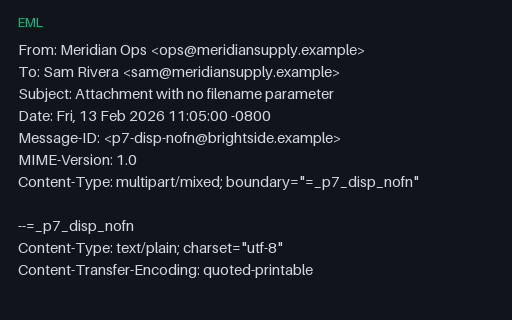
- emlEML — Attachment With No Filename At AllAn attachment with a bare Content-Disposition: attachment and no name in either header. A client has to invent a filename, and the extension it invents decides whether the saved file opens as a spreadsheet or as unknown binary.
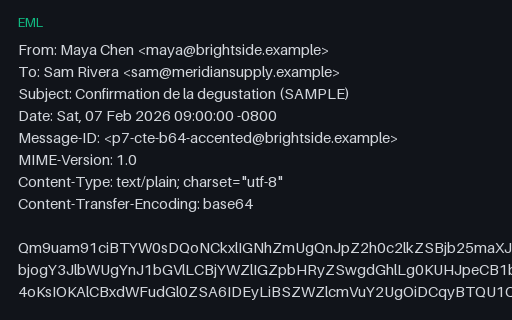
- emlEML — Base64: Accented UTF-8 BodyA base64 text/plain message in utf-8 carrying the identical body to the quoted-printable twin beside it. Base64 is opaque to whitespace and line-start characters, so it is the reference side of the pair when a QP decoder is suspect.
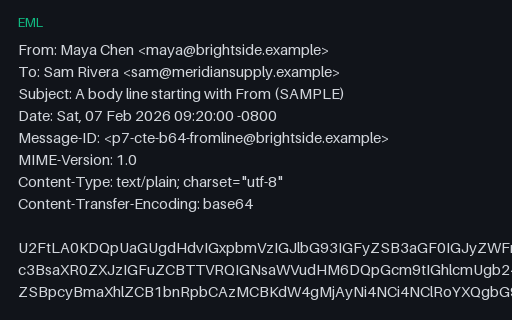
- emlEML — Base64: From-Line and Lone DotA base64 text/plain message in utf-8 carrying the identical body to the quoted-printable twin beside it. Base64 is opaque to whitespace and line-start characters, so it is the reference side of the pair when a QP decoder is suspect.
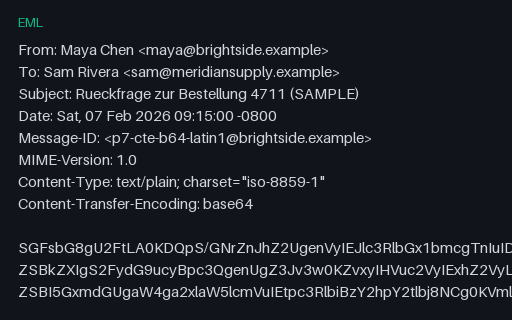
- emlEML — Base64: ISO-8859-1 BodyA base64 text/plain message in iso-8859-1 carrying the identical body to the quoted-printable twin beside it. Base64 is opaque to whitespace and line-start characters, so it is the reference side of the pair when a QP decoder is suspect.
- emlEML — Base64: Soft Line BreaksA base64 text/plain message in utf-8 carrying the identical body to the quoted-printable twin beside it. Base64 is opaque to whitespace and line-start characters, so it is the reference side of the pair when a QP decoder is suspect.
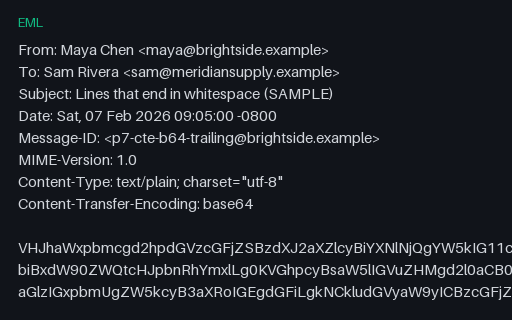
- emlEML — Base64: Trailing WhitespaceA base64 text/plain message in utf-8 carrying the identical body to the quoted-printable twin beside it. Base64 is opaque to whitespace and line-start characters, so it is the reference side of the pair when a QP decoder is suspect.
Generated by generation/email_wave_c.py. Free for any use, no attribution required, license.