
X12 EDI 204 — SAMPLE
Short ANSI X12 204 SAMPLE transaction for EDI parser / translator tests.
ISA*00*          *00*          *ZZ*NOVUSBUYER      *ZZ*CARRIER01       *260117*1000*U*00401*000000015*0*P*>~
GS*SM*NOVUSBUYER*CARRIER01*20260117*1000*15*X*004010~
ST*204*0001~
B2**CARRIER01**LOAD-SAMPLE-1**PP~
B2A*00*LT~
L11*PO-2026-0042*PO~
SE*5*0001~
GE*1*15~
IEA*1*000000015~
Specifications
- Standard
- ANSI X12 004010
- Transaction
- 204
- Note
- synthetic SAMPLE
Testing contract
Expected to pass- Scenario
- Exercise X12 EDI 204 — SAMPLE in its hl7 edi workflow. Short ANSI X12 204 SAMPLE transaction for EDI parser / translator tests.
- Expected result
- 9 text lines, decoded as UTF-8; first nonempty line is 'ISA*00* *00* *ZZ*NOVUSBUYER *ZZ*CARRIER01 *260117*1000*U*00401*000000015*0*P*>~'. Declared feature checks: standard=ANSI X12 004010; transaction=204.
What is a .edi file?
EDI (Electronic Data Interchange), in the ANSI X12 family, is a structured plain-text format for exchanging business documents like purchase orders (850) and invoices (810) between trading partners. It is built from segments (ISA, GS, ST, …) separated by delimiters, with tightly specified element positions. It underpins much of B2B supply-chain and retail commerce.
How to use this file
Use an example X12 EDI file to test EDI parsers and translators, segment/element extraction, and mapping from EDI to JSON or XML. The parties and values here are synthetic.
How to use this file for testing
“X12 EDI 204 — SAMPLE” is a deterministic Novus Examples fixture for Encoding detection, Editor testing. UTF-8, UTF-8-BOM, UTF-16, and Latin-1 files with documented encodings and line endings for testing charset detection.
Documented properties for this file: EDI · 288 bytes. Compare results against paired or grouped companions on this page when present (clean↔damaged, searchable↔scanned, or format twins) so scores stay reproducible across runs.
Download the file once, keep the path stable in CI or local scripts, and treat the spec table as the contract: dimensions, seeds, field lists, and roles are intentional. Corrupt or invalid samples are labelled as such, expect parsers to fail loudly rather than silently accept them.
Document fixtures list their internal structure (pages, fields, tracked changes, embedded objects) in the spec table. Test extractors, converters, and OCR against that known structure, and compare searchable↔scanned or format-twin companions when present.
Code examples
from pydifact.segmentcollection import Interchange  # EDIFACT

inter = Interchange.from_file("x12-204.edi")
for seg in inter.segments:
    print(seg.tag, seg.elements)
Related files
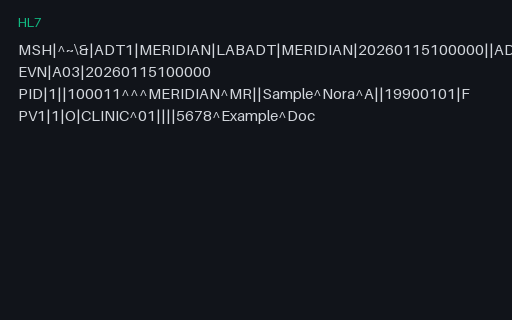
- hl7HL7 v2 — ADT-A03 SAMPLEShort synthetic HL7 v2 ADT-A03 message — fictional SAMPLE demographics for parser tests.
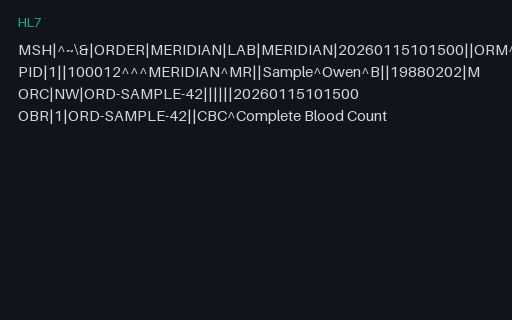
- hl7HL7 v2 — ORM-O01 SAMPLEShort synthetic HL7 v2 ORM-O01 message — fictional SAMPLE demographics for parser tests.
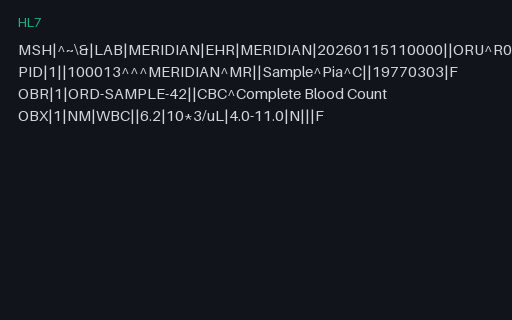
- hl7HL7 v2 — ORU-R01 SAMPLEShort synthetic HL7 v2 ORU-R01 message — fictional SAMPLE demographics for parser tests.
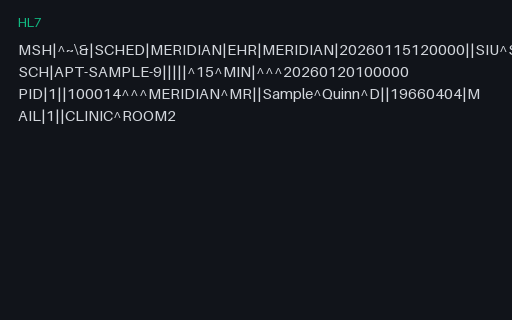
- hl7HL7 v2 — SIU-S12 SAMPLEShort synthetic HL7 v2 SIU-S12 message — fictional SAMPLE demographics for parser tests.
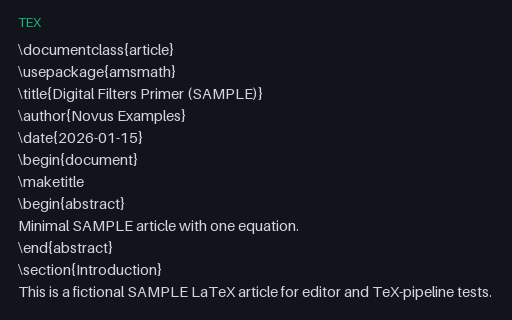
- texLaTeX Article — Digital Filters Primer (.tex)SAMPLE LaTeX article “Digital Filters Primer” with abstract, equation, and \cite to a twin .bib.
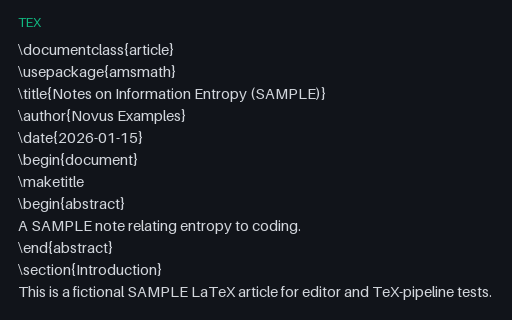
- texLaTeX Article — Notes on Information Entropy (.tex)SAMPLE LaTeX article “Notes on Information Entropy” with abstract, equation, and \cite to a twin .bib.
Generated by generation/docs_wave_e.py. Free for any use, no attribution required, license.