
Harbour Kitchen Group: GST/HST return workings
GST/HST return workings for Harbour Kitchen Group. Every source record behind the return: 56 sales rows tagged to line 105 and 24 purchase rows tagged to line 108, 80 rows in all. Taxing each row and adding gives 3407.94 and 255.23, which are 0.12 and -0.02 away from the 3407.82 and 255.25 on the return, because the return taxes the period total once and this file taxes every row and then adds.
csv
text/csv
- Document Set
- tax
- Industry
- retail
- Source Kit
- retail-commerce
- Entity
- Harbour Kitchen Group
- Synthetic
- true
- As Of
- 2026-09-08
Binary csv: no in-browser preview. Download it above to open in a compatible application.
Specifications
- Document Set
- tax
- Industry
- retail
- Source Kit
- retail-commerce
- Entity
- Harbour Kitchen Group
- Synthetic
- true
- As Of
- 2026-09-08
- Rows
- 80
- Sales Rows
- 56
- Purchase Rows
- 24
- Per Row Line105
- 3407.94
- Return Line105
- 3407.82
- Per Row Line108
- 255.23
- Return Line108
- 255.25
- Rounding Order
- return rounds once on the period total
Testing contract
Expected to pass- Scenario
- Group by return_line, sum tax_cad and compare with the return.
- Expected result
- Line 105 comes to 3407.94 per row against 3407.82 on the return, and line 108 to 255.23 against 255.25. The differences are pure rounding order: rounding each of 80 rows and adding is not the same as adding first and rounding once, and the return states which it does.
What is a .csv file?
CSV (Comma-Separated Values) is a plain-text tabular format where rows are lines and fields are separated by commas, with quoting rules for values that contain delimiters, quotes, or newlines. It has no formal type system and depends on encoding and dialect conventions. It is the most portable format for tabular data exchange.
How to use this file
Use an example CSV to test parsers against quoting and embedded-delimiter edge cases, header handling, encoding detection, and import pipelines into databases or spreadsheets.
How to use this file for testing
“Harbour Kitchen Group: GST/HST return workings” is a deterministic Novus Examples fixture for Data import, CSV parsing. Realistic faker-generated datasets with documented schemas for testing import and ETL flows.
Documented properties for this file: 80 rows. Compare results against paired or grouped companions on this page when present (clean↔damaged, searchable↔scanned, or format twins) so scores stay reproducible across runs.
Download the file once, keep the path stable in CI or local scripts, and treat the spec table as the contract: dimensions, seeds, field lists, and roles are intentional. Corrupt or invalid samples are labelled as such, expect parsers to fail loudly rather than silently accept them.
Data fixtures document their exact quirks (delimiters, encodings, null handling, schema, and row counts) in the spec table. Point your parser or importer at the file and assert it handles the documented edge cases; clean and deliberately-messy siblings make before/after diffs straightforward.
Code examples
import pandas as pd

df = pd.read_csv("gst-hst-workings.csv")
print(df.head())
print(df.dtypes)
Related files
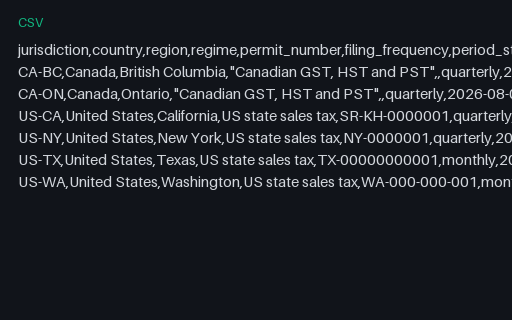
- csvFieldnote Supply Shop: Sales tax filing worksheetSales tax filing worksheet for Fieldnote Supply Shop. The 6 jurisdictions this shop collected in during 2026-08-01 to 2026-08-31, taken to the point of remittance. Net tax due sums to 88.88 USD, exactly the figure the wave-one tax-summary.csv reaches by a different route; two jurisdictions allow a vendor collection discount, which takes 0.13 off, so 88.75 USD is actually remitted. 2 rows have an empty permit_number because the two Canadian jurisdictions are filed on the GST/HST return instead.
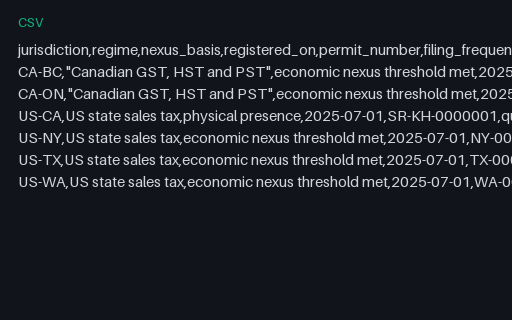
- csvFieldnote Supply Shop: Sales tax nexus summarySales tax nexus summary for Fieldnote Supply Shop. Why the shop is registered in each of the 6 jurisdictions, with the permit, the filing frequency and the next due date. Due dates range from 2026-09-20 to 2026-10-31, so a reader that assumes one filing calendar across a multi-state seller gets four of the six wrong.
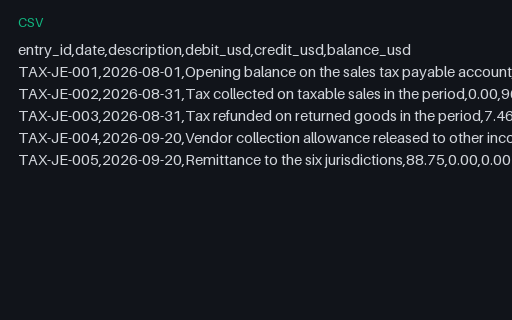
- csvFieldnote Supply Shop: Sales tax payable control accountSales tax payable control account for Fieldnote Supply Shop. The ledger account behind the filing: opening 0.00, credited 96.34 of tax collected, debited 7.46 of tax refunded, leaving 88.88 USD payable at the end of the period. The 0.13 vendor allowance and the 88.75 remittance then clear it to exactly 0.00 on 2026-09-20. The balance after row 3 is the same number the filing worksheet reaches by summing six jurisdictions.
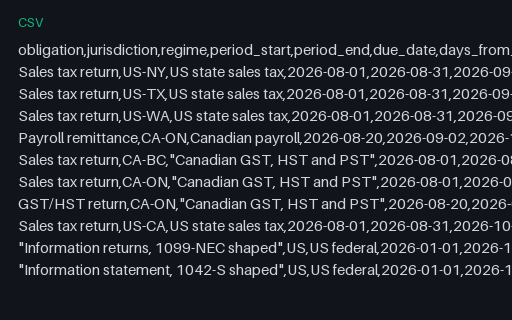
- csvFieldnote Supply Shop: Tax obligation calendarTax obligation calendar for Fieldnote Supply Shop. 10 dated obligations across four regimes and two currencies, in due date order, each with the days from the fixed snapshot and the amount due. The amount column mixes USD and CAD, so it must not be summed without the currency column: doing so gives a meaningless 10399.60.
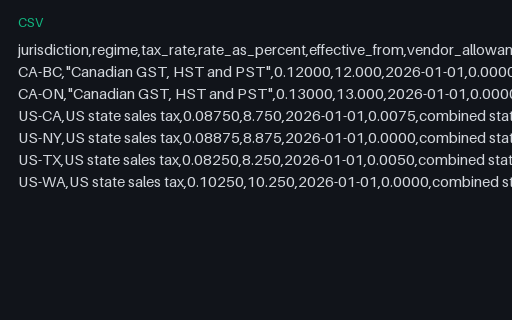
- csvFieldnote Supply Shop: Tax rate tableTax rate table for Fieldnote Supply Shop. The 6 rates as both a decimal and a percentage, so a reader can check one against the other. US-NY at 0.08875 is the one that a float round trip most often damages, and it is carried here to five decimal places and as 8.875 percent.
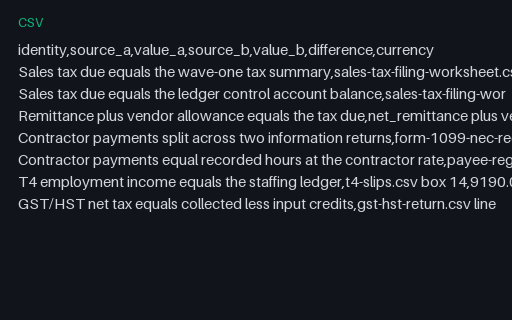
- csvFieldnote Supply Shop: Tax reconciliation, source against sourceTax reconciliation, source against source for Fieldnote Supply Shop. 7 identities stated as a pair of sources and their values, with the difference computed rather than asserted. Every difference is 0.00, and two of the rows reach across into the wave-one ecommerce set and into the crm-services model, so the file is also a cross-set consistency check.
Generated by generation/industry_documents_two.py. Free for any use, no attribution required, license.