
Pine Assembly Workshop: Bill of lading register
Bill of lading register for Pine Assembly Workshop. 4 bills of lading, one per delivery round, covering all 16 shipments and all 56 pieces. The piece counts are 8, 12, 16, 20 and they sum to 56, which is the parcels column of shipments-export.csv. Freight terms are prepaid on every round.
csv
text/csv
- Document Set
- logistics
- Industry
- logistics
- Source Kit
- inventory-manufacturing
- Synthetic
- true
- As Of
- 2026-09-08
- Rows
- 4
Binary csv: no in-browser preview. Download it above to open in a compatible application.
Specifications
- Document Set
- logistics
- Industry
- logistics
- Source Kit
- inventory-manufacturing
- Synthetic
- true
- As Of
- 2026-09-08
- Rows
- 4
- Pieces
- 56
- Weight Kg
- 683.200
- Encoding
- UTF-8
Testing contract
Expected to pass- Scenario
- Join the register to the shipment export on route_id and compare the piece counts.
- Expected result
- The 4 bills account for every shipment exactly once: the shipments column sums to 16, the pieces column to 56 and gross_weight_kg to 683.200, all matching the shipment export grouped by route.
What is a .csv file?
CSV (Comma-Separated Values) is a plain-text tabular format where rows are lines and fields are separated by commas, with quoting rules for values that contain delimiters, quotes, or newlines. It has no formal type system and depends on encoding and dialect conventions. It is the most portable format for tabular data exchange.
How to use this file
Use an example CSV to test parsers against quoting and embedded-delimiter edge cases, header handling, encoding detection, and import pipelines into databases or spreadsheets.
How to use this file for testing
“Pine Assembly Workshop: Bill of lading register” is a deterministic Novus Examples fixture for Data import. Realistic faker-generated datasets with documented schemas for testing import and ETL flows.
Documented properties for this file: 4 rows · UTF-8. Compare results against paired or grouped companions on this page when present (clean↔damaged, searchable↔scanned, or format twins) so scores stay reproducible across runs.
Download the file once, keep the path stable in CI or local scripts, and treat the spec table as the contract: dimensions, seeds, field lists, and roles are intentional. Corrupt or invalid samples are labelled as such, expect parsers to fail loudly rather than silently accept them.
Data fixtures document their exact quirks (delimiters, encodings, null handling, schema, and row counts) in the spec table. Point your parser or importer at the file and assert it handles the documented edge cases; clean and deliberately-messy siblings make before/after diffs straightforward.
Code examples
import pandas as pd

df = pd.read_csv("bill-of-lading-register.csv")
print(df.head())
print(df.dtypes)
Related files
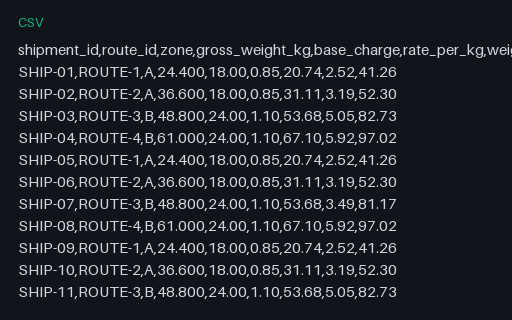
- csvPine Assembly Workshop: Carrier invoice whose fuel surcharge uses the wrong basis on one lineCarrier invoice whose fuel surcharge uses the wrong basis on one line for Pine Assembly Workshop. The 13 billable shipments with a TOTAL row. Every line is correct except SHIP-07, whose fuel_surcharge was computed on the weight charge alone: 53.68 times 0.065 gives 3.49 instead of 5.05 on the base plus weight charge. The line is 1.56 light and the TOTAL row reads 859.63 against the correct 861.19.
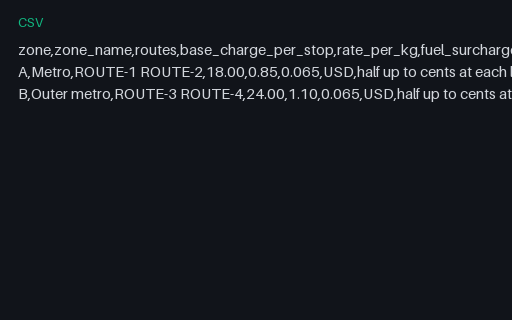
- csvPine Assembly Workshop: Carrier rate sheetCarrier rate sheet for Pine Assembly Workshop. Two delivery zones. Zone A covers ROUTE-1 ROUTE-2 at 18.00 per stop plus 0.85 per kg; zone B covers ROUTE-3 ROUTE-4 at 24.00 per stop plus 1.10 per kg. A fuel surcharge of 0.065 applies to the base plus the weight charge, and every line rounds half up to cents.
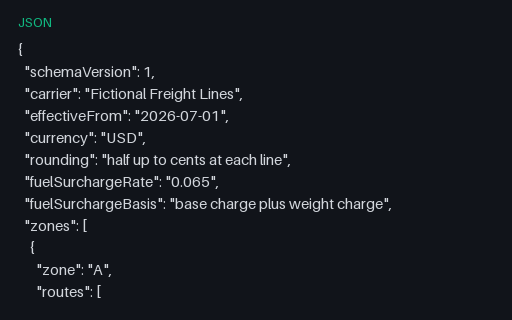
- jsonPine Assembly Workshop: Carrier rate sheet JSONCarrier rate sheet JSON for Pine Assembly Workshop. The same two zones as rate-sheet.csv with the rating formula written out as a string, including the fact that the fuel surcharge applies to the base charge as well as the weight charge. That basis is the one most often got wrong.
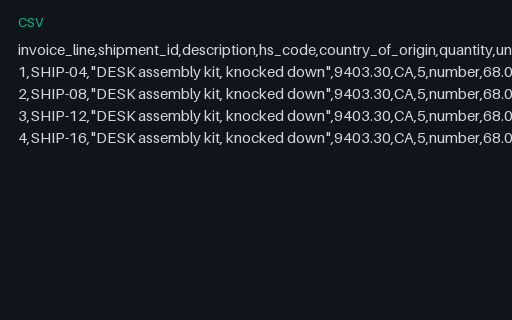
- csvPine Assembly Workshop: Customs commercial invoice linesCustoms commercial invoice lines for Pine Assembly Workshop. 4 invoice lines covering the 20 kits on BOL-2026-0004, all classified under HS 9403.30 with country of origin CA. amount_usd equals quantity times unit_price_usd on every line and the column sums to 1360.00; net weight sums to 226.880 kg and gross to 244.000 kg, the difference being the packaging.
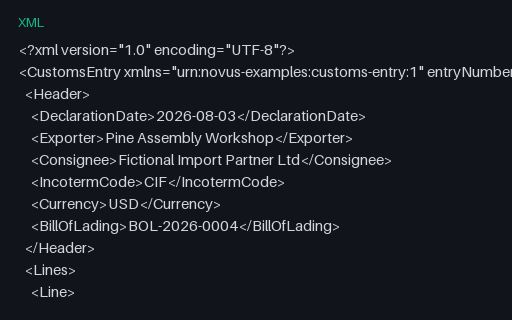
- xmlPine Assembly Workshop: Customs entry XMLCustoms entry XML for Pine Assembly Workshop. An import entry for the BOL-2026-0004 consignment on a CIF basis. Goods 1360.00 plus freight 388.08 gives a customs value of 1748.08; duty at 0.025 is 43.70 and import tax at 0.050 on the customs value plus duty is 89.59, a total payable of 133.29. The statistical breakdown restates the 226.880 kg across the three component codes.
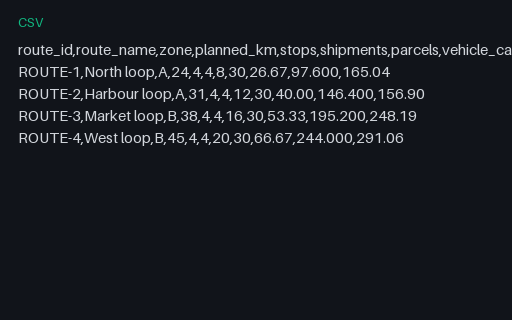
- csvPine Assembly Workshop: Delivery route plan and capacityDelivery route plan and capacity for Pine Assembly Workshop. 4 rounds with 4 stops each. Parcels per round are 8, 12, 16, 20 against a vehicle capacity of 30 parcels, so capacity_used_percent runs from 26.67 to 66.67 and no round is over capacity. freight_charged_usd counts only delivered shipments and sums to 861.19.
Generated by generation/industry_documents.py. Free for any use, no attribution required, license.