
Fieldnote Supply Shop: Chargeback evidence index
Chargeback evidence index for Fieldnote Supply Shop. 8 evidence items with the file and record each one points at and what it proves. Seven of the eight resolve into the wave-one ecommerce document set by filename and record identifier, so the packet is not a self-contained story but a set of pointers that either resolve or do not.
csv
text/csv
- Document Set
- banking
- Industry
- finance
- Source Kit
- accounting-reconciliation
- Entity
- Fieldnote Supply Shop
- Synthetic
- true
- As Of
- 2026-09-08
Binary csv: no in-browser preview. Download it above to open in a compatible application.
Specifications
- Document Set
- banking
- Industry
- finance
- Source Kit
- accounting-reconciliation
- Entity
- Fieldnote Supply Shop
- Synthetic
- true
- As Of
- 2026-09-08
- Rows
- 8
- Cross Set References
- 7
- Unresolved References
- 0
Testing contract
Expected to pass- Scenario
- Open each source_file in the named set and find the source_record.
- Expected result
- All seven wave-one references resolve: ORD-006 in the order export, its two line identifiers in the line export, the capture line in the settlement, SHP-2026-0006 in the shipping manifest, CUS-06 in the customer export, the CA-BC row in the tax summary, and no row at all for this order in refunds.csv, which is the point of EV-06.
What is a .csv file?
CSV (Comma-Separated Values) is a plain-text tabular format where rows are lines and fields are separated by commas, with quoting rules for values that contain delimiters, quotes, or newlines. It has no formal type system and depends on encoding and dialect conventions. It is the most portable format for tabular data exchange.
How to use this file
Use an example CSV to test parsers against quoting and embedded-delimiter edge cases, header handling, encoding detection, and import pipelines into databases or spreadsheets.
How to use this file for testing
“Fieldnote Supply Shop: Chargeback evidence index” is a deterministic Novus Examples fixture for Data import, CSV parsing. Realistic faker-generated datasets with documented schemas for testing import and ETL flows.
Documented properties for this file: 8 rows. Compare results against paired or grouped companions on this page when present (clean↔damaged, searchable↔scanned, or format twins) so scores stay reproducible across runs.
Download the file once, keep the path stable in CI or local scripts, and treat the spec table as the contract: dimensions, seeds, field lists, and roles are intentional. Corrupt or invalid samples are labelled as such, expect parsers to fail loudly rather than silently accept them.
Data fixtures document their exact quirks (delimiters, encodings, null handling, schema, and row counts) in the spec table. Point your parser or importer at the file and assert it handles the documented edge cases; clean and deliberately-messy siblings make before/after diffs straightforward.
Code examples
import pandas as pd

df = pd.read_csv("chargeback-evidence-index.csv")
print(df.head())
print(df.dtypes)
Related files
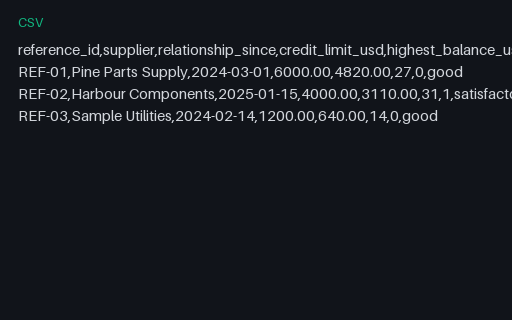
- csvAlder Books Reconciliation: Trade credit referencesTrade credit references for Alder Books Reconciliation. 3 trade references with credit limits, highest balance reached and average days to pay. Every highest_balance_usd is below its own credit_limit_usd, so a utilisation check passes on all three, and the two supplier names are the suppliers the inventory-manufacturing model actually buys from.
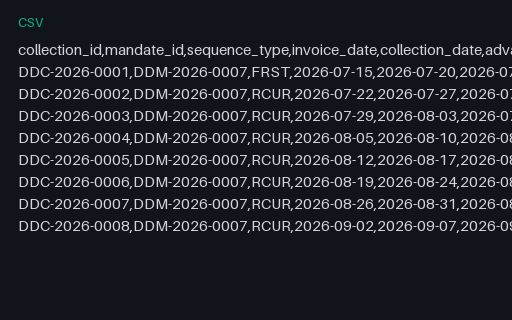
- csvHarbour Kitchen Group: Direct debit collection scheduleDirect debit collection schedule for Harbour Kitchen Group. 8 collections under mandate DDM-2026-0007, each 5 days after its invoice date with advance notice three days before that. The amounts are the supplier invoice totals the restaurant purchase ledger holds and sum to 4,077.58 CAD. The first collection carries sequence type FRST and the other 7 carry RCUR, which is the distinction a scheme rejects a file for getting wrong.
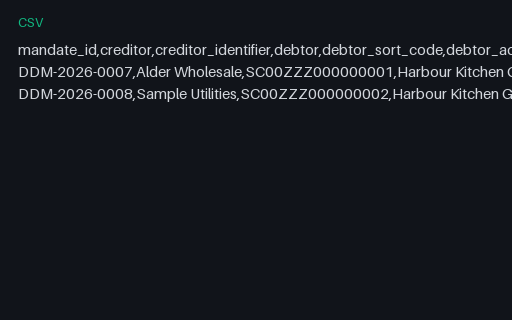
- csvHarbour Kitchen Group: Direct debit mandate registerDirect debit mandate register for Harbour Kitchen Group. Two mandates for the same debtor account, one active and one cancelled. The active mandate has taken 8 of its 8 collections by the 2026-09-08 snapshot, 4,077.58 CAD of the 4,077.58 authorised. The cancelled mandate still shows the three collections it took before it was cancelled, because cancelling a mandate does not reverse what it already collected.
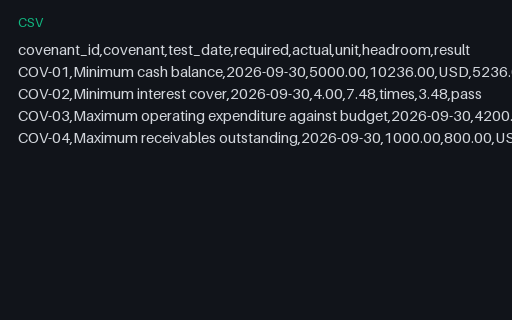
- csvPine Assembly Workshop: Covenant test scheduleCovenant test schedule for Pine Assembly Workshop. The 4 covenant tests as data, with required, actual and headroom in their own columns and a unit column, because two of the four are money and one is a ratio. Headroom is signed in the direction of compliance, so a minimum covenant and a maximum covenant both show positive headroom when they pass.
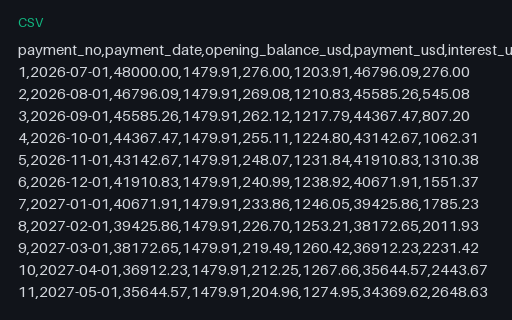
- csvPine Assembly Workshop: Loan amortisation scheduleLoan amortisation schedule for Pine Assembly Workshop. 36 rows with opening balance, payment, interest, capital, closing balance and cumulative interest. Payment equals interest plus capital and closing equals opening less capital on every row. The closing balance on row 36 is exactly 0.00 because the final payment is adjusted to 1479.81, and cumulative interest ends at 5276.66 USD.
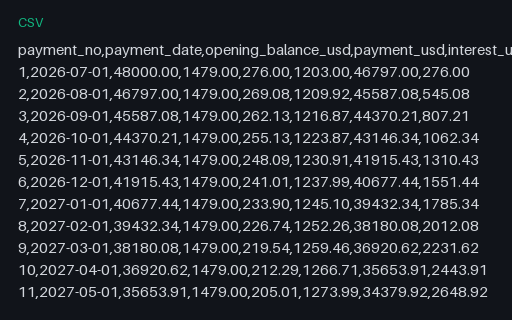
- csvPine Assembly Workshop: Loan amortisation schedule whose final balance does not reach zeroLoan amortisation schedule whose final balance does not reach zero for Pine Assembly Workshop. The same 36 months with one number changed: the instalment is 1479.00, the correct 1479.91 rounded down to whole dollars. Every row still satisfies payment equals interest plus capital and closing equals opening less capital, but after the last payment the borrower still owes 36.15 USD instead of 0.00. Cumulative interest ends at 5280.15, which is 3.49 more than the correct schedule, because the balance falls more slowly.
Generated by generation/industry_documents_two.py. Free for any use, no attribution required, license.