Skip to content
Novus Examples

Food Service · Synthetic business data

Copper Oven Bakery

A fictional bakery with eight weeks of comparable supplier purchases, recipe planning, stock balances, menu sales and guest feedback.

ZIP with instructions and SHA-256 checksums. Files stay in your browser.

Create from this data

Choose a starting template, then follow its table and field mapping. Studio imports add a table to your project; they do not automatically replace the template’s sample content.

Guided source import

Inspect and edit the source data

Source table: purchases in the linked operating model.

purchase_id
purchase_id
ingredient_id
ingredient_id
quantity
quantity
unit_price
unit_price
total_price
total_price
  1. Open the linked operating model in the text and data editor. Find tables.purchases.rows to inspect the records and exact field names.
  2. Keep identifiers as quoted text, retain the other tables and compare edits with the linked schema and expected results. Save a local copy before changing records.

Guided source import

Purchasing report

Source table: purchases in the linked operating model.

purchase_id
purchase_id
ingredient_id
ingredient_id
quantity
quantity
unit_price
unit_price
total_price
total_price
  1. Download operating-model.json, then open this Document Studio template. Choose Import business data, select the JSON file, choose purchases in Business data table and click Use table.
  2. The import appends a new typed table with all source columns. Use the listed fields for your report, edit its heading and remove unrelated sample blocks. Transfer any values needed by the original template into its fields explicitly; imported records do not replace or bind its sample line items.
  3. Save editable source to preserve the document project. Use the kit workbook in a spreadsheet application when you need its existing formulas, worksheets and chart layout.

Starts with this kit’s data

Bakery menu

Source table: menu in the linked operating model.

name
Item
price
Price (CAD)
  1. This visual starts from Copper Oven Bakery data. Open the template and select its business-table layer to edit the existing data-driven composition.
  2. Map menu.name to Item and menu.price to Price (CAD), keeping their row order. Edit the existing menu table cells to change prices in the composition.
  3. To inspect a changed source file inside Visual Studio, choose Import business data, select operating-model.json, choose menu and click Use table. This adds a separate table layer. It does not overwrite the composed menu or chart; transfer the listed fields to that layer explicitly and remove the temporary imported layer when finished.

Start with blank input tables

The ZIP contains a header-only CSV for every source table. Fill the fields using the kit schema, then open the CSV in the text and data editor or import it into a Studio. Open the completed operating workbook in a spreadsheet application to retain its native worksheets, formulas and chart layout.

Download blank CSV templates

Start with the expected results

Read the kit guide, follow each input’s import order, then compare your output with the reconciliation checks. Planning datasets do not imply that a platform can import them.

Platform compatibility

Specification validated

Novus Restaurant purchases

Profile 2026-09-08.1 · reviewed 2026-09-08 · CA

  1. Use the purchase file or the first worksheet of operations.xlsx.
  2. Review the mapping and confirm rights in the import form.

Only purchase rows are imported. Location IDs are not preserved.

Application persistence and duplicate-replay expectations still require an account-level test.

Evidence: Novus importer parser

Specification validated

Novus Restaurant reviews

Profile 2026-09-08.1 · reviewed 2026-09-08 · CA

  1. Use reviews.csv in the review importer.

Ratings must be explicitly numeric in these fixtures. Current importer coercion treats some missing numeric values as zero.

Evidence: Novus importer parser

Manual entry / planning

Restaurant planning tables

Profile 2026-09-08.1 · reviewed 2026-09-08

  1. Read the guide before transcribing menu and recipe data.

No current menu, recipe, inventory, sales or chart-file importer.

Inputs, templates and references

Input · 104 KB · Valid

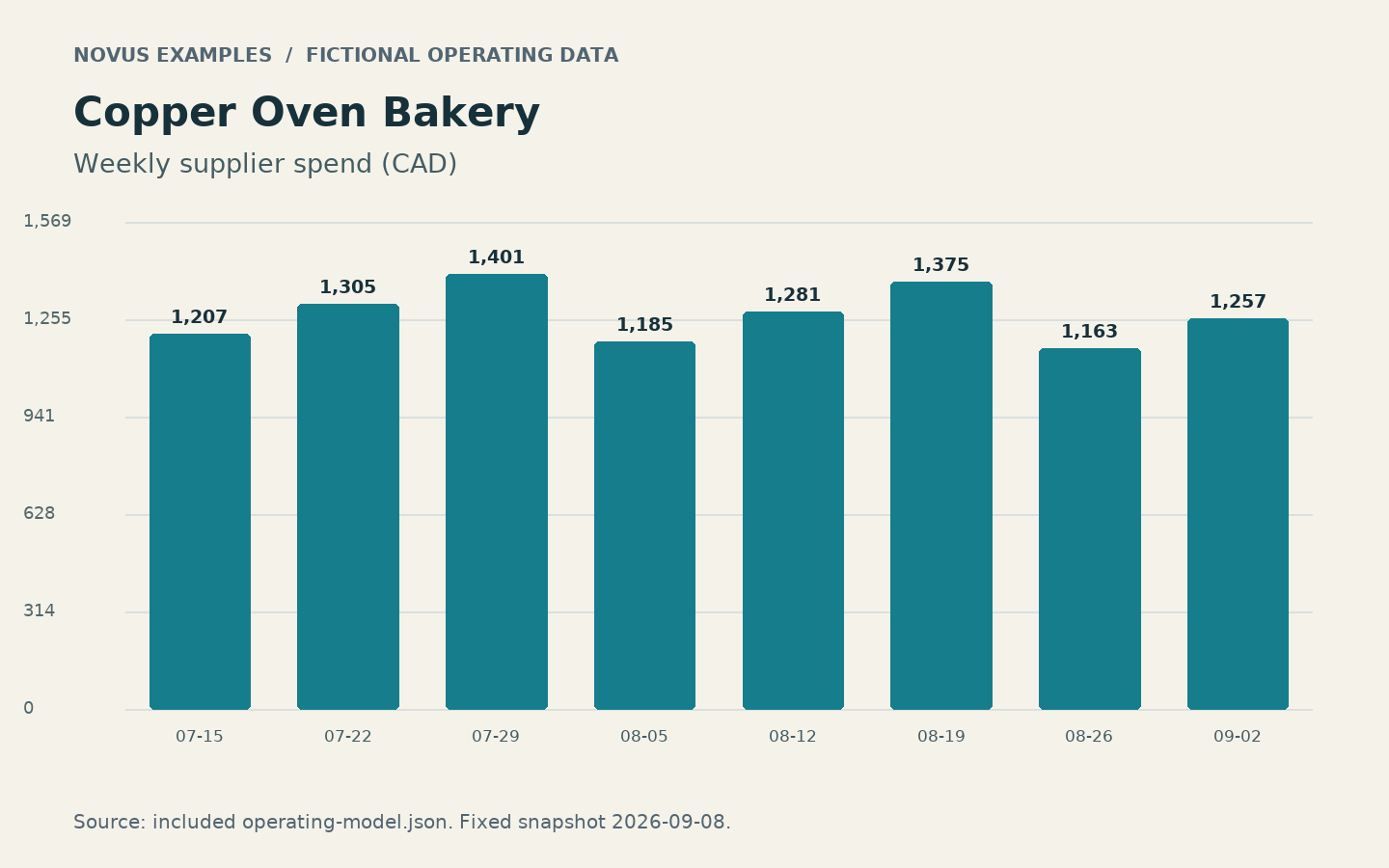
368 records across 18 linked tables; no duplicate primary keys or missing references. Supplier spend=10,172.83 CAD; Net menu sales=6,651.14 CAD; Menu items sold=1,316.00 items; Guest reviews=18.00 records.

Schema · 39.3 KB · Reference

Draft 2020-12 schema accepts the paired operating model. Relational rules additionally require unique keys and existing foreign references.

Expected Results · 3.7 KB · Reference

Exact table counts, metric formulas, 8 chart points and three negative-test outcomes. Supplier spend=10,172.83 CAD; Net menu sales=6,651.14 CAD; Menu items sold=1,316.00 items; Guest reviews=18.00 records.

Reference · 60.3 KB · Valid

Three readable pages summarize the same model, chart, source tables and usage instructions. Supplier spend=10,172.83 CAD; Net menu sales=6,651.14 CAD; Menu items sold=1,316.00 items; Guest reviews=18.00 records.

Template · 58.3 KB · Valid

Native sheets preserve 368 source records, 4 calculated headline metrics and one editable chart. Supplier spend=10,172.83 CAD; Net menu sales=6,651.14 CAD; Menu items sold=1,316.00 items; Guest reviews=18.00 records. The first worksheet holds 96 compatible purchase rows.

Deliberately invalid tests