
7z - Password Protected
A password-protected 7z archive (AES-256, encrypted header). The password is “novus-example” — printed here on purpose so you can test encrypted-archive extraction. Contains only harmless sample text.
7z
application/x-7z-compressed
- Format
- 7z (AES-256)
- Members
- 3
- Encryption
- AES-256, encrypted header
- Password
- novus-example
Binary 7z — no in-browser preview. Download it above to open in a compatible application.
Specifications
- Format
- 7z (AES-256)
- Members
- 3
- Encryption
- AES-256, encrypted header
- Password
- novus-example
What is a .7z file?
7z is the native archive format of 7-Zip, supporting high-ratio LZMA and LZMA2 compression, strong AES-256 encryption, and solid compression across multiple files. It bundles many files with a flexible header and typically outperforms ZIP on compression. It is popular for efficient archiving and distribution.
How to use this file
Use an example 7z to test 7-Zip-compatible extraction, LZMA decoding, solid-archive and multi-volume handling, and optional encrypted-archive support.
How to use this file for testing
“7z - Password Protected” is a deterministic Novus Examples fixture for Conversion testing. The same content exported across many formats and linked as a group, so you can convert one and diff against the expected twin.
Documented properties for this file: 7z (AES-256). Compare results against paired or grouped companions on this page when present (clean↔damaged, searchable↔scanned, or format twins) so scores stay reproducible across runs.
Download the file once, keep the path stable in CI or local scripts, and treat the spec table as the contract: dimensions, seeds, field lists, and roles are intentional. Corrupt or invalid samples are labelled as such — expect parsers to fail loudly rather than silently accept them.
Archive fixtures are documented down to their member list (shown on this page) and are deliberately safe — no zip bombs, executables, or hidden payloads. Test extractors against nested, unicode, empty, and encrypted variants.
Related files
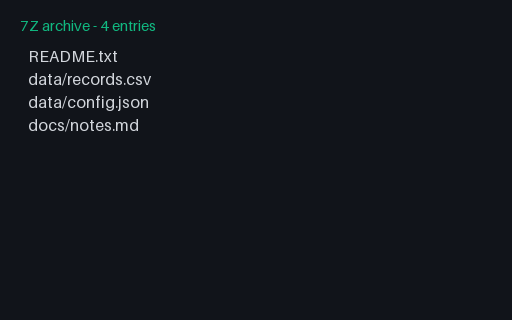
- 7z7z - LZMA2 ArchiveA 7-Zip archive using LZMA2 compression, containing a small documented file tree. For testing 7z extraction and conversion.
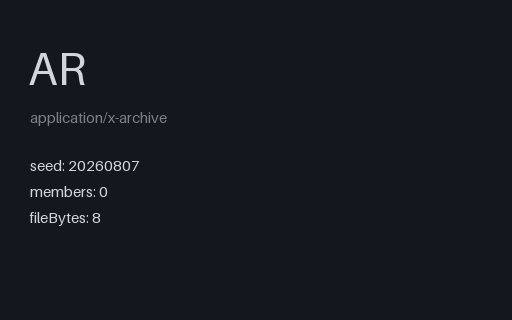
- arAR - Empty Archive (magic only)The smallest valid archive in this catalog: the 8-byte ar magic and nothing after it. ar has no trailer record, so end-of-file is the only end marker, and this is what an empty static library or an empty .deb control archive looks like on disk.
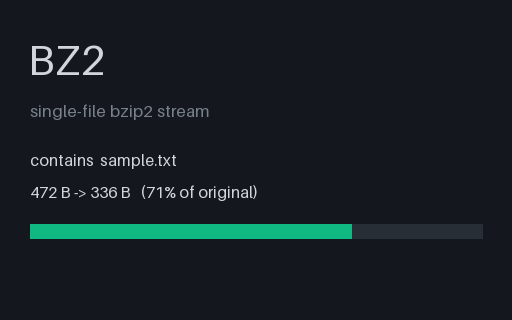
- bz2BZ2 - Bzip2 Single FileA single text file compressed with bzip2 — the container-free codec on its own, for testing decompression and codec detection.
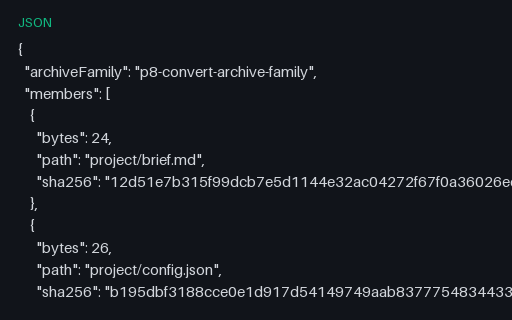
- jsonConvert v2 Archive Member ManifestJSON ground-truth manifest for the canonical compressed-TAR twins, publishing each safe path, byte count, and full SHA-256 digest. Stable P8 artifact p8-convert-archive-member-manifest.
- txtConvert v2 Archive SHA-256 ListGNU-style SHA-256 list for the two canonical TAR members, preserving relative paths and full lowercase digests. Stable P8 artifact p8-convert-archive-sha256.
- zipConvert v2 Archive-Media ZIP ControlExisting-format ZIP/TXT media control combining a plain README and a WebVTT sidecar for nested media extraction checks Stable P8 artifact p8-convert-legacy-archive-media-control.

Generated by generation/archives.py. Free for any use, no attribution required — license.