
GDPR Preferences (TOML, SAMPLE)
SAMPLE consent/preferences TOML for privacy-export parsers.
# SAMPLE subject preferences — fictional
[subject]
id = "usr_sample_002"
email = "casey.ng@example.com"

[consents]
marketing = false
analytics = true
essential = true
updated_at = "2026-01-05T00:00:00Z"
Specifications
- Format
- toml
- Note
- fictional SAMPLE
Testing contract
Reference control- Scenario
- Exercise GDPR Preferences (TOML, SAMPLE) in its exports workflow. SAMPLE consent/preferences TOML for privacy-export parsers.
- Expected result
- 10 text lines, decoded as UTF-8; first nonempty line is '# SAMPLE subject preferences — fictional'.
What is a .toml file?
TOML (Tom's Obvious Minimal Language) is a configuration format designed to be unambiguous and easy to read, with typed values, sections in bracketed tables, and clear date and number handling. It maps cleanly to hash tables. It is widely used for application and package configuration, such as Rust's Cargo and Python's pyproject.
How to use this file
Use an example TOML file to test config parsers, typed-value and table handling, and tools that read project or application settings.
How to use this file for testing
“GDPR Preferences (TOML, SAMPLE)” is a deterministic Novus Examples fixture for Privacy export testing, Editor testing. Sample subject-access ZIP packages, DPA/consent templates, and fictional PII, for testing privacy-export parsers and consent UX tooling.
Documented properties for this file: toml. Compare results against paired or grouped companions on this page when present (clean↔damaged, searchable↔scanned, or format twins) so scores stay reproducible across runs.
Download the file once, keep the path stable in CI or local scripts, and treat the spec table as the contract: dimensions, seeds, field lists, and roles are intentional. Corrupt or invalid samples are labelled as such, expect parsers to fail loudly rather than silently accept them.
Archive fixtures are documented down to their member list (shown on this page) and are deliberately safe, no zip bombs, executables, or hidden payloads. Test extractors against nested, unicode, empty, and encrypted variants.
Code examples
import tomllib

with open("gdpr-preferences.toml", "rb") as f:
    data = tomllib.load(f)
print(data)
Related files
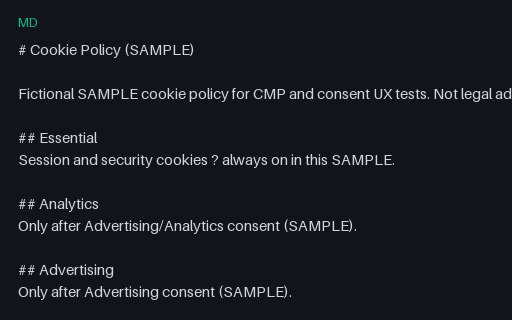
- mdCookie Policy (Markdown, SAMPLE)Fictional SAMPLE cookie policy for CMP and consent UX tests.
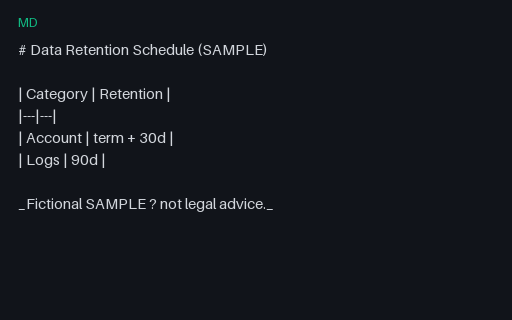
- mdData Retention Schedule (Markdown, SAMPLE)Fictional SAMPLE data retention schedule Markdown for privacy/security document tooling.
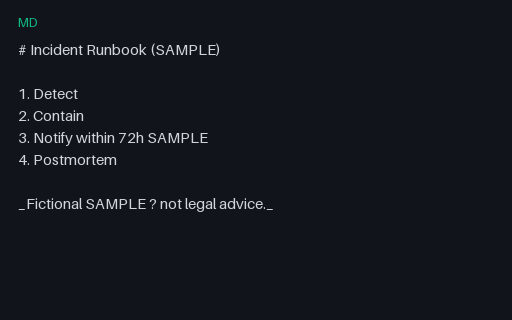
- mdIncident Runbook (Markdown, SAMPLE)Fictional SAMPLE incident runbook Markdown for privacy/security document tooling.
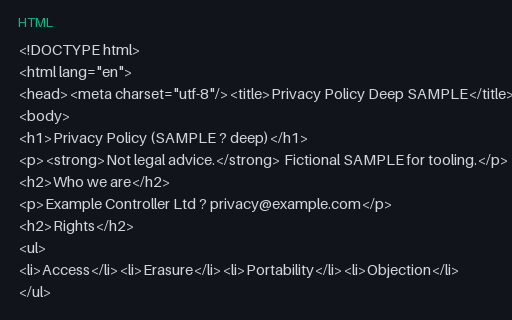
- htmlPrivacy Policy Deep (HTML, SAMPLE)HTML twin of the deep SAMPLE privacy policy.
- mdPrivacy Policy Deep (Markdown, SAMPLE)Deeper SAMPLE privacy policy in Markdown with purposes table and rights — not legal advice.
- mdPrivacy Policy Template (Markdown, SAMPLE)A short fictional privacy policy in Markdown — for template and content-pipeline tests.
Generated by generation/residuals_wave_h.py. Free for any use, no attribution required, license.