
Well-Known — Related Website Set
.well-known SAMPLE JSON (related-website-set) for crawler and client discovery tests.
{
  "primary": "https://sample.example",
  "associatedSites": [
    "https://shop.sample.example"
  ],
  "sample": true
}
Specifications
- Wave
- I
- Role
- well-known
Testing contract
Expected to pass- Scenario
- Exercise Well-Known — Related Website Set in its well known workflow. .well-known SAMPLE JSON (related-website-set) for crawler and client discovery tests.
- Expected result
- top-level keys are primary, associatedSites, sample; array lengths: associatedSites=1; selected values: {"sample": true}. Declared feature checks: role=well-known.
What is a .json file?
JSON (JavaScript Object Notation) is a lightweight, text-based data-interchange format representing objects, arrays, strings, numbers, booleans, and null. It is language-independent, human-readable, and the dominant format for web APIs and configuration. It requires a single well-formed root value.
How to use this file
Use an example JSON file to test parsers and serializers, schema validation, Unicode and number-precision handling, and API request or response processing.
How to use this file for testing
“Well-Known — Related Website Set” is a deterministic Novus Examples fixture for Web assets, JSON parsing. Favicons, web app manifests, service workers, robots and sitemap files, Open Graph images, and .well-known resources, for testing web tooling, crawlers, PWA installers, and asset pipelines.
Documented properties for this file: well-known. Compare results against paired or grouped companions on this page when present (clean↔damaged, searchable↔scanned, or format twins) so scores stay reproducible across runs.
Download the file once, keep the path stable in CI or local scripts, and treat the spec table as the contract: dimensions, seeds, field lists, and roles are intentional. Corrupt or invalid samples are labelled as such, expect parsers to fail loudly rather than silently accept them.
Web-platform fixtures are standards-compliant samples against fictional example.com data. Test crawlers, PWA installers and manifest validators, favicon/icon pipelines, service-worker registration, or .well-known parsers against the documented structure.
Code examples
import json

with open("related-website-set.json") as f:
    data = json.load(f)
print(type(data), len(data))
Related files
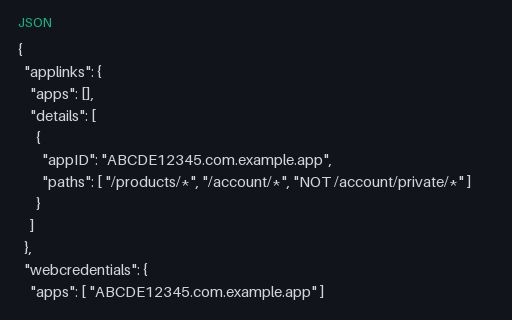
- jsonapple-app-site-associationAn Apple app-site-association file declaring Universal Links, web credentials, and app clips — normally served without an extension at /.well-known/, for testing AASA parsers (shown here as .json).
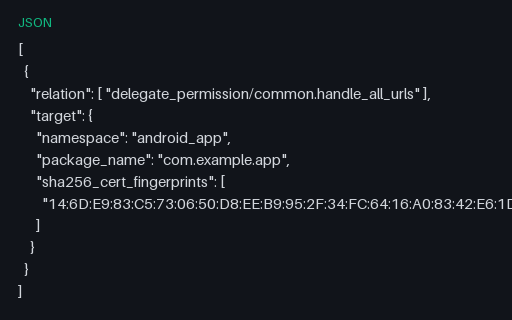
- jsonassetlinks.json (Android)An Android Digital Asset Links file granting app-link handling to a package via a certificate fingerprint (sample) — for testing assetlinks.json parsers and App Links verification.
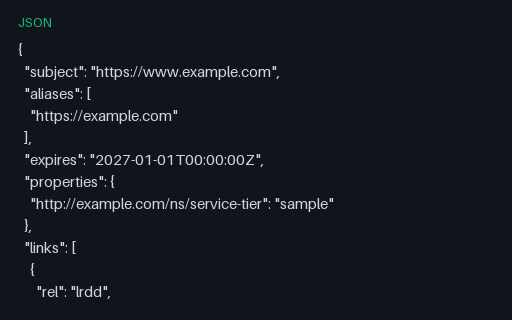
- jsonhost-meta.json (JRD, JSON form)The JSON Resource Descriptor twin of the XRD host-meta: identical subject, alias, expiry, property and three links, expressed with lower-case JSON member names. For testing XRD-to-JRD conversion against a known answer.
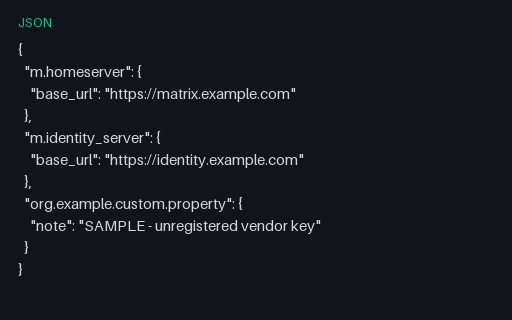
- jsonMatrix client discovery (m.homeserver)The client-side twin of the Matrix delegation pair: homeserver and identity server base URLs plus an unregistered vendor key, which clients must carry through rather than reject. For testing discovery and unknown-member tolerance.
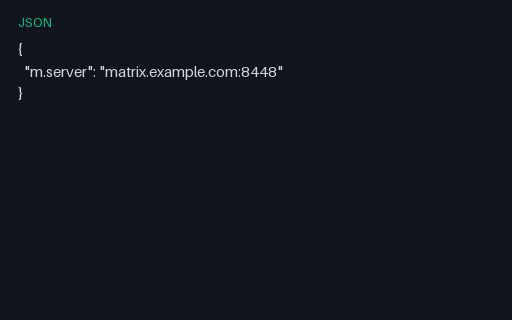
- jsonMatrix server delegation (m.server)The one-member server-delegation document that lets example.com host its Matrix homeserver at matrix.example.com:8448 without changing user IDs. For testing federation discovery and explicit-port handling.
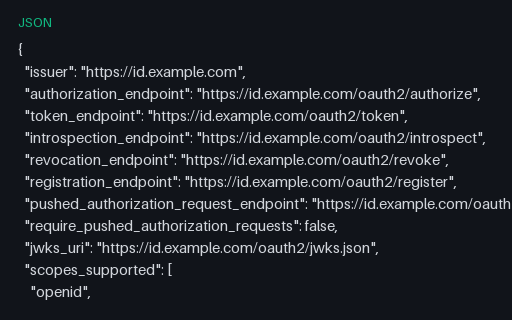
- jsonoauth-authorization-server metadata (RFC 8414)A fully populated RFC 8414 authorization-server metadata document for a fictional issuer: seven endpoints including PAR, introspection and dynamic registration, PKCE and DPoP algorithm lists, and policy URIs. Distinct from the minimal OpenID configuration already in this category.
Generated by generation/pad_wave_i.py. Free for any use, no attribution required, license.