
HTML hreflang cluster, German page
The German member of the same cluster, with lang="de" on the html element and the identical alternate block. For testing that an audit compares the annotation set rather than the document language, and that the two agree.
<!DOCTYPE html>
<html lang="de">
<head>
<meta charset="utf-8">
<meta name="viewport" content="width=device-width, initial-scale=1">
<title>Wanderstiefel | Example</title>
<link rel="canonical" href="https://www.example.com/de/katalog/stiefel">
<link rel="alternate" hreflang="en" href="https://www.example.com/catalog/boots">
<link rel="alternate" hreflang="de" href="https://www.example.com/de/katalog/stiefel">
<link rel="alternate" hreflang="fr-CA" href="https://www.example.com/fr-ca/catalogue/bottes">
<link rel="alternate" hreflang="x-default" href="https://www.example.com/catalog/boots">
</head>
<body>
<h1>Wanderstiefel</h1>
<p>Beispielseite mit erfundenen Produktdaten.</p>
</body>
</html>
Specifications
- Seed
- 70400
- Site
- example.com (fictional)
- Format
- HTML5 head fixture
- Encoding
- UTF-8
- Alternates
- 4
- Html Lang
- de
- Self Reference
- true
- Reciprocal
- true
Testing contract
Expected to pass- Scenario
- Compare the html lang attribute with the hreflang annotations on the same page.
- Expected result
- lang="de" matches the page's own hreflang="de" alternate, all four return tags resolve, and no mismatch between declared document language and annotation is reported.
What is a .html file?
HTML (HyperText Markup Language) is the structural markup language of the web, using nested tags to define document content, semantics, and links. It is typically paired with CSS for presentation and JavaScript for behavior. It is the foundational format rendered by browsers.
How to use this file
Use an example HTML file to test parsers, DOM construction, sanitization of untrusted markup, and rendering or scraping pipelines.
How to use this file for testing
“HTML hreflang cluster, German page” is a deterministic Novus Examples fixture for Web assets, HTML parsing, Internationalization. Favicons, web app manifests, service workers, robots and sitemap files, Open Graph images, and .well-known resources — for testing web tooling, crawlers, PWA installers, and asset pipelines.
Documented properties for this file: seed 70400 · UTF-8 · HTML5 head fixture. Compare results against paired or grouped companions on this page when present (clean↔damaged, searchable↔scanned, or format twins) so scores stay reproducible across runs.
Download the file once, keep the path stable in CI or local scripts, and treat the spec table as the contract: dimensions, seeds, field lists, and roles are intentional. Corrupt or invalid samples are labelled as such — expect parsers to fail loudly rather than silently accept them.
Web-platform fixtures are standards-compliant samples against fictional example.com data. Test crawlers, PWA installers and manifest validators, favicon/icon pipelines, service-worker registration, or .well-known parsers against the documented structure.
Related files
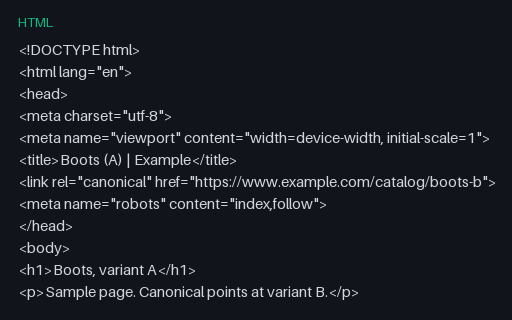
- htmlHTML canonical loop, page A (deliberately invalid)Page A of a deliberately invalid two-page canonical loop: A declares B canonical while B declares A canonical, so no page in the pair is its own canonical. For testing that a crawler detects the cycle instead of following it forever.
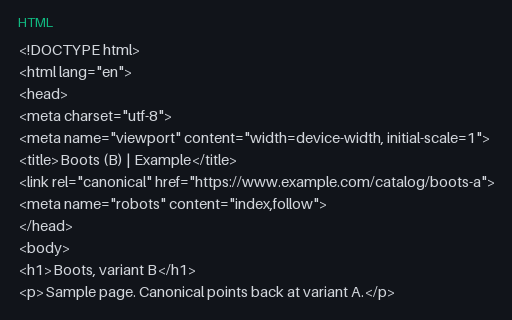
- htmlHTML canonical loop, page B (deliberately invalid)Page B of the deliberately invalid canonical loop, closing the cycle by naming page A as its canonical. Ships with page A so the loop can actually be traversed rather than described.
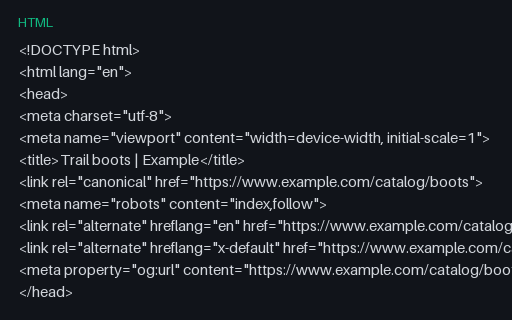
- htmlHTML head with a self-referential canonicalThe baseline every canonical audit should pass: one self-referential canonical, an indexable robots meta, matching hreflang self-reference and an og:url that agrees with all of them. For use as the comparison reference against the conflicting pages in this set.
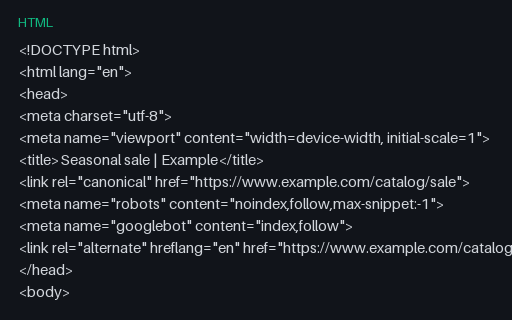
- htmlHTML where canonical and robots noindex conflictA page that names itself canonical while telling robots not to index it, and then contradicts that again with an agent-specific googlebot meta that permits indexing. For testing directive precedence when a page argues with itself.
- htmlHTML with three conflicting canonical tags (deliberately invalid)A deliberately invalid page carrying two canonical tags in the head and a third in the body. Search engines ignore body-level canonicals entirely and treat multiple head-level ones as a conflict. For testing that an extractor reports position as well as value.
- htmlHTML Bidi — dir=auto, <bdi> and a scoped <bdo>The HTML half of bidi handling: paragraphs with dir=ltr, dir=rtl and dir=auto, the same user-supplied string with and without a <bdi> wrapper, one balanced <bdo> showing display override scoped to a single element, and explicit RLM/FSI marks inside markup. No scripts and no external resources.
Generated by generation/web_p7.py. Free for any use, no attribution required — license.