
Cedar Street Tacos: Recipe costing workbook with live formulas
Recipe costing workbook with live formulas for Cedar Street Tacos. Four sheets. Ingredients converts 6 purchase packs to a cost per recipe unit; PlateCosts holds 18 recipe lines; Summary uses SUMIF to roll each dish up and computes margin and food-cost percent; Notes records the provenance. Exactly 91 cells are live formulas with no cached value, so a values-only reader sees them empty and a recalculating reader reproduces plate-costs.csv exactly.
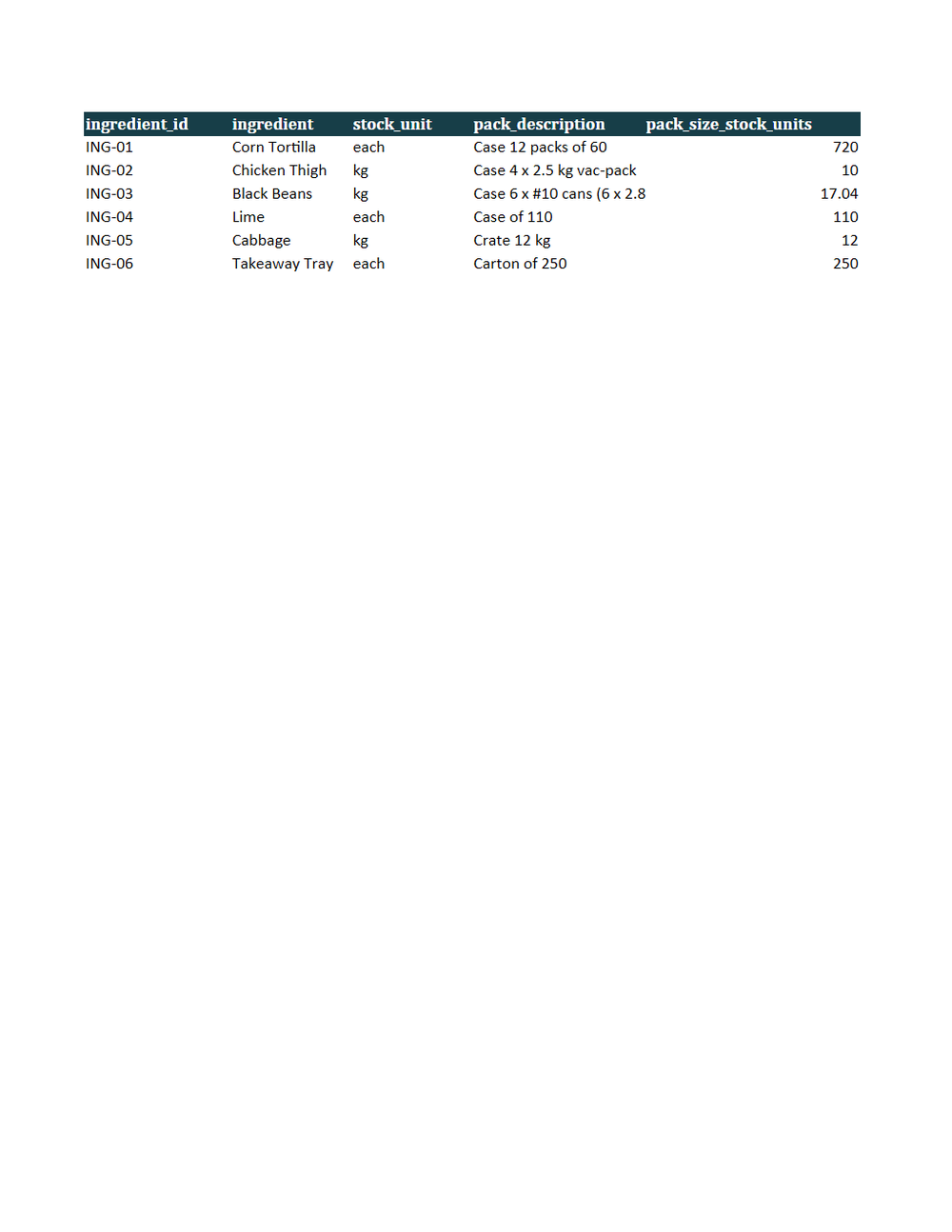
Rendered preview of the xlsx file (9.8 KB). Download above for the original.
Specifications
- Kit
- restaurant-food-truck
- Industry
- food-service
- Schema Version
- 1
- Synthetic
- true
- As Of
- 2026-09-08
- Currency
- CAD
- Period Start
- 2026-08-20
- Period End
- 2026-09-02
- Sheets
- 4
- Charts
- 0
- Recipe Lines
- 18
- Formula Cells
- 91
- Cached Values
- false
Testing contract
Expected to pass- Scenario
- Use recipe costing workbook with live formulas in the Cedar Street Tacos costing and daily operations workflow.
- Expected result
- Four sheets. Ingredients converts 6 purchase packs to a cost per recipe unit; PlateCosts holds 18 recipe lines; Summary uses SUMIF to roll each dish up and computes margin and food-cost percent; Notes records the provenance. Exactly 91 cells are live formulas with no cached value, so a values-only reader sees them empty and a recalculating reader reproduces plate-costs.csv exactly.
What is a .xlsx file?
XLSX is the default Microsoft Excel format, an Office Open XML spreadsheet stored as a ZIP archive containing worksheet XML, shared strings, styles, and formulas. It supports multiple sheets, cell formatting, charts, and calculated values. It is the standard for editable tabular workbooks.
How to use this file
Use an example XLSX to test spreadsheet parsing, formula and multi-sheet handling, shared-string extraction, and pipelines that read or generate Excel workbooks.
How to use this file for testing
“Cedar Street Tacos: Recipe costing workbook with live formulas” is a deterministic Novus Examples fixture for Spreadsheet testing, Data import. Multi-sheet workbooks with documented formulas and plain sheets for testing spreadsheet parsers and importers.
Documented properties for this file: 4 sheets. Compare results against paired or grouped companions on this page when present (clean↔damaged, searchable↔scanned, or format twins) so scores stay reproducible across runs.
Download the file once, keep the path stable in CI or local scripts, and treat the spec table as the contract: dimensions, seeds, field lists, and roles are intentional. Corrupt or invalid samples are labelled as such, expect parsers to fail loudly rather than silently accept them.
This template ships filled with realistic sample content and documented fields and formulas. Download it as a starting point, or point a converter/parser at it, format twins (for example DOCX↔PDF) let you diff conversion fidelity.
Code examples
from openpyxl import load_workbook

wb = load_workbook("recipe-costing.xlsx")
ws = wb.active
print(ws.title, ws.max_row, ws.max_column)
Related files
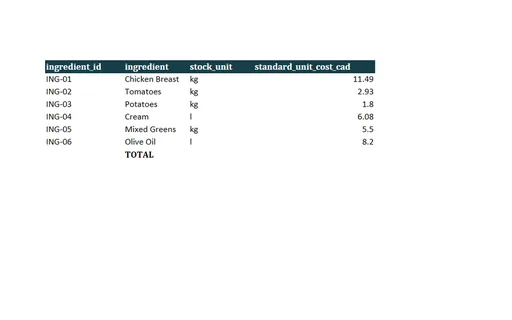
- xlsxAlder Table Bistro: Cost of goods sold workbook with live formulasCost of goods sold workbook with live formulas for Alder Table Bistro. Four sheets. COGS computes opening plus purchases less closing for 6 ingredients; Reconciliation proves the identity usage and waste at standard, plus the purchase price variance, less the count variance, equals the reported figure; Summary lands on 1574.81 CAD against 15780.80 CAD of net menu sales, a food cost of 9.98 percent. The purchases line is the sum of the 24 shared purchase rows dated inside 2026-08-20 to 2026-09-02.
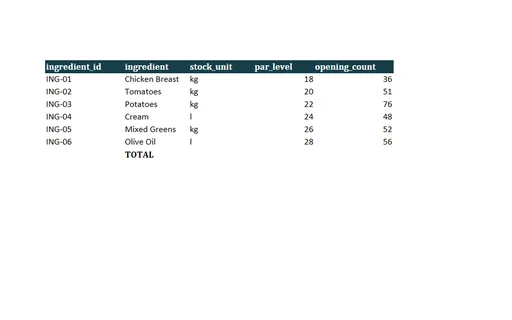
- xlsxAlder Table Bistro: Inventory variance workbook with live formulasInventory variance workbook with live formulas for Alder Table Bistro. 6 ingredients over two sheets. Theoretical closing, the variance quantity, the variance priced at standard cost, the below-par flag and the total are formulas. Theoretical usage is built from the sales table multiplied by the yield-adjusted recipe quantities, so it already carries the yield adjustment.
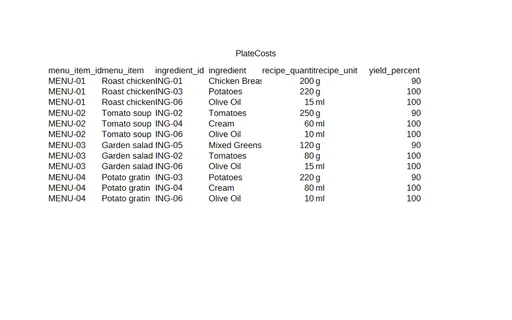
- odsAlder Table Bistro: Recipe costing as an OpenDocument spreadsheetRecipe costing as an OpenDocument spreadsheet for Alder Table Bistro. Three tables. PlateCosts holds 12 recipe lines with the as-purchased quantity and line cost as live ODF formulas; Summary rolls each dish up with SUMIF and computes margin and food-cost percent. The same figures in value form are in plate-costs.csv.
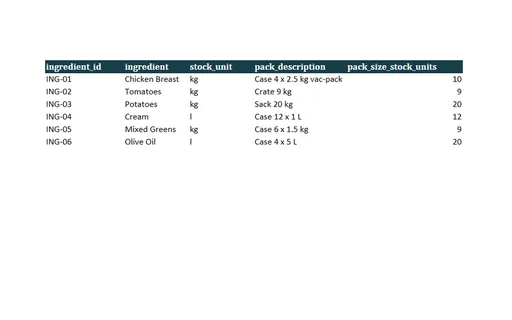
- xlsxAlder Table Bistro: Recipe costing workbook with live formulasRecipe costing workbook with live formulas for Alder Table Bistro. Four sheets. Ingredients converts 6 purchase packs to a cost per recipe unit; PlateCosts holds 12 recipe lines; Summary uses SUMIF to roll each dish up and computes margin and food-cost percent; Notes records the provenance. Exactly 73 cells are live formulas with no cached value, so a values-only reader sees them empty and a recalculating reader reproduces plate-costs.csv exactly.
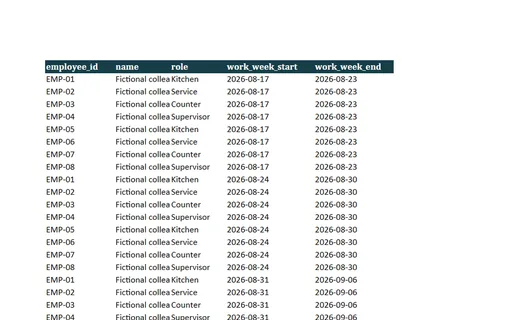
- xlsxAlder Table Bistro: Scheduled hours and overtime workbookScheduled hours and overtime workbook for Alder Table Bistro. Three sheets. WeeklyHours carries 24 employee-weeks over 3 Monday-start work weeks, with weekly overtime above 44 hours, payable overtime as the greater of the daily and weekly figures, and the premium at half the base rate. DailyHours breaks the same segments down into 59 employee-days with a daily overtime formula above 8 hours. The period carries 5.00 payable overtime hours and 51.50 CAD of premium.
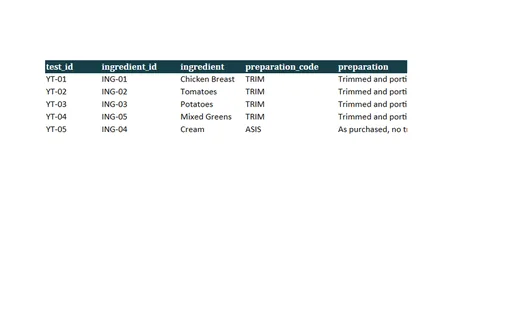
- xlsxAlder Table Bistro: Yield test workbook with live formulasYield test workbook with live formulas for Alder Table Bistro. 5 tests over two sheets. Trimmed weight, trim yield, cooking loss and the yield factor are formulas; the last column is an IF that compares the measured trim yield against the yield the recipe applies and writes yes or no.
Generated by generation/restaurant_costing.py. Free for any use, no attribution required, license.