
Corrected gettext MO — Français
GNU gettext loads all seven original translations using the declared UTF-8 charset. Message IDs are sorted, metadata occupies the empty key, Unicode survives, and the %s placeholder is retained. The corrected catalog preserves the legacy translations.
| Message IDtext | Translationtext |
|---|---|
| Cancel | Annuler |
| Hello | Bonjour |
| Log out | Déconnexion |
| Save | Enregistrer |
| Search | Rechercher |
| Settings | Paramètres |
| Welcome, %s | Bienvenue, %s |
Specifications
- Locale
- fr
- Messages
- 7
- Charset
- UTF-8
- Sorted Keys
- true
- Metadata Header
- true
- Source Id
- loc-wc-mo-fr
Testing contract
Expected to pass- Scenario
- Load the corrected compiled message catalog with GNU gettext and compare every translation and placeholder with the legacy source messages.
- Expected result
- GNU gettext loads all seven original translations using the declared UTF-8 charset. Message IDs are sorted, metadata occupies the empty key, Unicode survives, and the %s placeholder is retained. The corrected catalog preserves the legacy translations.
What is a .mo file?
A MO file (.mo, Machine Object) is the compiled binary form of a gettext PO catalog used at runtime by gettext libraries. It stores msgid/msgstr pairs in a compact hashed table for fast lookup.
How to use this file
Use an example .mo file to test gettext runtime loaders, MO parsers, and PO↔MO conversion tooling.
How to use this file for testing
“Corrected gettext MO — Français” is a deterministic Novus Examples fixture for Internationalization. Parallel text and accented, multi-script content, for testing translation pipelines, Unicode handling, and localization tooling.
Documented properties for this file: 7 messages. Compare results against paired or grouped companions on this page when present (clean↔damaged, searchable↔scanned, or format twins) so scores stay reproducible across runs.
Download the file once, keep the path stable in CI or local scripts, and treat the spec table as the contract: dimensions, seeds, field lists, and roles are intentional. Corrupt or invalid samples are labelled as such, expect parsers to fail loudly rather than silently accept them.
Translation-catalog fixtures carry the same message set across formats, each with its native placeholder syntax. Test your i18n loader, catalog converter, or translation-memory tool, and use the RTL and CJK variants to check bidirectional text and Unicode handling.
Load the catalog with your i18n framework and verify placeholder interpolation and plural handling; the RTL and CJK variants exercise bidirectional text and font fallback.
Code examples
import gettext

with open("app_fr.mo", "rb") as f:
    cat = gettext.GNUTranslations(f)
print(cat.gettext("Hello"))   # .mo is the compiled catalog
Related files
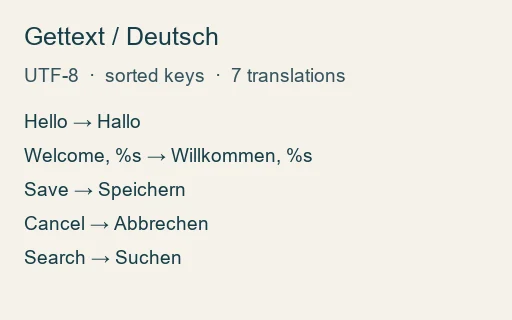
- moCorrected gettext MO — DeutschGNU gettext loads all seven original translations using the declared UTF-8 charset. Message IDs are sorted, metadata occupies the empty key, Unicode survives, and the %s placeholder is retained. The corrected catalog preserves the legacy translations.
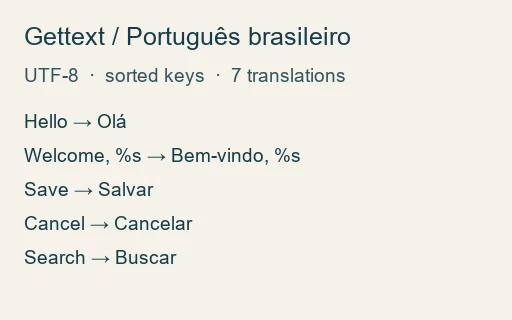
- moCorrected gettext MO — Português brasileiroGNU gettext loads all seven original translations using the declared UTF-8 charset. Message IDs are sorted, metadata occupies the empty key, Unicode survives, and the %s placeholder is retained. The corrected catalog preserves the legacy translations.
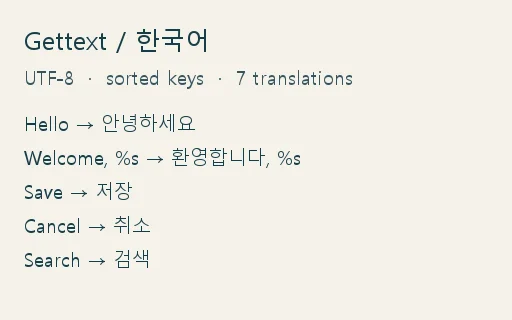
- moCorrected gettext MO — 한국어GNU gettext loads all seven original translations using the declared UTF-8 charset. Message IDs are sorted, metadata occupies the empty key, Unicode survives, and the %s placeholder is retained. The corrected catalog preserves the legacy translations.
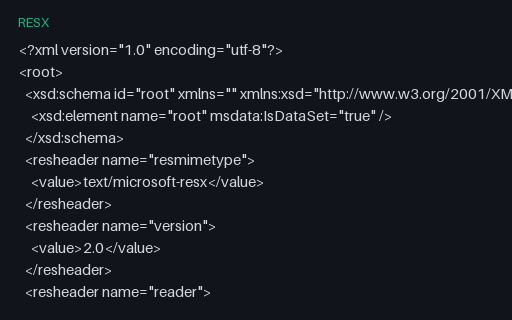
- resx.NET RESX — composite format strings (Arabic (Egypt))A Arabic (Egypt) resource file built around composite format strings — {0:N2}, {2:P1}, {0:C}, {0:d} and {0:t} — whose rendered output depends entirely on CultureInfo. Includes a whitespace-significant resource guarded by xml:space, and documents the suffixed-key convention .NET falls back on because String.Format has no plural selector.
- resx.NET RESX — composite format strings (English (United States))A English (United States) resource file built around composite format strings — {0:N2}, {2:P1}, {0:C}, {0:d} and {0:t} — whose rendered output depends entirely on CultureInfo. Includes a whitespace-significant resource guarded by xml:space, and documents the suffixed-key convention .NET falls back on because String.Format has no plural selector.
- resx.NET RESX — composite format strings (German (Germany))A German (Germany) resource file built around composite format strings — {0:N2}, {2:P1}, {0:C}, {0:d} and {0:t} — whose rendered output depends entirely on CultureInfo. Includes a whitespace-significant resource guarded by xml:space, and documents the suffixed-key convention .NET falls back on because String.Format has no plural selector.
Generated by generation/business_localization.py. Free for any use, no attribution required, license.