
Segmentation Scene 01 — Class Map (JSON)
Class-id → label map for segmentation scene 1. Ground truth companion to the RGB and mask.
{
  "0": "background-unused",
  "1": "sky",
  "2": "ground",
  "3": "object",
  "4": "accent",
  "palette": "indexed L mask; pixel value = class id",
  "seed": 1101
}
Specifications
- Role
- class labels
- Classes
- 4
- Seed
- 1101
Testing contract
Expected to pass- Scenario
- Exercise Segmentation Scene 01 — Class Map (JSON) in its seg set workflow. Class-id → label map for segmentation scene 1.
- Expected result
- top-level keys are 0, 1, 2, 3, 4, palette, seed; selected values: {"seed": 1101}. Declared feature checks: role=class labels; classes=4.
What is a .json file?
JSON (JavaScript Object Notation) is a lightweight, text-based data-interchange format representing objects, arrays, strings, numbers, booleans, and null. It is language-independent, human-readable, and the dominant format for web APIs and configuration. It requires a single well-formed root value.
How to use this file
Use an example JSON file to test parsers and serializers, schema validation, Unicode and number-precision handling, and API request or response processing.
How to use this file for testing
“Segmentation Scene 01 — Class Map (JSON)” is a deterministic Novus Examples fixture for Segmentation, Computer vision. Multi-class RGB scenes with indexed masks and class maps for semantic/instance segmentation loaders and eval harnesses.
Documented properties for this file: seed 1101 · class labels. Compare results against paired or grouped companions on this page when present (clean↔damaged, searchable↔scanned, or format twins) so scores stay reproducible across runs.
Download the file once, keep the path stable in CI or local scripts, and treat the spec table as the contract: dimensions, seeds, field lists, and roles are intentional. Corrupt or invalid samples are labelled as such, expect parsers to fail loudly rather than silently accept them.
For image AI or enhancement tools, run the model or filter on this file and diff against the clean or ground-truth companion in the same group when available. Keep seeds and documented damage parameters in your evaluation notes so regressions are attributable.
Use the RGB input with its mask or soft-alpha companion. Class IDs and edge kinds are documented in specs, score IoU or boundary error against that ground truth, not a hand label.
Code examples
import json

with open("scene-01-classes.json") as f:
    data = json.load(f)
print(type(data), len(data))
Related files
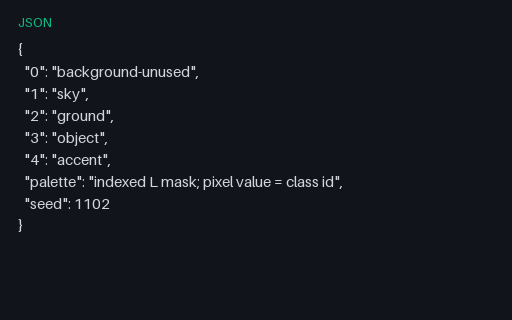
- jsonSegmentation Scene 02 — Class Map (JSON)Class-id → label map for segmentation scene 2. Ground truth companion to the RGB and mask.
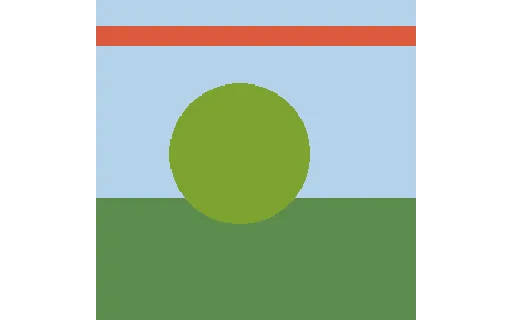
- pngSegmentation Scene 02 — Class Mask (288px)Indexed L mask for scene 2: pixel value equals class id (1=sky, 2=ground, 3=object, 4=accent).

- pngSegmentation Scene 02 — RGB (288px)Synthetic multi-class scene 2 (sky/ground/object/accent) for semantic-segmentation smoke tests. Paired with an indexed mask and class JSON.
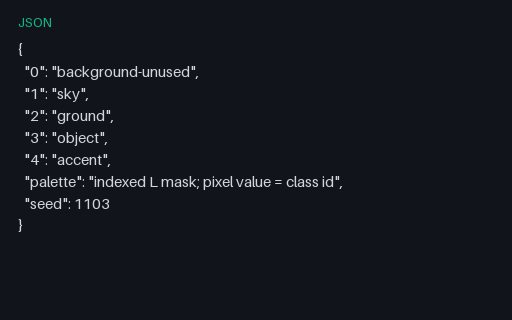
- jsonSegmentation Scene 03 — Class Map (JSON)Class-id → label map for segmentation scene 3. Ground truth companion to the RGB and mask.
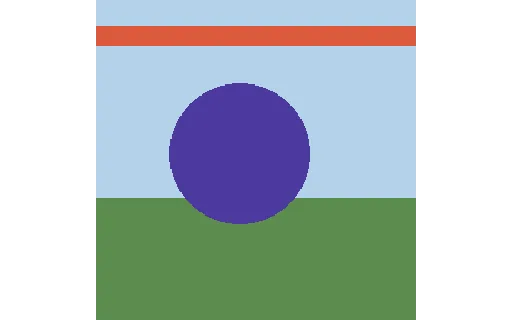
- pngSegmentation Scene 03 — Class Mask (288px)Indexed L mask for scene 3: pixel value equals class id (1=sky, 2=ground, 3=object, 4=accent).

- pngSegmentation Scene 03 — RGB (288px)Synthetic multi-class scene 3 (sky/ground/object/accent) for semantic-segmentation smoke tests. Paired with an indexed mask and class JSON.
Generated by generation/images_wave_e.py. Free for any use, no attribution required, license.