
EML — DSN Relayed SAMPLE
multipart/report delivery-status SAMPLE with action=relayed for DSN parsers.
From: Mailer-Daemon <postmaster@mail.sample.example>
To: Alex SAMPLE <alex@brightside.example>
Subject: Delivery Status Notification (relayed) SAMPLE
Date: Tue, 24 Jan 2026 08:00:00 -0800
Message-ID: <dsn-04@mail.sample.example>
MIME-Version: 1.0
Content-Type: multipart/report; report-type=delivery-status; boundary="=_wg_dsn_04"

--=_wg_dsn_04
Content-Type: text/plain; charset=utf-8

Your message to sam@meridiansupply.example: relayed.
--=_wg_dsn_04
Content-Type: message/delivery-status

Reporting-MTA: dns; mail.sample.example

Final-Recipient: rfc822; sam@meridiansupply.example
Action: relayed
Status: 2.0.0
Diagnostic-Code: smtp; SAMPLE diagnostic
--=_wg_dsn_04
Content-Type: message/rfc822

From: Alex SAMPLE <alex@brightside.example>
To: Sam Rivera <sam@meridiansupply.example>
Subject: Original SAMPLE
Message-ID: <orig-dsn-04@brightside.example>

Original SAMPLE message body.
--=_wg_dsn_04--
Specifications
- Report Type
- delivery-status
- Action
- relayed
- Wave
- G
Testing contract
Expected to pass- Scenario
- Exercise EML — DSN Relayed SAMPLE in its dsn workflow. multipart/report delivery-status SAMPLE with action=relayed for DSN parsers.
- Expected result
- subject='Delivery Status Notification (relayed) SAMPLE'; content type=multipart/report; MIME leaf parts=4. Declared feature checks: reportType=delivery-status; action=relayed.
What is a .eml file?
An EML file is a single email message stored in the RFC 822 / MIME format: plain-text headers (From, To, Subject, Date, Message-ID) followed by the body, which may be plain text, HTML, or a multipart structure with alternative bodies and file attachments encoded in base64.
How to use this file
Use an example EML to test email header parsing, MIME decoding, HTML-part handling, attachment extraction, and EML-to-other-format conversion.
How to use this file for testing
“EML — DSN Relayed SAMPLE” is a deterministic Novus Examples fixture for Email parsing, Conversion testing. Standards-compliant RFC 822 messages (plain, multipart text+HTML, and with an attachment) plus an MBOX mailbox, for testing header parsing, MIME decoding, attachment extraction, and mailbox splitting.
Documented properties for this file: EML · 906 bytes. Compare results against paired or grouped companions on this page when present (clean↔damaged, searchable↔scanned, or format twins) so scores stay reproducible across runs.
Download the file once, keep the path stable in CI or local scripts, and treat the spec table as the contract: dimensions, seeds, field lists, and roles are intentional. Corrupt or invalid samples are labelled as such, expect parsers to fail loudly rather than silently accept them.
Email fixtures use fixed dates, message IDs, and MIME boundaries so runs are reproducible, and every address is fictional. Test header parsing, MIME decoding, attachment extraction, and EML/MBOX conversion against the documented structure.
Code examples
from email import policy
from email.parser import BytesParser

msg = BytesParser(policy=policy.default).parse(open("dsn-relayed.eml", "rb"))
print(msg["subject"], msg["from"])
Related files
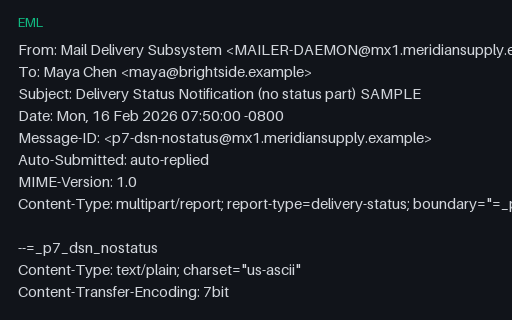
- emlEML — DSN Missing Its message/delivery-status Part (Deliberately Incomplete)A multipart/report that advertises report-type=delivery-status but is deliberately incomplete: the required message/delivery-status part is missing, leaving only human prose and the returned headers. Real MTAs emit this, and a parser must not assume the part exists.
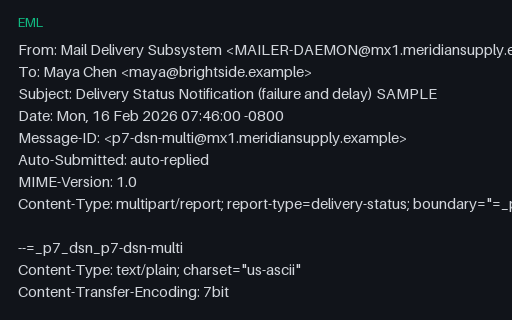
- emlEML — DSN Reporting Two Recipients With Different OutcomesOne multipart/report carrying two per-recipient blocks: a permanent 5.1.1 failure and a temporary 4.4.7 delay for the same original message. Bounce processors that read only the first block suppress a good address, or keep retrying a dead one.
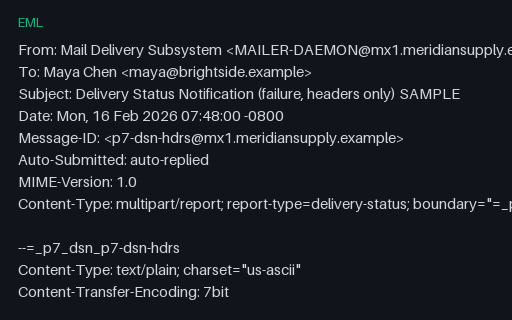
- emlEML — DSN Returning Only the Original HeadersThe same bounce as its twin, except the returned content is text/rfc822-headers — the privacy-preserving form most large providers send. A processor keyed on message/rfc822 finds nothing here and reports an un-attributable bounce.
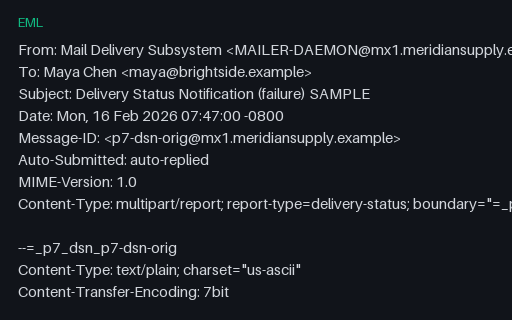
- emlEML — DSN Returning the Original Message in FullA bounce whose third part is the complete original message — headers and body — as message/rfc822. Paired with the headers-only twin beside it, it shows whether a bounce processor can recover the original Message-ID from either shape.
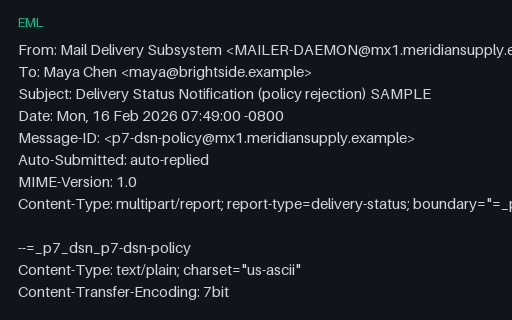
- emlEML — DSN With a 5.7.1 Policy RejectionA permanent bounce whose extended status is 5.7.1 — rejected by policy — with Remote-MTA, Original-Recipient and Last-Attempt-Date all present. Suppression lists that key on the 5.x class alone blacklist a perfectly valid address over a sender-side problem.
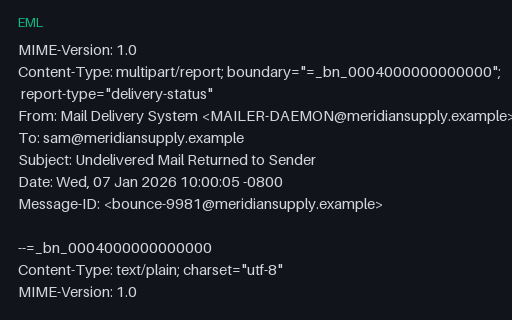
- emlBounce / Non-Delivery Report (EML)A bounce / non-delivery report (NDR) — a multipart/report message with a human-readable notice, a message/delivery-status part, and the original headers — for testing bounce parsing and delivery-status extraction.
Generated by generation/email_wave_g.py. Free for any use, no attribution required, license.