
Survey Responses — Likert + NPS (CSV, 60 rows)
A customer-survey response set — 60 respondents rating five statements on a 1–5 Likert scale plus a 0–10 NPS score and a segment. A fixture for testing survey analysis, aggregation, and NPS/CSAT calculations.
respondent_id,q1_ease,q2_value,q3_support,q4_reliability,q5_recommend,nps,segment
R0001,3,2,1,1,2,5,SMB
R0002,4,4,5,4,4,10,SMB
R0003,5,4,4,5,5,9,Enterprise
R0004,2,3,2,3,2,7,SMB
R0005,3,2,4,4,4,5,SMB
R0006,4,3,3,3,4,6,Consumer
R0007,5,5,5,4,5,10,Consumer
R0008,1,1,3,3,2,5,Enterprise
R0009,4,4,4,5,5,10,Enterprise
R0010,3,3,4,3,3,7,Enterprise
R0011,4,5,5,4,4,9,SMB
R0012,2,4,2,4,3,4,SMB
R0013,3,5,4,4,4,6,SMB
R0014,3,1,2,3,1,3,SMB
R0015,3,5,4,3,4,9,Consumer
R0016,5,5,4,5,4,10,SMB
R0017,5,5,5,4,5,10,Consumer
R0018,2,4,4,3,4,7,SMB
R0019,5,3,3,4,4,7,Enterprise
R0020,5,5,5,4,4,10,Consumer
R0021,1,3,1,1,2,4,SMB
R0022,5,4,4,5,5,10,Enterprise
R0023,1,2,3,1,2,3,SMB
R0024,4,5,5,4,4,8,Consumer
R0025,5,4,5,3,4,6,Consumer
R0026,2,3,3,2,2,5,SMB
R0027,2,4,4,3,2,7,SMB
R0028,4,4,3,5,5,9,Consumer
R0029,4,4,4,3,4,7,SMB
R0030,2,2,3,4,2,5,Enterprise
R0031,5,4,5,5,5,10,Consumer
R0032,2,2,3,2,3,4,Enterprise
R0033,3,1,1,2,3,2,SMB
R0034,4,4,4,5,5,8,Enterprise
R0035,3,1,3,3,2,5,Consumer
R0036,5,5,4,4,5,9,SMB
R0037,5,5,4,4,5,10,SMB
R0038,1,3,1,3,2,2,Consumer
R0039,2,3,4,4,2,7,Consumer
R0040,5,5,5,5,4,10,Enterprise
R0041,5,3,5,5,3,7,SMB
R0042,3,2,1,2,3,2,SMB
R0043,2,4,2,4,4,6,Consumer
R0044,3,3,1,2,2,4,Enterprise
R0045,2,2,2,3,2,3,Enterprise
R0046,4,4,5,5,5,9,Enterprise
R0047,4,2,3,2,4,4,SMB
R0048,3,5,4,3,5,6,Consumer
R0049,4,3,2,2,2,7,ConsumerSpecifications
- Rows
- 60
- Scale
- 1–5 Likert + 0–10 NPS
- Questions
- 5
- Seed
- 909
What is a .csv file?
CSV (Comma-Separated Values) is a plain-text tabular format where rows are lines and fields are separated by commas, with quoting rules for values that contain delimiters, quotes, or newlines. It has no formal type system and depends on encoding and dialect conventions. It is the most portable format for tabular data exchange.
How to use this file
Use an example CSV to test parsers against quoting and embedded-delimiter edge cases, header handling, encoding detection, and import pipelines into databases or spreadsheets.
How to use this file for testing
“Survey Responses — Likert + NPS (CSV, 60 rows)” is a deterministic Novus Examples fixture for Data import, Conversion testing, Model evaluation. Realistic faker-generated datasets with documented schemas for testing import and ETL flows.
Documented properties for this file: seed 909 · 60 rows. Compare results against paired or grouped companions on this page when present (clean↔damaged, searchable↔scanned, or format twins) so scores stay reproducible across runs.
Download the file once, keep the path stable in CI or local scripts, and treat the spec table as the contract: dimensions, seeds, field lists, and roles are intentional. Corrupt or invalid samples are labelled as such — expect parsers to fail loudly rather than silently accept them.
Data fixtures document their exact quirks — delimiters, encodings, null handling, schema, and row counts — in the spec table. Point your parser or importer at the file and assert it handles the documented edge cases; clean and deliberately-messy siblings make before/after diffs straightforward.
Code examples
import pandas as pd

df = pd.read_csv("survey-responses.csv")
print(df.head())
print(df.dtypes)
Related files
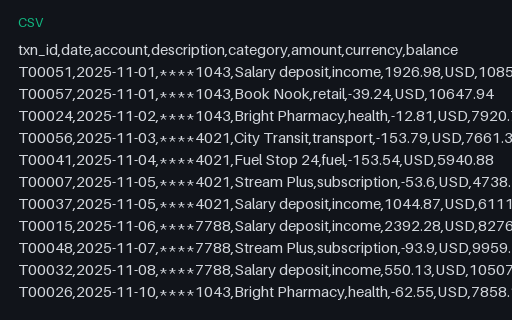
- csvBank Transactions (CSV, 60 rows)A bank-transaction statement — 60 debits and credits across three accounts (masked numbers) with running balances, categories, and merchants. Synthetic data for testing statement parsers, categorisation, and reconciliation.
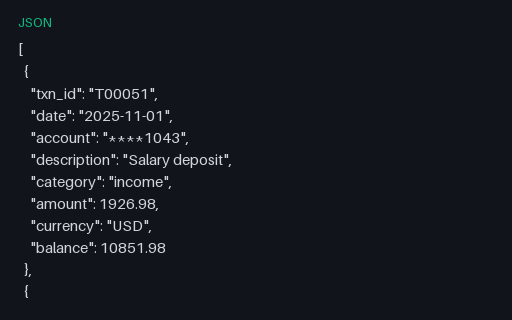
- jsonBank Transactions (JSON, 60 records)The bank transactions as a JSON array — the format twin of the CSV, for import and reconciliation testing.
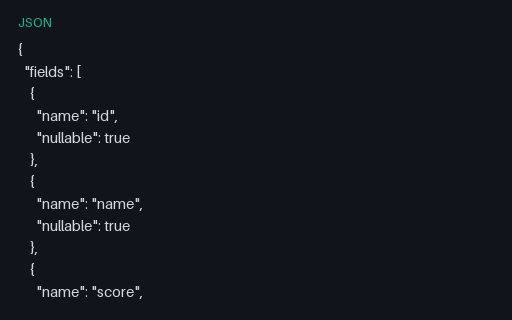
- jsonColumnar Nulls Schema (JSON)JSON description of nullable columns in the null-heavy columnar fixtures.
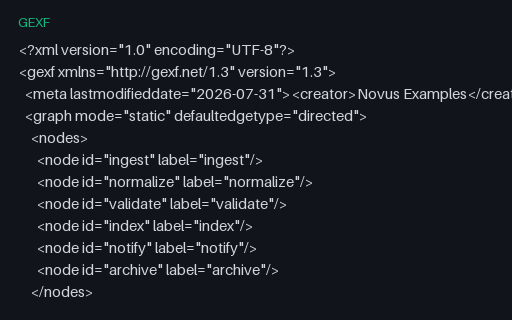
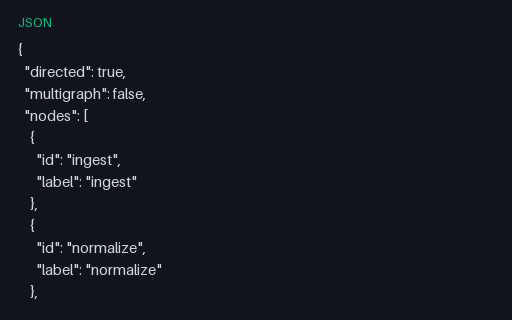
- gexfDirected Acyclic Pipeline - GEXF 1.3A six-stage software pipeline DAG for testing dependency import, cycle checks and reproducible topological sorting. This GEXF 1.3 member carries the same node IDs, edge IDs, directions and weights as its two format twins.
- graphmlDirected Acyclic Pipeline - GraphMLA six-stage software pipeline DAG for testing dependency import, cycle checks and reproducible topological sorting. This GraphML member carries the same node IDs, edge IDs, directions and weights as its two format twins.
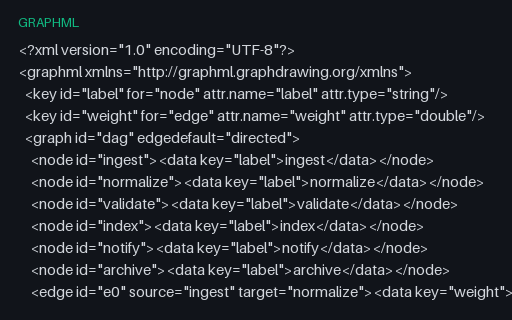
- jsonDirected Acyclic Pipeline - JSON edge listA six-stage software pipeline DAG for testing dependency import, cycle checks and reproducible topological sorting. This JSON edge list member carries the same node IDs, edge IDs, directions and weights as its two format twins.
Generated by generation/data_graphs.py. Free for any use, no attribution required — license.