
Sports Match Results (JSON)
The full round of match results behind the league table — home/away teams, scores, and dates as a JSON array. A fixture for testing sports-data importers and standings calculators.
[
  {
    "match_id": "M001",
    "date": "2026-01-11",
    "home": "Red Lions",
    "away": "Blue Hawks",
    "home_score": 4,
    "away_score": 3
  },
  {
    "match_id": "M002",
    "date": "2026-01-12",
    "home": "Red Lions",
    "away": "Green Wolves",
    "home_score": 4,
    "away_score": 2
  },
  {
    "match_id": "M003",
    "date": "2026-01-13",
    "home": "Red Lions",
    "away": "Gold Eagles",
    "home_score": 1,
    "away_score": 2
  },
  {
    "match_id": "M004",
    "date": "2026-01-14",
    "home": "Red Lions",
    "away": "Silver Sharks",
    "home_score": 0,
    "away_score": 2
  },
  {
    "match_id": "M005",
    "date": "2026-01-15",
    "home": "Red Lions",
    "away": "Black Bears",
    "home_score": 3,
    "away_score": 3
  },
  {
    "match_id": "M006",
    "date": "2026-01-16",
    "home": "Red Lions",
    "away": "White Tigers",
    "home_score": 1,
    "away_score": 2
  },
{Specifications
- Matches
- 45
- Schema
- match_id, date, home, away, home_score, away_score
- Domain
- sports
What is a .json file?
JSON (JavaScript Object Notation) is a lightweight, text-based data-interchange format representing objects, arrays, strings, numbers, booleans, and null. It is language-independent, human-readable, and the dominant format for web APIs and configuration. It requires a single well-formed root value.
How to use this file
Use an example JSON file to test parsers and serializers, schema validation, Unicode and number-precision handling, and API request or response processing.
How to use this file for testing
“Sports Match Results (JSON)” is a deterministic Novus Examples fixture for Data import, Conversion testing. Realistic faker-generated datasets with documented schemas for testing import and ETL flows.
Documented properties for this file: schema: match_id, date, home, away, home_score, away_score. Compare results against paired or grouped companions on this page when present (clean↔damaged, searchable↔scanned, or format twins) so scores stay reproducible across runs.
Download the file once, keep the path stable in CI or local scripts, and treat the spec table as the contract: dimensions, seeds, field lists, and roles are intentional. Corrupt or invalid samples are labelled as such — expect parsers to fail loudly rather than silently accept them.
Data fixtures document their exact quirks — delimiters, encodings, null handling, schema, and row counts — in the spec table. Point your parser or importer at the file and assert it handles the documented edge cases; clean and deliberately-messy siblings make before/after diffs straightforward.
Code examples
import json

with open("results.json") as f:
    data = json.load(f)
print(type(data), len(data))
Related files
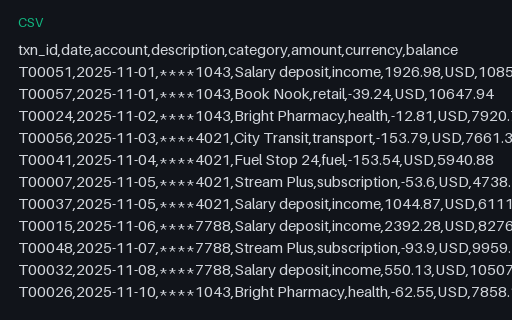
- csvBank Transactions (CSV, 60 rows)A bank-transaction statement — 60 debits and credits across three accounts (masked numbers) with running balances, categories, and merchants. Synthetic data for testing statement parsers, categorisation, and reconciliation.
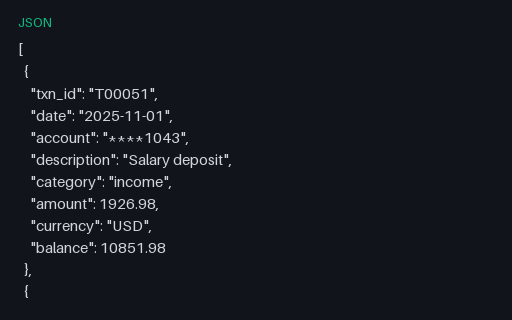
- jsonBank Transactions (JSON, 60 records)The bank transactions as a JSON array — the format twin of the CSV, for import and reconciliation testing.
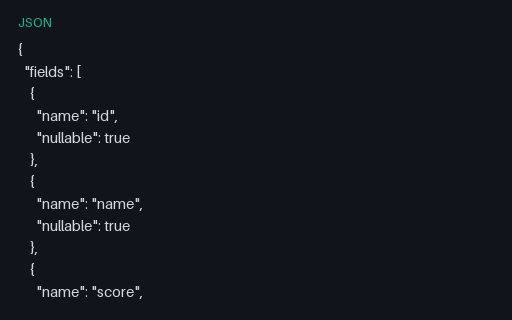
- jsonColumnar Nulls Schema (JSON)JSON description of nullable columns in the null-heavy columnar fixtures.
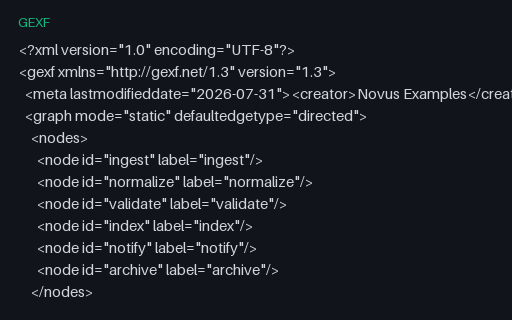
- gexfDirected Acyclic Pipeline - GEXF 1.3A six-stage software pipeline DAG for testing dependency import, cycle checks and reproducible topological sorting. This GEXF 1.3 member carries the same node IDs, edge IDs, directions and weights as its two format twins.
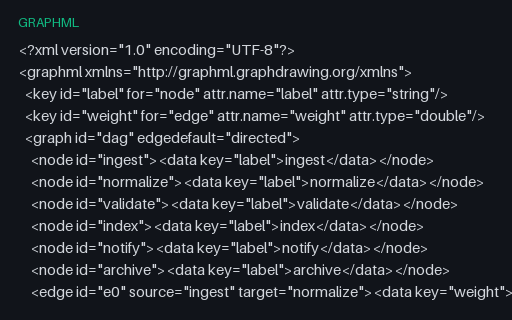
- graphmlDirected Acyclic Pipeline - GraphMLA six-stage software pipeline DAG for testing dependency import, cycle checks and reproducible topological sorting. This GraphML member carries the same node IDs, edge IDs, directions and weights as its two format twins.
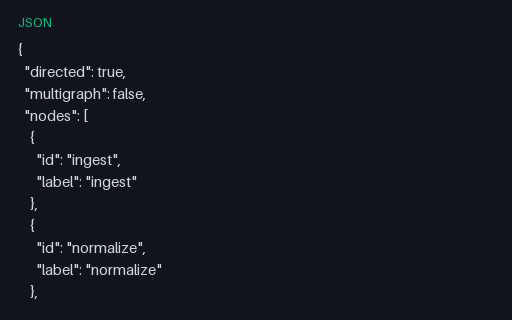
- jsonDirected Acyclic Pipeline - JSON edge listA six-stage software pipeline DAG for testing dependency import, cycle checks and reproducible topological sorting. This JSON edge list member carries the same node IDs, edge IDs, directions and weights as its two format twins.
Generated by generation/data_domains.py. Free for any use, no attribution required — license.