
Homophone stress: ladder answer key
Machine-readable description of all 16 variants in this group: the file, the kind of damage, the measured parameters that produced it and what each one is expected to demonstrate. Provided so a test suite can walk the ladder programmatically instead of hard-coding filenames.
json
application/json
- Utterance
- homophone-stress
- Voice
- bm_lewis
- Speech Rate
- 1
- Synthetic
- true
- Disclosure
- Synthetic speech. Generated locally with a text-to-speech model from an authored script; not a recording of a real person, and no real customer, order or incident is described.
- Schema Version
- 1
Binary json: no in-browser preview. Download it above to open in a compatible application.
Specifications
- Utterance
- homophone-stress
- Voice
- bm_lewis
- Speech Rate
- 1
- Synthetic
- true
- Disclosure
- Synthetic speech. Generated locally with a text-to-speech model from an authored script; not a recording of a real person, and no real customer, order or incident is described.
- Schema Version
- 1
- Role
- answer-key
- Variants
- 16
Testing contract
Expected to pass- Scenario
- Decode this variant and the clean plate in the same group, then measure the difference against the parameters recorded in its specs.
- Expected result
- It decodes to the same duration as the plate and differs from it by exactly what was applied: the parameters in its specs. The degradation was APPLIED rather than estimated, so the figure in the specs is the true answer and not a second measurement of it.
What is a .json file?
JSON (JavaScript Object Notation) is a lightweight, text-based data-interchange format representing objects, arrays, strings, numbers, booleans, and null. It is language-independent, human-readable, and the dominant format for web APIs and configuration. It requires a single well-formed root value.
How to use this file
Use an example JSON file to test parsers and serializers, schema validation, Unicode and number-precision handling, and API request or response processing.
How to use this file for testing
“Homophone stress: ladder answer key” is a deterministic Novus Examples fixture for ASR testing, JSON parsing. Short synthetic digit/tone utterances with transcript JSON and clean↔noise pairs, for testing ASR loaders, WER harnesses, and audio preprocessing.
Documented properties for this file: answer-key. Compare results against paired or grouped companions on this page when present (clean↔damaged, searchable↔scanned, or format twins) so scores stay reproducible across runs.
Download the file once, keep the path stable in CI or local scripts, and treat the spec table as the contract: dimensions, seeds, field lists, and roles are intentional. Corrupt or invalid samples are labelled as such, expect parsers to fail loudly rather than silently accept them.
Data fixtures document their exact quirks (delimiters, encodings, null handling, schema, and row counts) in the spec table. Point your parser or importer at the file and assert it handles the documented edge cases; clean and deliberately-messy siblings make before/after diffs straightforward.
Run ASR on the clip and score the transcript against the documented ground-truth script; clips are short, synthetic, and read from a fixed word or digit sequence.
Code examples
import json

with open("index.json") as f:
    data = json.load(f)
print(type(data), len(data))
Related files
- jsonComplaint call: ladder answer keyMachine-readable description of all 16 variants in this group: the file, the kind of damage, the measured parameters that produced it and what each one is expected to demonstrate. Provided so a test suite can walk the ladder programmatically instead of hard-coding filenames.
- jsonCost podcast: ladder answer keyMachine-readable description of all 16 variants in this group: the file, the kind of damage, the measured parameters that produced it and what each one is expected to demonstrate. Provided so a test suite can walk the ladder programmatically instead of hard-coding filenames.
- jsonDelivery driver: ladder answer keyMachine-readable description of all 16 variants in this group: the file, the kind of damage, the measured parameters that produced it and what each one is expected to demonstrate. Provided so a test suite can walk the ladder programmatically instead of hard-coding filenames.
- jsonHaccp training: ladder answer keyMachine-readable description of all 16 variants in this group: the file, the kind of damage, the measured parameters that produced it and what each one is expected to demonstrate. Provided so a test suite can walk the ladder programmatically instead of hard-coding filenames.
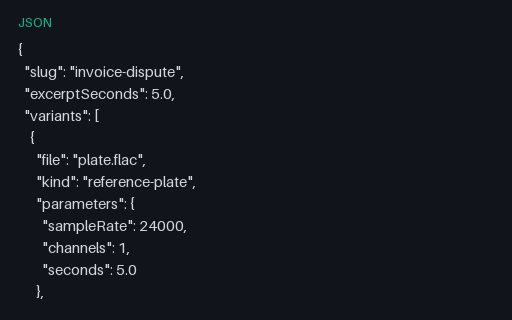
- jsonInvoice dispute: ladder answer keyMachine-readable description of all 16 variants in this group: the file, the kind of damage, the measured parameters that produced it and what each one is expected to demonstrate. Provided so a test suite can walk the ladder programmatically instead of hard-coding filenames.
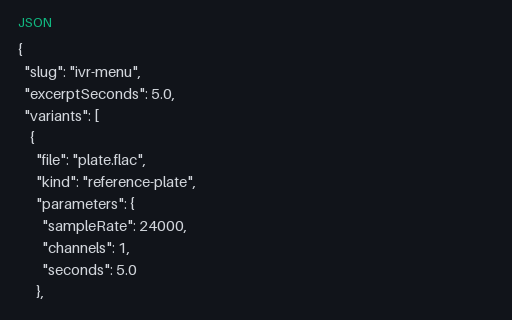
- jsonIvr menu: ladder answer keyMachine-readable description of all 16 variants in this group: the file, the kind of damage, the measured parameters that produced it and what each one is expected to demonstrate. Provided so a test suite can walk the ladder programmatically instead of hard-coding filenames.
Generated by generation/audio_ladder_wave.py. Free for any use, no attribution required, license.