
Product JSON Schema (draft-07)
A JSON Schema (draft-07) describing a product object, with required fields, types, and constraints — paired with a conforming and a deliberately non-conforming instance for testing validators.
{
  "$schema": "http://json-schema.org/draft-07/schema#",
  "title": "Product",
  "type": "object",
  "required": [
    "product_id",
    "name",
    "price",
    "in_stock"
  ],
  "properties": {
    "product_id": {
      "type": "integer",
      "minimum": 1
    },
    "name": {
      "type": "string",
      "minLength": 1
    },
    "price": {
      "type": "number",
      "exclusiveMinimum": 0
    },
    "in_stock": {
      "type": "boolean"
    },
    "tags": {
      "type": "array",
      "items": {
        "type": "string"
      }
    }
  },
  "additionalProperties": false
}
Specifications
- Spec
- JSON Schema draft-07
- Required
- product_id, name, price, in_stock
- Additional Properties
- false
What is a .json file?
JSON (JavaScript Object Notation) is a lightweight, text-based data-interchange format representing objects, arrays, strings, numbers, booleans, and null. It is language-independent, human-readable, and the dominant format for web APIs and configuration. It requires a single well-formed root value.
How to use this file
Use an example JSON file to test parsers and serializers, schema validation, Unicode and number-precision handling, and API request or response processing.
How to use this file for testing
“Product JSON Schema (draft-07)” is a deterministic Novus Examples fixture for Schema validation, Data import. JSON Schema documents describing a data shape — for testing validators and schema-aware tooling.
Documented properties for this file: JSON · 589 bytes. Compare results against paired or grouped companions on this page when present (clean↔damaged, searchable↔scanned, or format twins) so scores stay reproducible across runs.
Download the file once, keep the path stable in CI or local scripts, and treat the spec table as the contract: dimensions, seeds, field lists, and roles are intentional. Corrupt or invalid samples are labelled as such — expect parsers to fail loudly rather than silently accept them.
Data fixtures document their exact quirks — delimiters, encodings, null handling, schema, and row counts — in the spec table. Point your parser or importer at the file and assert it handles the documented edge cases; clean and deliberately-messy siblings make before/after diffs straightforward.
Code examples
import json

with open("product.schema.json") as f:
    data = json.load(f)
print(type(data), len(data))
Related files
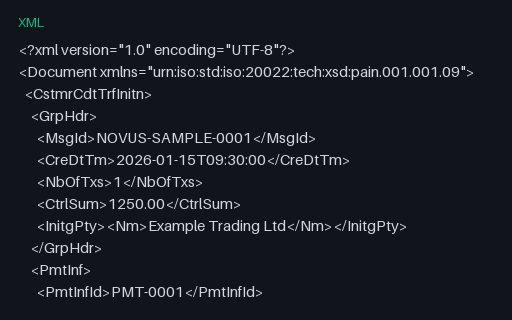
- xmlISO 20022 Credit Transfer — pain.001 (XML)A sample ISO 20022 customer credit-transfer initiation (pain.001.001.09) — a single payment with debtor/creditor parties, IBANs, BICs, amount, and remittance info. IBANs are published documentation examples; a fixture for testing payment-message parsers and bank integrations.
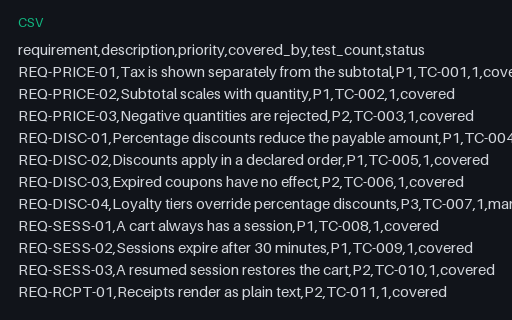
- csvRequirements Traceability Matrix with One Gap (CSV)Thirteen requirements mapped to the test cases that cover them — and one, REQ-PAY-02, deliberately covered by nothing. A coverage-gap report that does not surface that row is not working, which makes this the answer key for exactly that check.
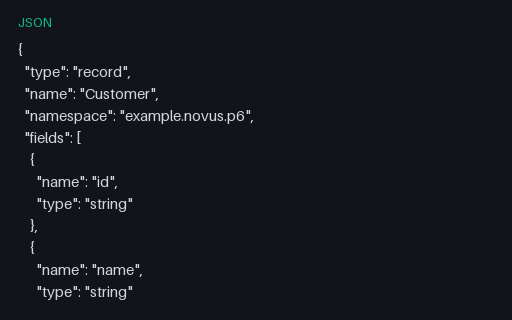
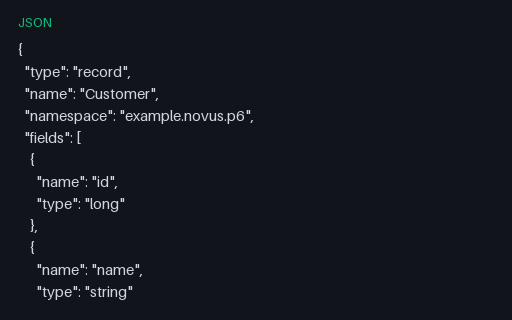
- jsonAvro Schema Evolution - Backward-CompatibleThe compatible Avro record schema for reader/writer compatibility tests. Backward compatible for old records: nullable email is added with a null default.
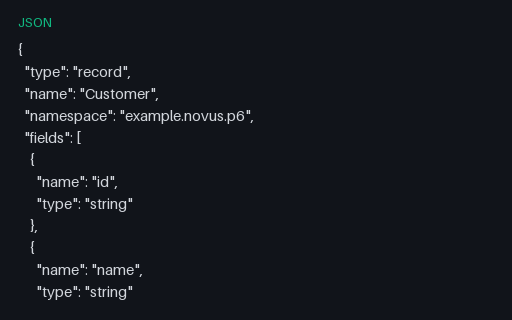
- jsonAvro Schema Evolution - BaselineThe baseline Avro record schema for reader/writer compatibility tests. Reference writer schema: id and name are strings.
- jsonAvro Schema Evolution - BreakingThe breaking Avro record schema for reader/writer compatibility tests. Breaking relative to baseline: id changes to long and tenantId has no default.
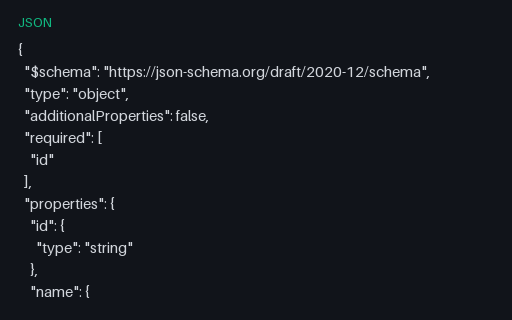
- jsonJSON Schema Edge — Additional Properties FalseMinimal JSON Schema SAMPLE focusing on additional properties false constraints.
Generated by generation/data_realworld.py. Free for any use, no attribution required — license.