
Openapi Response Pet Page
Sample paginated pet list response for mock-server and contract tests.
{
  "items": [
    {
      "id": 1,
      "name": "Sample Cat",
      "tag": "demo"
    }
  ],
  "nextCursor": "c_abc123"
}
Specifications
- Kind
- request/response example
- Openapi
- petstore
Testing contract
Expected to pass- Scenario
- Exercise Openapi Response Pet Page in its schema workflow. Sample paginated pet list response for mock-server and contract tests.
- Expected result
- top-level keys are items, nextCursor; array lengths: items=1. Declared feature checks: kind=request/response example; openapi=petstore.
What is a .json file?
JSON (JavaScript Object Notation) is a lightweight, text-based data-interchange format representing objects, arrays, strings, numbers, booleans, and null. It is language-independent, human-readable, and the dominant format for web APIs and configuration. It requires a single well-formed root value.
How to use this file
Use an example JSON file to test parsers and serializers, schema validation, Unicode and number-precision handling, and API request or response processing.
How to use this file for testing
“Openapi Response Pet Page” is a deterministic Novus Examples fixture for Schema / OpenAPI testing, API testing. Valid and intentionally invalid OpenAPI/JSON Schema documents plus request/response examples for schema validators and API tooling.
Documented properties for this file: JSON · 134 bytes. Compare results against paired or grouped companions on this page when present (clean↔damaged, searchable↔scanned, or format twins) so scores stay reproducible across runs.
Download the file once, keep the path stable in CI or local scripts, and treat the spec table as the contract: dimensions, seeds, field lists, and roles are intentional. Corrupt or invalid samples are labelled as such, expect parsers to fail loudly rather than silently accept them.
Data fixtures document their exact quirks (delimiters, encodings, null handling, schema, and row counts) in the spec table. Point your parser or importer at the file and assert it handles the documented edge cases; clean and deliberately-messy siblings make before/after diffs straightforward.
Valid and intentionally invalid siblings are labelled in title and description. Assert parsers accept the valid twin and fail loudly on the invalid one; for time series, check DST gaps and duplicate keys against the spec table.
Code examples
import json

with open("openapi-response-pet-page.json") as f:
    data = json.load(f)
print(type(data), len(data))
Related files
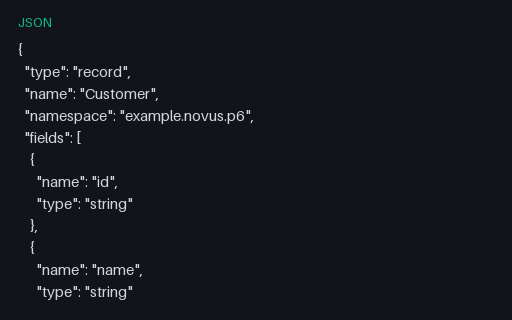
- jsonAvro Schema Evolution - Backward-CompatibleThe compatible Avro record schema for reader/writer compatibility tests. Backward compatible for old records: nullable email is added with a null default.
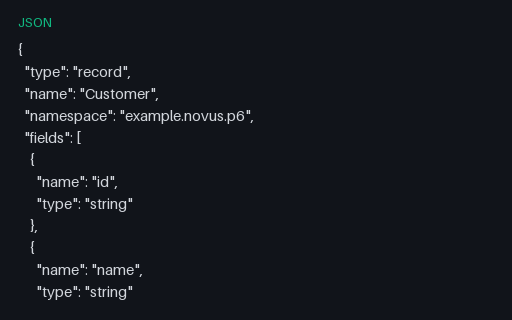
- jsonAvro Schema Evolution - BaselineThe baseline Avro record schema for reader/writer compatibility tests. Reference writer schema: id and name are strings.
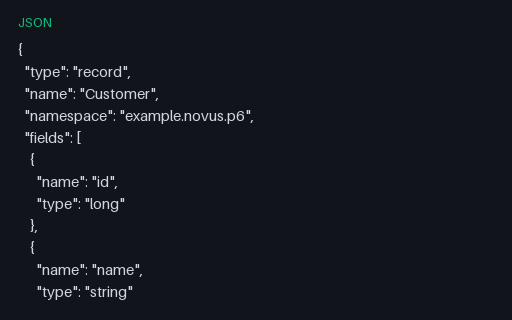
- jsonAvro Schema Evolution - BreakingThe breaking Avro record schema for reader/writer compatibility tests. Breaking relative to baseline: id changes to long and tenantId has no default.
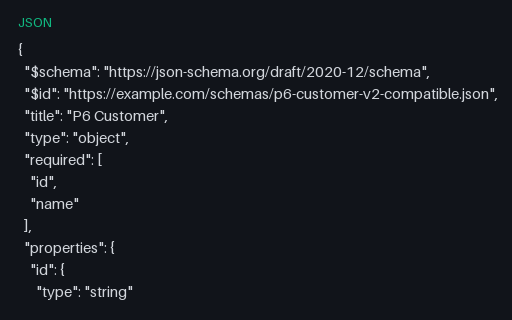
- jsonJSON Schema Schema Evolution - Backward-CompatibleThe compatible member of a JSON Schema 2020-12 customer contract. Backward compatible: existing instances remain valid because email is optional.
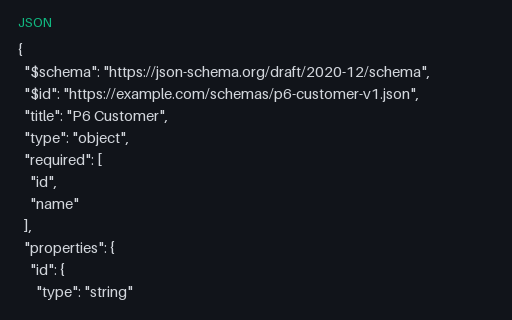
- jsonJSON Schema Schema Evolution - BaselineThe baseline member of a JSON Schema 2020-12 customer contract. Reference contract: id and name are required strings.
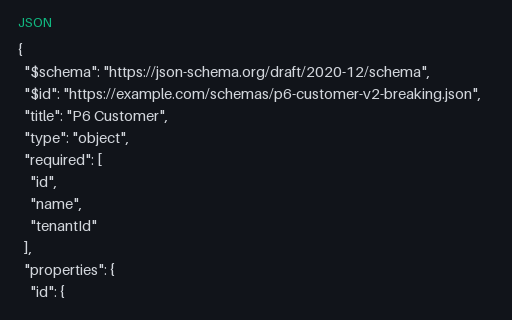
- jsonJSON Schema Schema Evolution - BreakingThe breaking member of a JSON Schema 2020-12 customer contract. Breaking relative to baseline: id changes from string to integer and tenantId becomes required.
Generated by generation/data_wave_f.py. Free for any use, no attribution required, license.