
Pine Property Services: Claim register JSON
Claim register JSON for Pine Property Services. The same 3 claims with the three column totals hoisted into a totals object, so a reader can check its own aggregation against the file rather than only against another file.
json
application/json
- Document Set
- insurance
- Industry
- trades-property
- Source Kit
- trades-property
- Entity
- Pine Property Services
- Synthetic
- true
- As Of
- 2026-09-08
Binary json: no in-browser preview. Download it above to open in a compatible application.
Specifications
- Document Set
- insurance
- Industry
- trades-property
- Source Kit
- trades-property
- Entity
- Pine Property Services
- Synthetic
- true
- As Of
- 2026-09-08
- Records
- 3
- Has Totals Object
- true
Testing contract
Expected to pass- Scenario
- Aggregate the claims array and compare with the totals object.
- Expected result
- The aggregation gives 17890.00 paid, 2760.00 reserved and 20650.00 incurred, which is exactly what the totals object holds.
What is a .json file?
JSON (JavaScript Object Notation) is a lightweight, text-based data-interchange format representing objects, arrays, strings, numbers, booleans, and null. It is language-independent, human-readable, and the dominant format for web APIs and configuration. It requires a single well-formed root value.
How to use this file
Use an example JSON file to test parsers and serializers, schema validation, Unicode and number-precision handling, and API request or response processing.
How to use this file for testing
“Pine Property Services: Claim register JSON” is a deterministic Novus Examples fixture for Data import, JSON parsing. Realistic faker-generated datasets with documented schemas for testing import and ETL flows.
Documented properties for this file: 3 records. Compare results against paired or grouped companions on this page when present (clean↔damaged, searchable↔scanned, or format twins) so scores stay reproducible across runs.
Download the file once, keep the path stable in CI or local scripts, and treat the spec table as the contract: dimensions, seeds, field lists, and roles are intentional. Corrupt or invalid samples are labelled as such, expect parsers to fail loudly rather than silently accept them.
Data fixtures document their exact quirks (delimiters, encodings, null handling, schema, and row counts) in the spec table. Point your parser or importer at the file and assert it handles the documented edge cases; clean and deliberately-messy siblings make before/after diffs straightforward.
Code examples
import json

with open("claim-register.json") as f:
    data = json.load(f)
print(type(data), len(data))
Related files
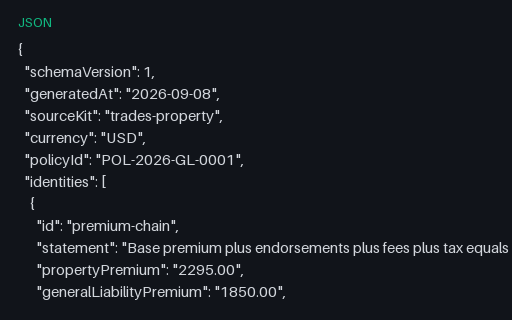
- jsonPine Property Services: Insurance reconciliation identitiesInsurance reconciliation identities for Pine Property Services. 6 named identities covering the premium chain, the instalment remainder, the apportioned insured values, the settlement calculation, the loss run and the broker account, with the figures behind each. The two deliberately invalid files and their measured 161 day gap are listed separately.
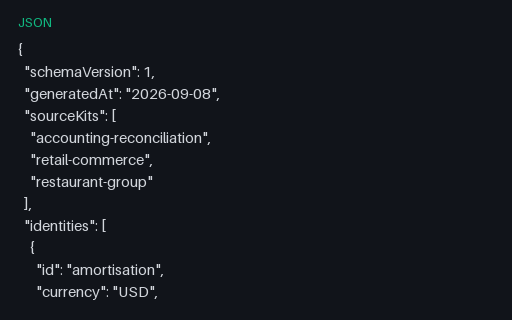
- jsonAlder Books Reconciliation: Banking reconciliation identitiesBanking reconciliation identities for Alder Books Reconciliation. 5 named identities covering the amortisation, the unfinanced arrangement fee, the covenant directions, the direct debit control sum and the two different chargeback totals, with the figures behind each. The deliberate defect and its measured 36.15 USD closing balance are listed separately.
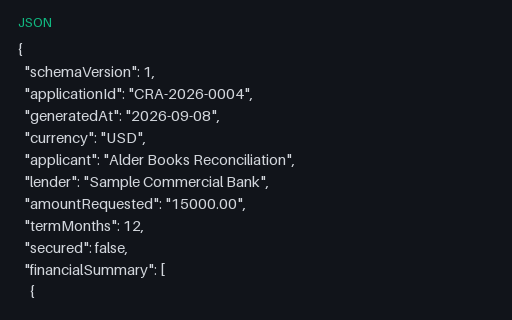
- jsonAlder Books Reconciliation: Credit application JSONCredit application JSON for Alder Books Reconciliation. The same application as an object, with each financial summary row keeping the source string that names the file and column it came from. The connected facility is a nested object rather than a string, so a reader can tell that the existing borrowing belongs to a different entity.
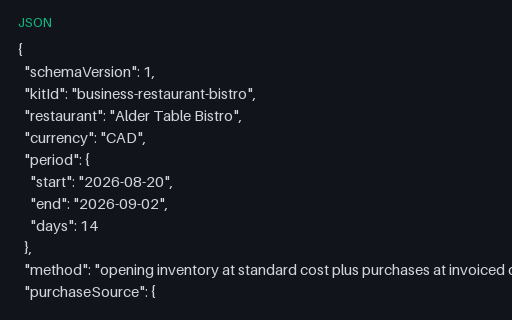
- jsonAlder Table Bistro: Cost of goods sold documentCost of goods sold document for Alder Table Bistro. The same statement as JSON, listing all 24 purchase ids it consumed so the total can be checked against the shared purchases table by id. Totals: opening 1736.91, purchases 2834.82, closing 2996.92, cost of goods sold 1574.81 CAD.
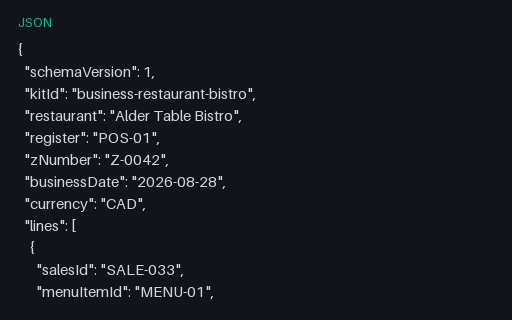
- jsonAlder Table Bistro: Daily Z-read as structured dataDaily Z-read as structured data for Alder Table Bistro. The same Z-read as JSON: 4 item lines, a summary block, 3 tender lines that sum to the total collected, 2 voids, one comp, 1 refund traced to its sales id, and a cash drawer block whose expected figure less the counted figure equals the declared over/short of -0.35 CAD.
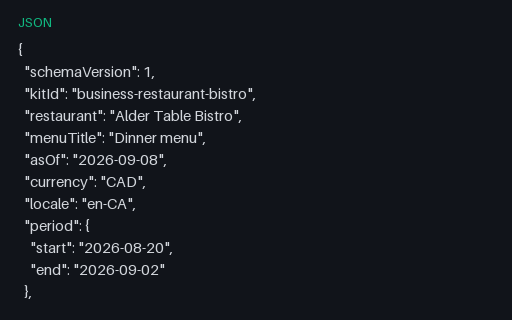
- jsonAlder Table Bistro: Digital menuDigital menu for Alder Table Bistro. One document holding the whole front of house: 3 printed sections with 4 dishes, 8 drink lines, the set menu, the specials and the 14 entry allergen key. Every dish carries its plate cost and the paths of the two costing files it was read from, so the join back to plate-costs.csv can be checked without guessing.
Generated by generation/industry_documents_two.py. Free for any use, no attribution required, license.