
Fixed-Width Positions File (TXT)
A classic fixed-width text extract with documented column positions — for COBOL-style / mainframe importer tests.
ID  NAME           AMOUNT
001 Ada Lovelace   001250
002 Ben Garcia     000320
003 Chen Wei       002900
Specifications
- Format
- fixed-width
- Columns
- ID(0-3), NAME(4-18), AMOUNT(19-24)
- Rows
- 3
Testing contract
Expected to pass- Scenario
- Exercise Fixed-Width Positions File (TXT) in its encodings workflow. A classic fixed-width text extract with documented column positions — for COBOL-style / mainframe importer tests.
- Expected result
- 4 text lines, decoded as UTF-8; first nonempty line is 'ID NAME AMOUNT'. Declared feature checks: columns=ID(0-3), NAME(4-18), AMOUNT(19-24).
What is a .txt file?
TXT is a plain-text file containing unformatted character data with no styling or structure beyond line breaks. Its interpretation depends on character encoding, most commonly UTF-8, and on line-ending convention. It is the most universal and portable text container.
How to use this file
Use an example TXT to test encoding detection, line-ending (LF versus CRLF) handling, and any tool that reads or streams raw text input.
How to use this file for testing
“Fixed-Width Positions File (TXT)” is a deterministic Novus Examples fixture for CSV parsing, Data import, Encoding detection. Clean and deliberately messy CSVs, quoted commas, embedded newlines, ragged rows, odd delimiters, and encodings.
Documented properties for this file: 3 rows · fixed-width. Compare results against paired or grouped companions on this page when present (clean↔damaged, searchable↔scanned, or format twins) so scores stay reproducible across runs.
Download the file once, keep the path stable in CI or local scripts, and treat the spec table as the contract: dimensions, seeds, field lists, and roles are intentional. Corrupt or invalid samples are labelled as such, expect parsers to fail loudly rather than silently accept them.
Data fixtures document their exact quirks (delimiters, encodings, null handling, schema, and row counts) in the spec table. Point your parser or importer at the file and assert it handles the documented edge cases; clean and deliberately-messy siblings make before/after diffs straightforward.
Feed the file to your parser and assert it handles the documented quirks, quoted delimiters, embedded newlines, ragged rows, or invalid syntax; the valid↔invalid distinction is labelled in the title.
Related files
- csvCSV — UTF-8 with BOMA CSV prefixed with a UTF-8 BOM (EF BB BF) and accented / CJK cells — for testing BOM-aware importers.

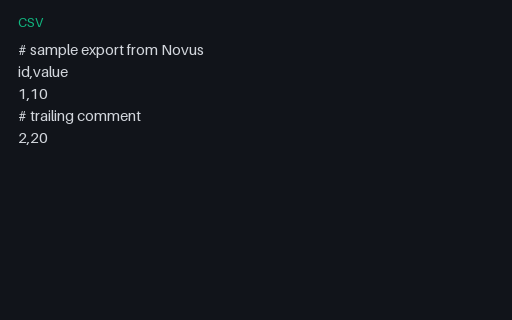
- csvCSV — Hash Comment LinesA CSV with # comment lines mixed among data — common in scientific exports; tests comment skipping.
- csvCSV — ISO-8859-1 (Latin-1)A Latin-1 CSV with high-bit accented characters — for legacy 8-bit charset detection.

- csvCSV — Mixed CRLF and LFA CSV that mixes CRLF and LF row endings within one file — newline normalisation fixture.

- csvCSV — Pipe DelimiterA pipe-delimited (| ) tabular file — for testing non-comma delimiter autodetection.

- csvCSV — Semicolon Delimiter (EU)European-style CSV using semicolons as delimiters and comma decimals — a common locale edge case.

Generated by generation/data_encodings_wave_c.py. Free for any use, no attribution required, license.