
E-commerce Orders (Parquet, 2000 rows)
The e-commerce orders table as Apache Parquet — the columnar twin, for testing analytics engines (pandas, DuckDB, Spark).
| order_id | customer_id | product_id | quantity | total | status | order_date |
|---|---|---|---|---|---|---|
| 1 | 150 | 171 | 2 | 705.98 | paid | 2025-10-19 |
| 2 | 174 | 36 | 1 | 25.59 | refunded | 2025-06-09 |
| 3 | 31 | 1 | 2 | 444.46 | shipped | 2025-04-27 |
| 4 | 293 | 51 | 4 | 881.44 | delivered | 2025-08-22 |
| 5 | 431 | 127 | 3 | 1105.89 | shipped | 2025-03-12 |
| 6 | 295 | 190 | 5 | 234.85 | delivered | 2025-05-03 |
| 7 | 336 | 52 | 5 | 2229.65 | refunded | 2025-05-26 |
| 8 | 236 | 54 | 4 | 207 | pending | 2025-04-29 |
Specifications
- Rows
- 2000
- Columns
- 7
- Format
- Apache Parquet
- Domain
- e-commerce
What is a .parquet file?
Apache Parquet (.parquet) is a binary, columnar storage format for analytical data. It stores each column separately with per-column compression and encoding, embeds a schema and statistics, and is the de-facto standard for data lakes and engines like Spark, DuckDB, and pandas/pyarrow.
How to use this file
Use an example .parquet file to test columnar readers (pyarrow, DuckDB, Spark), schema and predicate-pushdown handling, and Parquet-to-CSV/JSON converters.
How to use this file for testing
“E-commerce Orders (Parquet, 2000 rows)” is a deterministic Novus Examples fixture for Data engineering, Conversion testing. Columnar (Parquet/ORC/Feather), row (Avro), and messaging (MessagePack/CBOR/Protobuf) formats plus star-schema and log data — for testing ETL, data-lake ingestion, and warehouse loaders.
Documented properties for this file: 2,000 rows · 7 columns · Apache Parquet. Compare results against paired or grouped companions on this page when present (clean↔damaged, searchable↔scanned, or format twins) so scores stay reproducible across runs.
Download the file once, keep the path stable in CI or local scripts, and treat the spec table as the contract: dimensions, seeds, field lists, and roles are intentional. Corrupt or invalid samples are labelled as such — expect parsers to fail loudly rather than silently accept them.
Data fixtures document their exact quirks — delimiters, encodings, null handling, schema, and row counts — in the spec table. Point your parser or importer at the file and assert it handles the documented edge cases; clean and deliberately-messy siblings make before/after diffs straightforward.
Code examples
import pandas as pd  # pip install pyarrow

df = pd.read_parquet("orders.parquet")
print(df.head())
print(df.dtypes)
Related files
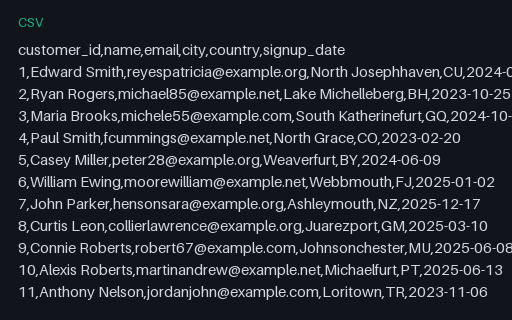
- csvE-commerce Customers (CSV, 500 rows)A realistic e-commerce customer directory (500 rows) — part of a relational dataset (products, customers, orders) with CSV, JSON, SQL, and Parquet twins for testing joins, imports, and conversion.
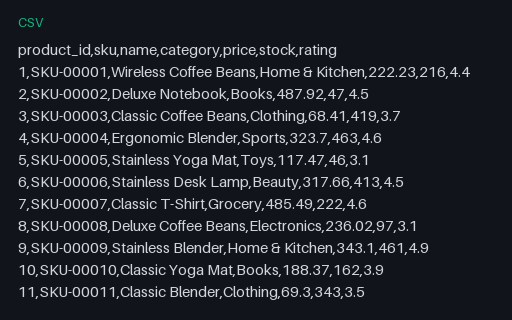
- csvE-commerce Products (CSV, 200 rows)A realistic e-commerce product catalogue (200 rows) — part of a relational dataset (products, customers, orders) with CSV, JSON, SQL, and Parquet twins for testing joins, imports, and conversion.
- parquetE-commerce Products (Parquet, 200 rows)The e-commerce products table as Apache Parquet — the columnar twin, for testing analytics engines (pandas, DuckDB, Spark).
- avroAvro — Row Binary + SchemaThe same records as Apache Avro — a compact row-based binary format that embeds its own schema, widely used in Kafka pipelines. For testing Avro decoders and schema evolution.
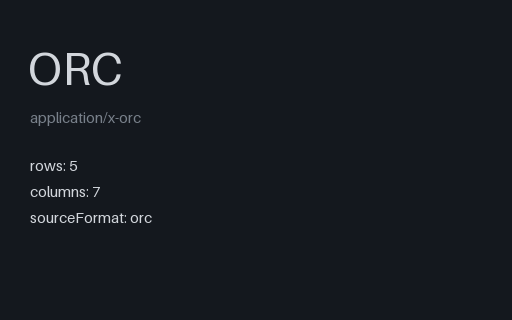
- orcConvert v2 ORC Employee Table SourceBinary orc source for the five-row P8 employee conversion table, preserving ids, names, departments, booleans, and scores. Stable P8 artifact p8-convert-orc-source.
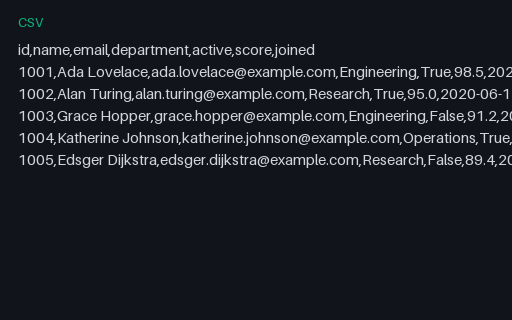
- csvConvert v2 ORC Expected CSVCsv semantic reference for the five-row P8 employee conversion table, preserving ids, names, departments, booleans, and scores. Stable P8 artifact p8-convert-orc-csv.
Generated by generation/data_realworld.py. Free for any use, no attribution required — license.