
Fieldnote Supply Shop: Inventory and price feed XML
Inventory and price feed XML for Fieldnote Supply Shop. The same 12 variants as inventory-feed.csv. Because the gtin values are element text rather than spreadsheet cells, the leading zeros survive here, which makes this file the reference against which the CSV round trip is checked.
xml
application/xml
- Document Set
- ecommerce
- Industry
- retail
- Source Kit
- retail-commerce
- Synthetic
- true
- As Of
- 2026-09-08
- Rows
- 12
Binary xml: no in-browser preview. Download it above to open in a compatible application.
Specifications
- Document Set
- ecommerce
- Industry
- retail
- Source Kit
- retail-commerce
- Synthetic
- true
- As Of
- 2026-09-08
- Rows
- 12
- Root Element
- ProductFeed
- Encoding
- UTF-8
Testing contract
Expected to pass- Scenario
- Parse the feed and verify every Gtin check digit.
- Expected result
- 12 Item elements parse, every Gtin is 13 characters beginning with 0, and every modulo-10 check digit verifies.
What is a .xml file?
XML (Extensible Markup Language) is a verbose, self-describing markup language using nested tags, attributes, and namespaces to represent structured, hierarchical data. It supports schemas, entities, and validation and underlies many document and data formats. It remains common in enterprise, publishing, and interchange contexts.
How to use this file
Use an example XML file to test parsers, namespace and schema validation, XPath queries, and protection against entity-expansion and external-entity attacks.
How to use this file for testing
“Fieldnote Supply Shop: Inventory and price feed XML” is a deterministic Novus Examples fixture for Data import. Realistic faker-generated datasets with documented schemas for testing import and ETL flows.
Documented properties for this file: 12 rows · UTF-8. Compare results against paired or grouped companions on this page when present (clean↔damaged, searchable↔scanned, or format twins) so scores stay reproducible across runs.
Download the file once, keep the path stable in CI or local scripts, and treat the spec table as the contract: dimensions, seeds, field lists, and roles are intentional. Corrupt or invalid samples are labelled as such, expect parsers to fail loudly rather than silently accept them.
Data fixtures document their exact quirks (delimiters, encodings, null handling, schema, and row counts) in the spec table. Point your parser or importer at the file and assert it handles the documented edge cases; clean and deliberately-messy siblings make before/after diffs straightforward.
Code examples
import xml.etree.ElementTree as ET

tree = ET.parse("inventory-feed.xml")
root = tree.getroot()
print(root.tag, [c.tag for c in root][:5])
Related files
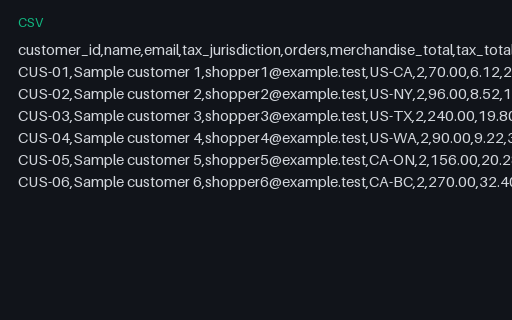
- csvFieldnote Supply Shop: Customer export with tax jurisdictionCustomer export with tax jurisdiction for Fieldnote Supply Shop. 6 fictional customers at example.test addresses, each with the jurisdiction that set the tax rate on their orders. Every customer placed 2 orders and merchandise_total sums to 922.00.
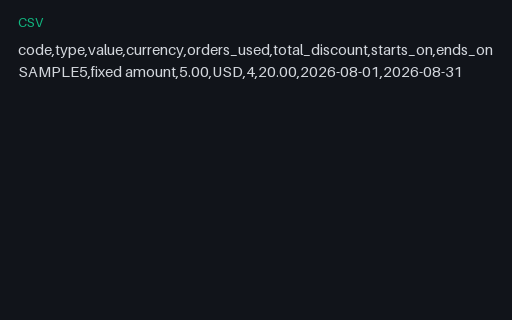
- csvFieldnote Supply Shop: Discount code usageDiscount code usage for Fieldnote Supply Shop. One promotion, SAMPLE5, a fixed 5.00 USD reduction used on 4 of the 12 orders for a total of 20.00. Those are exactly the orders whose discount_total column in orders-export.csv is not zero.
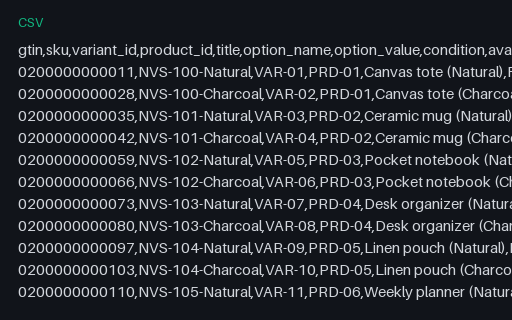
- csvFieldnote Supply Shop: Inventory and price feed with variantsInventory and price feed with variants for Fieldnote Supply Shop. 12 variant rows over 6 products, two finishes each. Every gtin is a valid 13-digit GS1 number whose final digit is the modulo-10 check digit, and all 12 begin with a zero, so a spreadsheet that types the column as a number destroys the identifier. Quantities sum to 285 units and match the variant stock in the shop model.
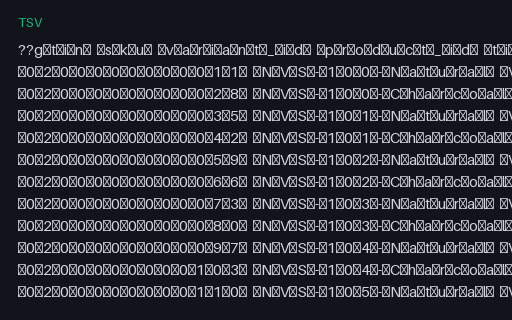
- tsvFieldnote Supply Shop: Inventory feed as UTF-16 LE tab-separated textInventory feed as UTF-16 LE tab-separated text for Fieldnote Supply Shop. The same 12 variants, tab separated and encoded UTF-16 little endian with an FF FE byte order mark. Every ASCII character occupies two bytes, so a reader that opens the file as UTF-8 sees NUL between each letter and usually reports one column.
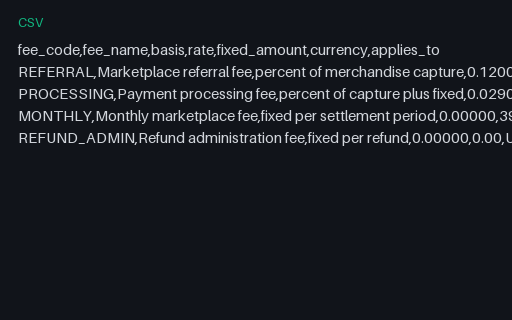
- csvFieldnote Supply Shop: Marketplace fee scheduleMarketplace fee schedule for Fieldnote Supply Shop. The four fee codes the settlement uses, with basis, rate and fixed component. REFERRAL at 0.12000 and PROCESSING at 0.02900 plus 0.30 reproduce every fee line in settlement-transactions.csv; REFUND_ADMIN is present at zero because the period waived it, which is why the settlement has no refund fee lines.
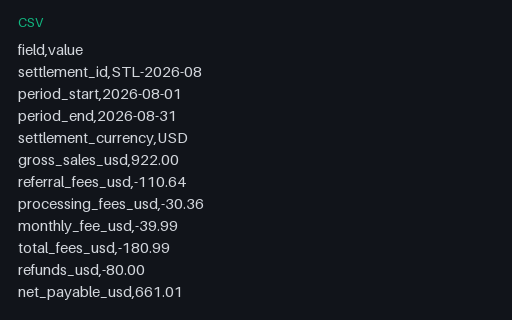
- csvFieldnote Supply Shop: Marketplace settlement and payout summaryMarketplace settlement and payout summary for Fieldnote Supply Shop. The reconciliation people get wrong, stated as a key-value sheet: gross sales 922.00 minus total fees 180.99 minus refunds 80.00 equals net payable 661.01 USD, converted once at 0.91250 to a 603.17 EUR deposit. Every fee component equals the matching group of lines in settlement-transactions.csv.
Generated by generation/industry_documents.py. Free for any use, no attribution required, license.