
INI Configuration
A classic INI configuration file with sections and key/value pairs — for testing INI parsers.
[server]
host = localhost
port = 8080
debug = false

[database]
url = postgres://localhost/app
pool_size = 10

[logging]
level = INFO
file = /var/log/app.log
Specifications
- Format
- INI
- Sections
- 3
- Keys
- 7
- Encoding
- UTF-8
What is a .ini file?
INI is an informal configuration format organizing key-value pairs under bracketed section headers, with comment lines and no strict standard. Parsing details like comment characters, quoting, and nesting vary between implementations. It is a long-standing choice for simple application and system configuration.
How to use this file
Use an example INI file to test section and key-value parsing, comment handling, and configuration loaders that must tolerate dialect differences.
How to use this file for testing
“INI Configuration” is a deterministic Novus Examples fixture for Config parsing. TOML and INI configuration files with nested sections and typed values — for testing config parsers and loaders.
Documented properties for this file: UTF-8 · INI. Compare results against paired or grouped companions on this page when present (clean↔damaged, searchable↔scanned, or format twins) so scores stay reproducible across runs.
Download the file once, keep the path stable in CI or local scripts, and treat the spec table as the contract: dimensions, seeds, field lists, and roles are intentional. Corrupt or invalid samples are labelled as such — expect parsers to fail loudly rather than silently accept them.
Data fixtures document their exact quirks — delimiters, encodings, null handling, schema, and row counts — in the spec table. Point your parser or importer at the file and assert it handles the documented edge cases; clean and deliberately-messy siblings make before/after diffs straightforward.
Point your config loader at the file and assert it reads the documented sections and typed values, including any deliberately-tricky nesting or comments.
Code examples
import configparser

c = configparser.ConfigParser()
c.read("sample.ini")
print(c.sections())
Related files
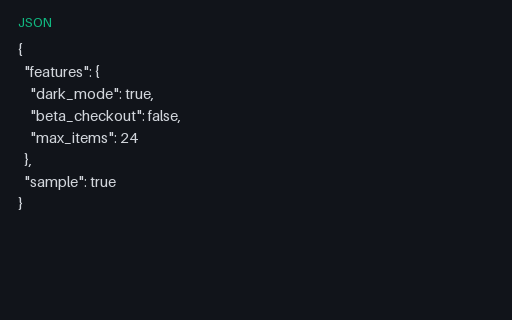
- jsonConfig — App Feature Flags (JSON)Tiny SAMPLE JSON config fixture (app-feature-flags) for parser and twin tests.
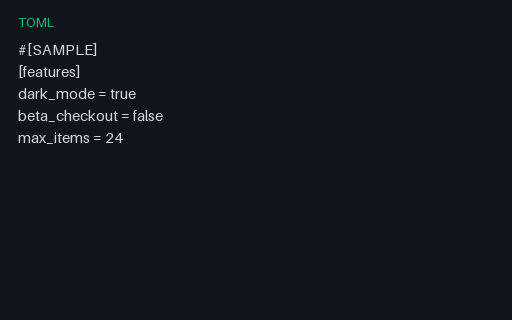
- tomlConfig — App Feature Flags (TOML)Tiny SAMPLE TOML config fixture (app-feature-flags) for parser and twin tests.
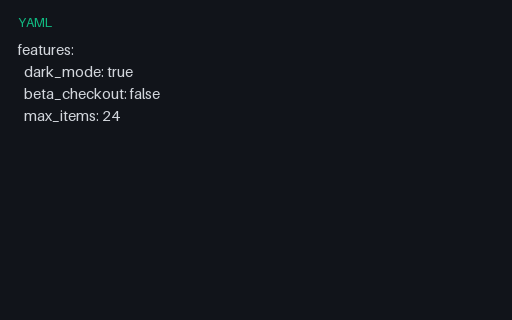
- yamlConfig — App Feature Flags (YAML)Tiny SAMPLE YAML config fixture (app-feature-flags) for parser and twin tests.
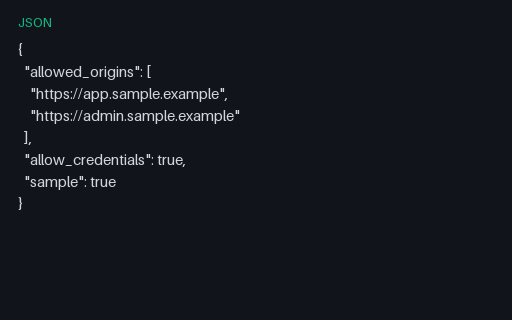
- jsonConfig — Cors Origins (JSON)Tiny SAMPLE JSON config fixture (cors-origins) for parser and twin tests.
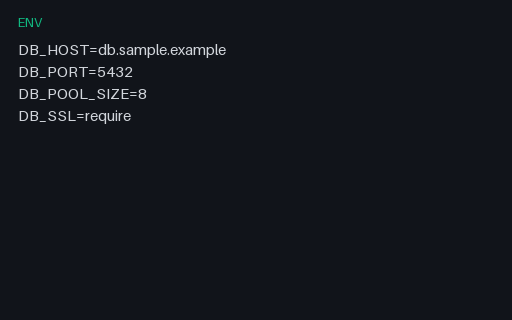
- envConfig — Database Pool (ENV)Tiny SAMPLE ENV config fixture (database-pool) for parser and twin tests.
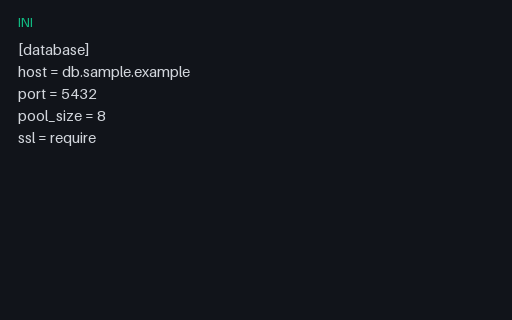
- iniConfig — Database Pool (INI)Tiny SAMPLE INI config fixture (database-pool) for parser and twin tests.
Generated by generation/data_formats.py. Free for any use, no attribution required — license.