
Calendar Recurrence - Weekly Series with EXDATE (ICS)
The same weekly series with its third occurrence excluded, for testing RRULE expansion followed by EXDATE filtering.
BEGIN:VCALENDAR
VERSION:2.0
PRODID:-//Novus Examples//P6 Calendar//EN
CALSCALE:GREGORIAN
BEGIN:VEVENT
UID:p6-recurrence@novus.example
DTSTAMP:20260731T120000Z
DTSTART:20260803T140000Z
DTEND:20260803T143000Z
RRULE:FREQ=WEEKLY;COUNT=5
EXDATE:20260817T140000Z
SUMMARY:Weekly parser review
END:VEVENT
END:VCALENDAR
Specifications
- Format
- iCalendar 2.0
- Encoding
- UTF-8
- Events
- 1
- Uid
- p6-recurrence@novus.example
- Expected Occurrences
- 4
- Line Endings
- CRLF
Testing contract
Expected to pass- Scenario
- Import recurrence-exdate.ics and evaluate its published calendar semantics.
- Expected result
- 4 occurrences: 2026-08-03, 10, 24 and 31 at 14:00Z; August 17 is absent.
What is a .ics file?
ICS (iCalendar) is a plain-text format for exchanging calendar data such as events, to-dos, and free/busy time, structured as nested VCALENDAR and VEVENT components with property lines. It encodes start and end times, recurrence rules, and reminders. It is the universal standard for calendar interchange and invitations.
How to use this file
Use an example ICS file to test calendar import, event and recurrence-rule parsing, timezone handling, and interoperability across calendar applications.
How to use this file for testing
“Calendar Recurrence - Weekly Series with EXDATE (ICS)” is a deterministic Novus Examples fixture for Calendar parsing, Conversion testing. iCalendar (.ics) files with events, timezones, and recurrence — for testing calendar imports and parsers.
Documented properties for this file: UTF-8 · CRLF · iCalendar 2.0. Compare results against paired or grouped companions on this page when present (clean↔damaged, searchable↔scanned, or format twins) so scores stay reproducible across runs.
Download the file once, keep the path stable in CI or local scripts, and treat the spec table as the contract: dimensions, seeds, field lists, and roles are intentional. Corrupt or invalid samples are labelled as such — expect parsers to fail loudly rather than silently accept them.
Data fixtures document their exact quirks — delimiters, encodings, null handling, schema, and row counts — in the spec table. Point your parser or importer at the file and assert it handles the documented edge cases; clean and deliberately-messy siblings make before/after diffs straightforward.
Code examples
from icalendar import Calendar  # pip install icalendar

cal = Calendar.from_ical(open("recurrence-exdate.ics", "rb").read())
for ev in cal.walk("VEVENT"):
    print(ev.get("summary"))
Related files
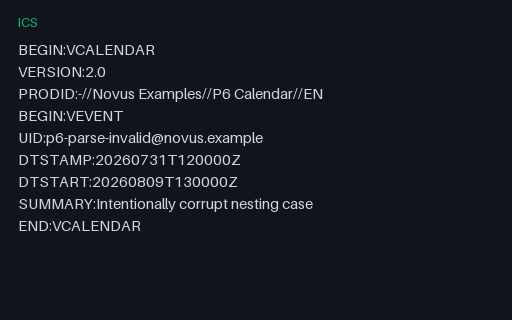
- icsCalendar Parsing - Intentionally Corrupt Missing END:VEVENT (ICS)An intentionally corrupt iCalendar file whose VEVENT is never closed, for testing fatal component-nesting errors without using a large or hostile payload.
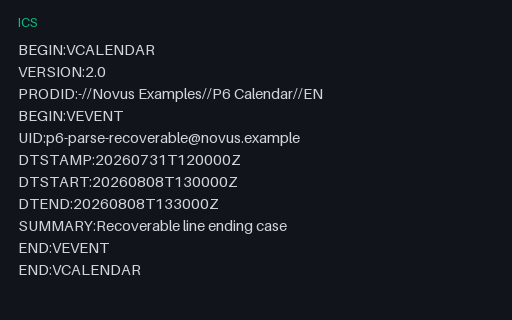
- icsCalendar Parsing - Recoverable LF Line Endings (ICS)A complete iCalendar structure using LF-only line endings, a common recoverable export defect for tolerant parser tests.
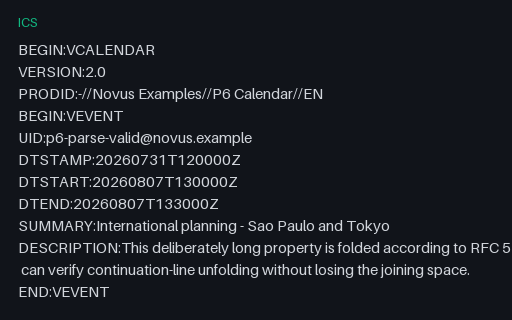
- icsCalendar Parsing - Valid Folded UTF-8 Event (ICS)A standards-conforming event with a folded content line and UTF-8 text for baseline parser and line-unfolding tests.
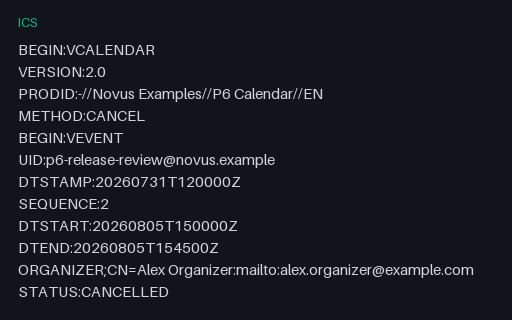
- icsCalendar Scheduling Lifecycle - CANCEL (ICS)The terminal cancellation for the scheduling group, checking METHOD, STATUS, UID and sequence precedence together.
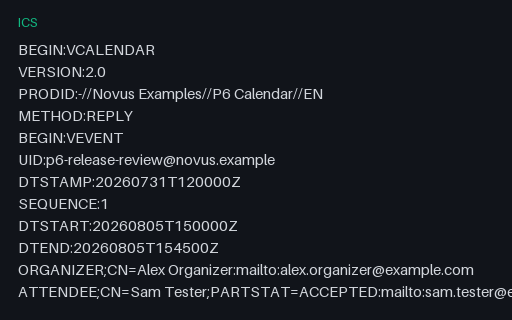
- icsCalendar Scheduling Lifecycle - REPLY (ICS)An attendee acceptance for the same meeting, used to test UID correlation and PARTSTAT state updates.
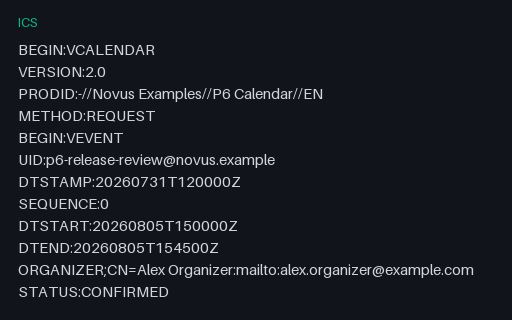
- icsCalendar Scheduling Lifecycle - REQUEST (ICS)The invitation that starts a scheduling lifecycle, using stable UID and organizer/attendee identities.
Generated by generation/p6_core.py. Free for any use, no attribution required — license.