
Fieldnote Learning Centre — Numeric expected results
Numeric expected results for Fieldnote Learning Centre. Exact table counts, metric formulas, 3 chart points and three negative-test outcomes. Enrollments=18.00 records; Passed completions=9.00 learners; Available course seats=30.00 seats.
{
  "schemaVersion": 1,
  "kitId": "business-education-training",
  "asOf": "2026-09-08",
  "tableCounts": {
    "courses": 3,
    "learners": 12,
    "enrollments": 18,
    "attendance": 36,
    "learning_materials": 3
  },
  "primaryKeyDuplicates": 0,
  "foreignKeyFailures": 0,
  "metrics": [
    {
      "id": "enrollments-count",
      "label": "Enrollments",
      "value": 18.0,
      "unit": "records",
      "calculation": "Count unique enrollment_id values in enrollments.",
      "formula": {
        "op": "count",
        "table": "enrollments"
      }
    },
    {
      "id": "enrollments-passed",
      "label": "Passed completions",
      "value": 9.0,
      "unit": "learners",
      "calculation": "Sum enrollments.passed over the included records.",
      "formula": {
        "op": "sum",
        "table": "enrollments",
        "column": "passed"
      }
    },
    {
      "id": "courses-capacity",
      "label": "Available course seats",
      "value": 30.0,
      "unit": "seats",
      "calculation": "Sum courses.capacity over the included records.",
      "formula": {
        "op": "sum",
        "table": "courses",
        "column": "capacity"
      }
    }
],Specifications
- Kit
- education-training
- Industry
- education
- Schema Version
- 1
- Synthetic
- true
- As Of
- 2026-09-08
Testing contract
Reference control- Scenario
- Use numeric expected results in the Fieldnote Learning Centre enrollment, completion, assessment, attendance, learning-materials workflow.
- Expected result
- Exact table counts, metric formulas, 3 chart points and three negative-test outcomes. Enrollments=18.00 records; Passed completions=9.00 learners; Available course seats=30.00 seats.
What is a .json file?
JSON (JavaScript Object Notation) is a lightweight, text-based data-interchange format representing objects, arrays, strings, numbers, booleans, and null. It is language-independent, human-readable, and the dominant format for web APIs and configuration. It requires a single well-formed root value.
How to use this file
Use an example JSON file to test parsers and serializers, schema validation, Unicode and number-precision handling, and API request or response processing.
How to use this file for testing
“Fieldnote Learning Centre — Numeric expected results” is a deterministic Novus Examples fixture for Data import. Realistic faker-generated datasets with documented schemas for testing import and ETL flows.
Documented properties for this file: JSON · 1,910 bytes. Compare results against paired or grouped companions on this page when present (clean↔damaged, searchable↔scanned, or format twins) so scores stay reproducible across runs.
Download the file once, keep the path stable in CI or local scripts, and treat the spec table as the contract: dimensions, seeds, field lists, and roles are intentional. Corrupt or invalid samples are labelled as such, expect parsers to fail loudly rather than silently accept them.
Data fixtures document their exact quirks (delimiters, encodings, null handling, schema, and row counts) in the spec table. Point your parser or importer at the file and assert it handles the documented edge cases; clean and deliberately-messy siblings make before/after diffs straightforward.
Code examples
import json

with open("expected-results.json") as f:
    data = json.load(f)
print(type(data), len(data))
Related files
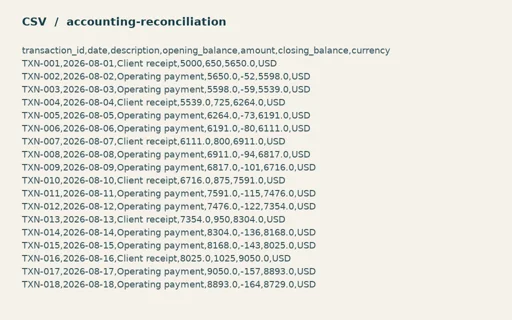
- csvAlder Books Reconciliation — Generic primary records CSVGeneric primary records CSV for Alder Books Reconciliation. 24 generic records with stable primary keys. Map the documented fields before importing into another platform.
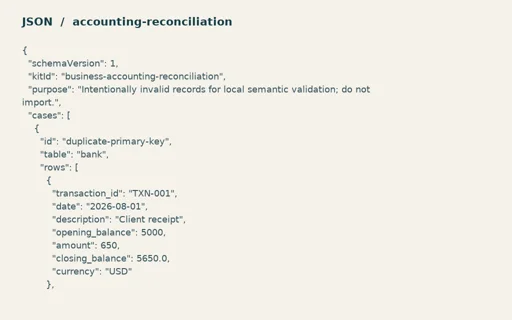
- jsonAlder Books Reconciliation — Intentionally invalid semantic test recordsIntentionally invalid semantic test records for Alder Books Reconciliation. Three independent cases report duplicate-primary-key, schema-type and foreign-key errors. JSON syntax remains valid.
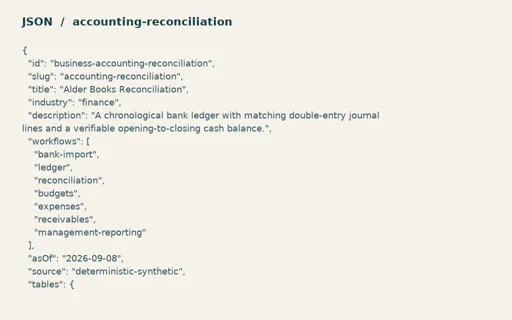
- jsonAlder Books Reconciliation — Linked operating modelLinked operating model for Alder Books Reconciliation. 102 records across 6 linked tables; no duplicate primary keys or missing references. Net cash change=5,236.00 USD; Journal debits=9,364.00 USD; Journal credits=9,364.00 USD.
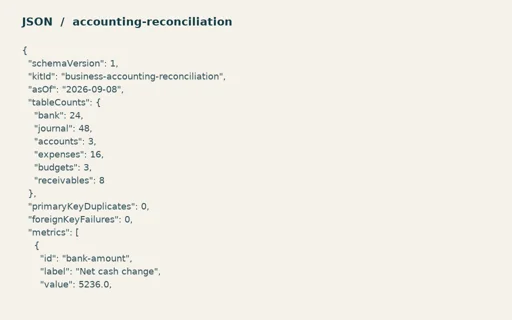
- jsonAlder Books Reconciliation — Numeric expected resultsNumeric expected results for Alder Books Reconciliation. Exact table counts, metric formulas, 24 chart points and three negative-test outcomes. Net cash change=5,236.00 USD; Journal debits=9,364.00 USD; Journal credits=9,364.00 USD.
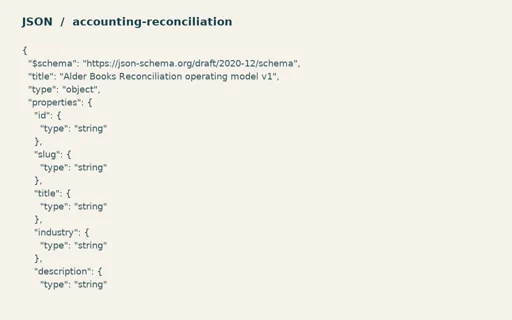
- jsonAlder Books Reconciliation — Operating model JSON SchemaOperating model JSON Schema for Alder Books Reconciliation. Draft 2020-12 schema accepts the paired operating model. Relational rules additionally require unique keys and existing foreign references.
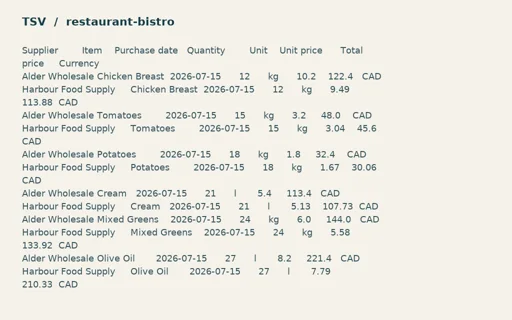
- tsvAlder Table Bistro — Equivalent purchase import TSVEquivalent purchase import TSV for Alder Table Bistro. 96 data rows, 8 columns and 96 expected accepted rows.
Generated by generation/business_fixtures.py. Free for any use, no attribution required, license.