
Alder Books Reconciliation: SAF-T style ledger extract
SAF-T style ledger extract for Alder Books Reconciliation. An audit-file extract structured after the OECD SAF-T 2.0 element names: Header, MasterFiles with 9 GeneralLedgerAccounts and 8 Customers, then GeneralLedgerEntries declaring NumberOfEntries 33, TotalDebit 22464.00 and TotalCredit 22464.00, with one Transaction per document and 66 Line elements in total.
xml
application/xml
- Document Set
- accounting
- Industry
- finance
- Source Kit
- accounting-reconciliation
- Synthetic
- true
- As Of
- 2026-09-08
- Standard
- OECD SAF-T 2.0 element names
Binary xml: no in-browser preview. Download it above to open in a compatible application.
Specifications
- Document Set
- accounting
- Industry
- finance
- Source Kit
- accounting-reconciliation
- Synthetic
- true
- As Of
- 2026-09-08
- Standard
- OECD SAF-T 2.0 element names
- Accounts
- 9
- Transactions
- 33
- Lines
- 66
- Total Debit
- 22464.00
- Schema Validated
- false
- Encoding
- UTF-8
Testing contract
Expected to pass- Scenario
- Parse the audit file and check the declared control totals against the transaction lines.
- Expected result
- NumberOfEntries is 33 and that many Transaction elements parse; the 66 Line elements carry DebitAmount and CreditAmount values summing to 22464.00 and 22464.00, exactly the declared TotalDebit and TotalCredit. Every AccountID resolves to a GeneralLedgerAccounts entry in the same file.
What is a .xml file?
XML (Extensible Markup Language) is a verbose, self-describing markup language using nested tags, attributes, and namespaces to represent structured, hierarchical data. It supports schemas, entities, and validation and underlies many document and data formats. It remains common in enterprise, publishing, and interchange contexts.
How to use this file
Use an example XML file to test parsers, namespace and schema validation, XPath queries, and protection against entity-expansion and external-entity attacks.
How to use this file for testing
“Alder Books Reconciliation: SAF-T style ledger extract” is a deterministic Novus Examples fixture for Data import. Realistic faker-generated datasets with documented schemas for testing import and ETL flows.
Documented properties for this file: UTF-8. Compare results against paired or grouped companions on this page when present (clean↔damaged, searchable↔scanned, or format twins) so scores stay reproducible across runs.
Download the file once, keep the path stable in CI or local scripts, and treat the spec table as the contract: dimensions, seeds, field lists, and roles are intentional. Corrupt or invalid samples are labelled as such, expect parsers to fail loudly rather than silently accept them.
Data fixtures document their exact quirks (delimiters, encodings, null handling, schema, and row counts) in the spec table. Point your parser or importer at the file and assert it handles the documented edge cases; clean and deliberately-messy siblings make before/after diffs straightforward.
Code examples
import xml.etree.ElementTree as ET

tree = ET.parse("saft-ledger-extract.xml")
root = tree.getroot()
print(root.tag, [c.tag for c in root][:5])
Related files
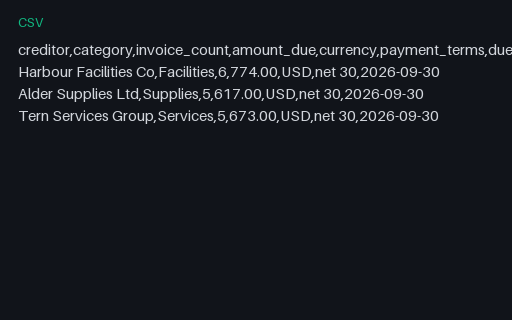
- csvAlder Books Reconciliation: Aged creditors summaryAged creditors summary for Alder Books Reconciliation. The 3 suppliers behind the 16 operating payments, grouped by expense category. The amounts due are 774.00, 617.00, 673.00 and they sum to 2064.00, which is the total of the three actual columns on the budget report.
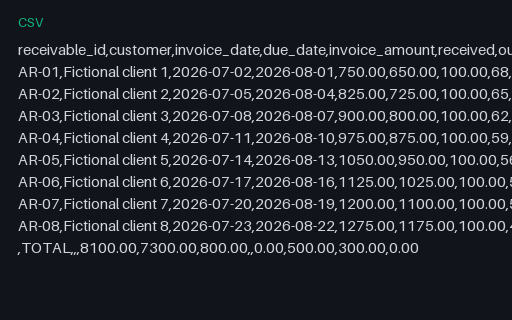
- csvAlder Books Reconciliation: Aged debtors reportAged debtors report for Alder Books Reconciliation. 8 open receivables aged at 2026-09-08, each with 100.00 outstanding against an invoice of between 750.00 and 1275.00. The ageing buckets hold 0.00 current, 500.00 at 31 to 60 days and 300.00 at 61 to 90 days, summing to 800.00, the receivables line of the trial balance.
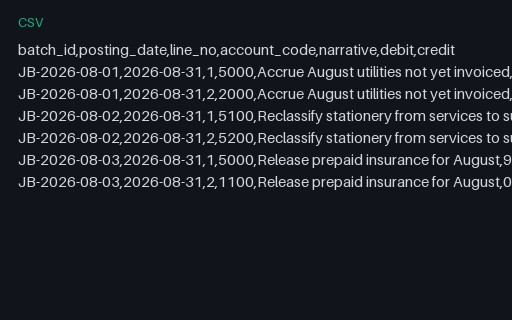
- csvAlder Books Reconciliation: Balanced manual journal batchBalanced manual journal batch for Alder Books Reconciliation. 3 month-end journals of 2 lines each, 6 lines in total: an accrual, a reclassification and a prepayment release. Each batch_id balances on its own and the batch as a whole posts 339.75 of debits and the same of credits.
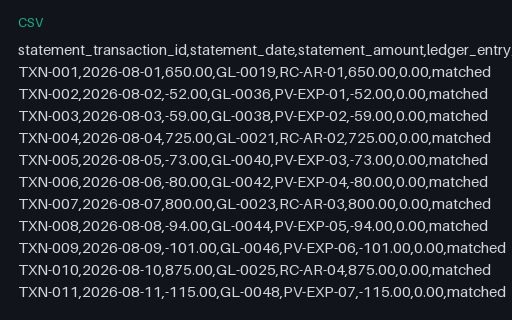
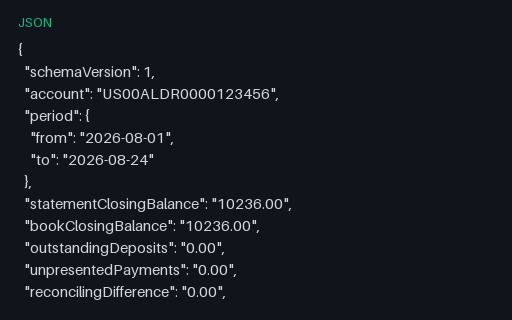
- csvAlder Books Reconciliation: Bank reconciliationBank reconciliation for Alder Books Reconciliation. All 24 statement transactions matched one for one to a cash-account ledger line, with a difference column that is 0.00 on every row. There are no unpresented items and no deposits in transit, so the book balance 10236.00 equals the statement balance 10236.00 and the reconciling difference is 0.00.
- jsonAlder Books Reconciliation: Bank reconciliation JSONBank reconciliation JSON for Alder Books Reconciliation. The same 24 matches as bank-reconciliation.csv with the reconciliation summary at the top: statement closing 10236.00, book closing 10236.00, nothing outstanding or unpresented and a reconciling difference of 0.00.
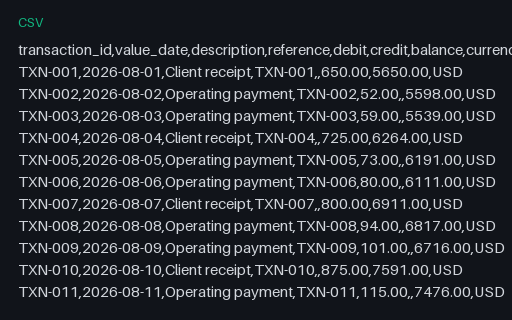
- csvAlder Books Reconciliation: Bank statement CSVBank statement CSV for Alder Books Reconciliation. 24 transactions from 2026-08-01 to 2026-08-24 in separate debit and credit columns, with a running balance. The statement opens at 5000.00 and closes at 10236.00; 8 credits total 7300.00 and 16 debits total 2064.00.
Generated by generation/industry_documents.py. Free for any use, no attribution required, license.