
Pairwise Ranking Preferences (JSONL)
Pairwise doc preferences for reward-model and reranker training tests.
{"query": "best sample phone", "preferred": "doc_a", "rejected": "doc_b"}
{"query": "best sample phone", "preferred": "doc_a", "rejected": "doc_b"}
{"query": "best sample phone", "preferred": "doc_a", "rejected": "doc_b"}
{"query": "best sample phone", "preferred": "doc_a", "rejected": "doc_b"}
{"query": "best sample phone", "preferred": "doc_a", "rejected": "doc_b"}
{"query": "best sample phone", "preferred": "doc_a", "rejected": "doc_b"}
Specifications
- Records
- 6
- Task
- pairwise
Testing contract
Reference control- Scenario
- Exercise Pairwise Ranking Preferences (JSONL) in its ranking workflow. Pairwise doc preferences for reward-model and reranker training tests.
- Expected result
- 6 independently parseable JSON records; array length is 6; first-record keys are query, preferred, rejected. Declared feature checks: task=pairwise.
What is a .jsonl file?
JSONL (JSON Lines) is a text format where each line is a complete, independent JSON value, allowing records to be streamed and appended without parsing the whole file. It is not itself a JSON array and each line must stand alone. It is common in logging, machine learning datasets, and data pipelines.
How to use this file
Use an example JSONL to test line-by-line streaming parsers, append-and-resume ingestion, and batch pipelines that process one record per line.
How to use this file for testing
“Pairwise Ranking Preferences (JSONL)” is a deterministic Novus Examples fixture for ML training data, NLP datasets. Labelled, synthetic datasets in the shapes ML pipelines expect (JSONL for text tasks, image annotations, embeddings, and sample weights) for testing data loaders, tokenizers, and training tooling.
Documented properties for this file: 6 records · task: pairwise. Compare results against paired or grouped companions on this page when present (clean↔damaged, searchable↔scanned, or format twins) so scores stay reproducible across runs.
Download the file once, keep the path stable in CI or local scripts, and treat the spec table as the contract: dimensions, seeds, field lists, and roles are intentional. Corrupt or invalid samples are labelled as such, expect parsers to fail loudly rather than silently accept them.
AI/ML fixtures are fully synthetic with documented schemas, no real people or data. Test data loaders, tokenizers, annotation converters, embedding/vector stores, or eval-metric parsers against the known structure and fixed seeds.
These are labelled, training-shaped fixtures with a documented schema. Test your data loader, tokenizer, or format converter against it; every label and value is synthetic.
Code examples
import json

with open("pairwise-preferences.jsonl") as f:
    rows = [json.loads(line) for line in f]
print(len(rows), rows[0])
Related files
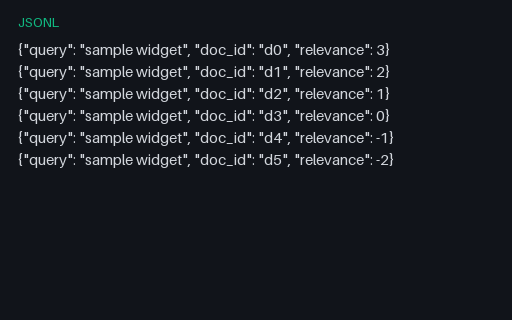
- jsonlLearning-to-Rank Queries (JSONL)Query-document relevance grades for learning-to-rank training and eval.
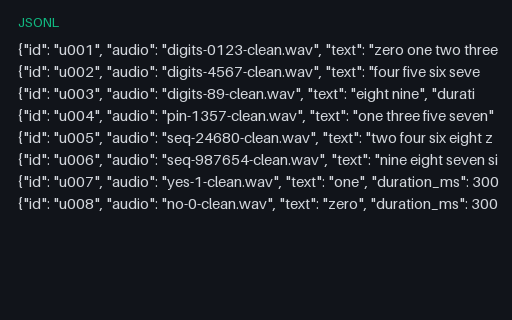
- jsonlASR Digit Utterances Dataset (JSONL)JSON Lines ASR training/eval set for the Wave B synthetic digit utterances — each row points at a clean WAV and carries the expected transcript.
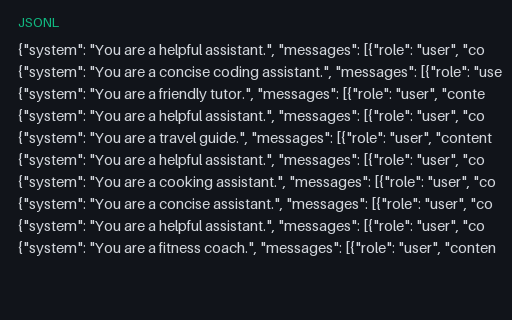
- jsonlChat Fine-tuning Dataset — Anthropic Format (JSONL)The same synthetic conversations in the Anthropic Messages JSONL shape — a top-level system prompt plus a messages array of user and assistant turns. The format twin of the OpenAI file, for testing chat-format conversion.
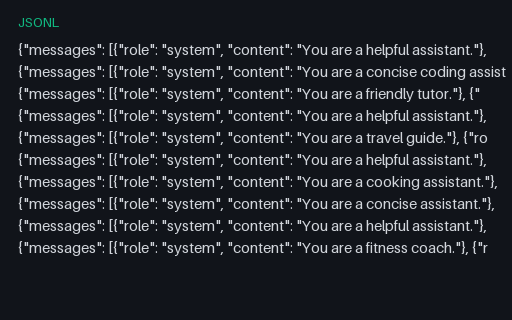
- jsonlChat Fine-tuning Dataset — OpenAI Format (JSONL)A chat fine-tuning dataset in the OpenAI JSONL format — one conversation per line as a messages array with system, user, and assistant turns. Synthetic Q&A content. Paired with an Anthropic-format twin for testing format converters.
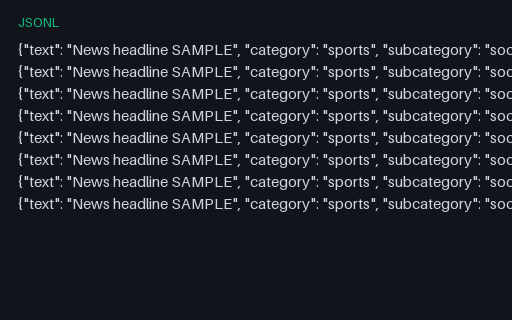
- jsonlClassification Dataset — Hierarchical (JSONL)Hierarchical category labels for taxonomy-aware classifiers.
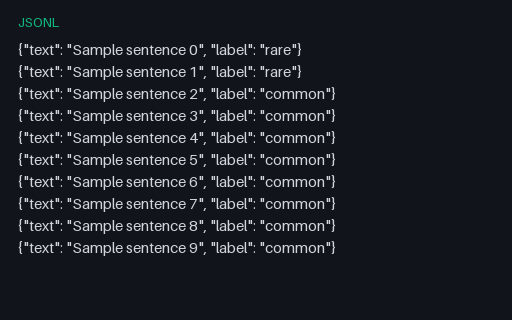
- jsonlClassification Dataset — Imbalanced (JSONL)Imbalanced label distribution — 2 rare vs 8 common rows.
Generated by generation/ai_wave_f.py. Free for any use, no attribution required, license.