
Mini RAG Queries (JSON)
Retrieval-eval queries with relevant_docs pointers into the mini RAG Markdown corpus.
{
  "queries": [
    {
      "id": "rq1",
      "query": "How long is the return window?",
      "relevant_docs": [
        "doc-a.md"
      ]
    },
    {
      "id": "rq2",
      "query": "When is Brightside Cafe open on weekends?",
      "relevant_docs": [
        "doc-b.md"
      ]
    },
    {
      "id": "rq3",
      "query": "Do I need to attribute Novus fixtures?",
      "relevant_docs": [
        "doc-c.md"
      ]
    },
    {
      "id": "rq4",
      "query": "What units should lab temperature use?",
      "relevant_docs": [
        "doc-d.md"
      ]
    },
    {
      "id": "rq5",
      "query": "Sample order id for returns?",
      "relevant_docs": [
        "doc-a.md"
      ]
    }
  ]
}
Specifications
- Queries
- 5
- Role
- retrieval eval queries
- Collection
- mini-rag
Testing contract
Expected to pass- Scenario
- Exercise Mini RAG Queries (JSON) in its rag workflow. Retrieval-eval queries with relevant_docs pointers into the mini RAG Markdown corpus.
- Expected result
- top-level keys are queries; array lengths: queries=5. Declared feature checks: queries=5; role=retrieval eval queries; collection=mini-rag.
What is a .json file?
JSON (JavaScript Object Notation) is a lightweight, text-based data-interchange format representing objects, arrays, strings, numbers, booleans, and null. It is language-independent, human-readable, and the dominant format for web APIs and configuration. It requires a single well-formed root value.
How to use this file
Use an example JSON file to test parsers and serializers, schema validation, Unicode and number-precision handling, and API request or response processing.
How to use this file for testing
“Mini RAG Queries (JSON)” is a deterministic Novus Examples fixture for ML training data, NLP datasets, JSON parsing. Labelled, synthetic datasets in the shapes ML pipelines expect (JSONL for text tasks, image annotations, embeddings, and sample weights) for testing data loaders, tokenizers, and training tooling.
Documented properties for this file: retrieval eval queries. Compare results against paired or grouped companions on this page when present (clean↔damaged, searchable↔scanned, or format twins) so scores stay reproducible across runs.
Download the file once, keep the path stable in CI or local scripts, and treat the spec table as the contract: dimensions, seeds, field lists, and roles are intentional. Corrupt or invalid samples are labelled as such, expect parsers to fail loudly rather than silently accept them.
AI/ML fixtures are fully synthetic with documented schemas, no real people or data. Test data loaders, tokenizers, annotation converters, embedding/vector stores, or eval-metric parsers against the known structure and fixed seeds.
These are labelled, training-shaped fixtures with a documented schema. Test your data loader, tokenizer, or format converter against it; every label and value is synthetic.
Code examples
import json

with open("queries.json") as f:
    data = json.load(f)
print(type(data), len(data))
Related files
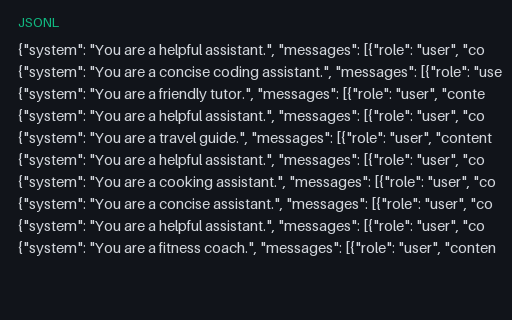
- jsonlChat Fine-tuning Dataset — Anthropic Format (JSONL)The same synthetic conversations in the Anthropic Messages JSONL shape — a top-level system prompt plus a messages array of user and assistant turns. The format twin of the OpenAI file, for testing chat-format conversion.
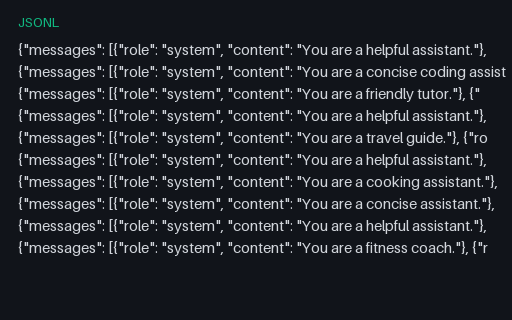
- jsonlChat Fine-tuning Dataset — OpenAI Format (JSONL)A chat fine-tuning dataset in the OpenAI JSONL format — one conversation per line as a messages array with system, user, and assistant turns. Synthetic Q&A content. Paired with an Anthropic-format twin for testing format converters.
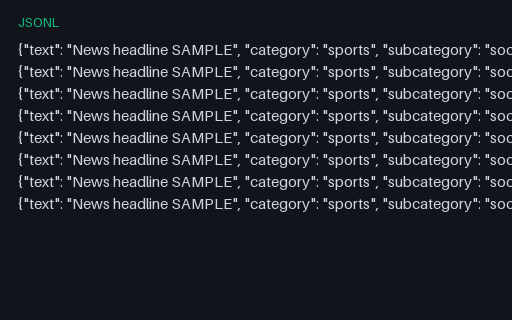
- jsonlClassification Dataset — Hierarchical (JSONL)Hierarchical category labels for taxonomy-aware classifiers.
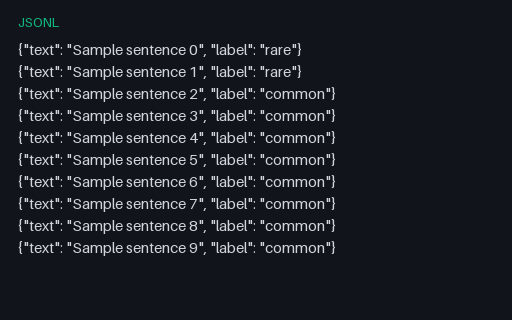
- jsonlClassification Dataset — Imbalanced (JSONL)Imbalanced label distribution — 2 rare vs 8 common rows.
- jsonlClassification Dataset — Intent (JSONL)Intent classification JSONL for dialog systems.
- jsonlClassification Dataset — Language Id (JSONL)Language identification JSONL with EN/ES pairs.
Generated by generation/ai_wave_b.py. Free for any use, no attribution required, license.