
Parallel Translation Corpus — EN↔ES (JSONL)
An English↔Spanish parallel corpus in JSON Lines — 20 aligned sentence pairs of everyday phrases. A fixture for training and evaluating machine-translation models and for testing UTF-8 handling of accented characters.
{"en": "Good morning.", "es": "Buenos días."}
{"en": "Where is the train station?", "es": "¿Dónde está la estación de tren?"}
{"en": "I would like a coffee, please.", "es": "Quisiera un café, por favor."}
{"en": "How much does this cost?", "es": "¿Cuánto cuesta esto?"}
{"en": "The weather is nice today.", "es": "Hoy hace buen tiempo."}
{"en": "My name is Alex.", "es": "Me llamo Alex."}
{"en": "Thank you very much.", "es": "Muchas gracias."}
{"en": "I don't understand.", "es": "No entiendo."}
{"en": "Can you help me?", "es": "¿Puedes ayudarme?"}
{"en": "The book is on the table.", "es": "El libro está sobre la mesa."}
{"en": "We are going to the beach.", "es": "Vamos a la playa."}
{"en": "What time is it?", "es": "¿Qué hora es?"}
{"en": "She speaks three languages.", "es": "Ella habla tres idiomas."}
{"en": "The food was delicious.", "es": "La comida estaba deliciosa."}
{"en": "I will call you tomorrow.", "es": "Te llamaré mañana."}
{"en": "This is my favourite song.", "es": "Esta es mi canción favorita."}
{"en": "They live near the park.", "es": "Ellos viven cerca del parque."}
{"en": "Please close the door.", "es": "Por favor, cierra la puerta."}
{"en": "The children are playing outside.", "es": "Los niños están jugando afuera."}
{"en": "I need to buy some bread.", "es": "Necesito comprar pan."}
Specifications
- Pairs
- 20
- Languages
- en, es
- Schema
- en, es
- Task
- machine translation
What is a .jsonl file?
JSONL (JSON Lines) is a text format where each line is a complete, independent JSON value, allowing records to be streamed and appended without parsing the whole file. It is not itself a JSON array and each line must stand alone. It is common in logging, machine learning datasets, and data pipelines.
How to use this file
Use an example JSONL to test line-by-line streaming parsers, append-and-resume ingestion, and batch pipelines that process one record per line.
How to use this file for testing
“Parallel Translation Corpus — EN↔ES (JSONL)” is a deterministic Novus Examples fixture for ML training data, NLP datasets, JSON parsing, Internationalization. Labelled, synthetic datasets in the shapes ML pipelines expect — JSONL for text tasks, image annotations, embeddings, and sample weights — for testing data loaders, tokenizers, and training tooling.
Documented properties for this file: schema: en, es · task: machine translation. Compare results against paired or grouped companions on this page when present (clean↔damaged, searchable↔scanned, or format twins) so scores stay reproducible across runs.
Download the file once, keep the path stable in CI or local scripts, and treat the spec table as the contract: dimensions, seeds, field lists, and roles are intentional. Corrupt or invalid samples are labelled as such — expect parsers to fail loudly rather than silently accept them.
AI/ML fixtures are fully synthetic with documented schemas — no real people or data. Test data loaders, tokenizers, annotation converters, embedding/vector stores, or eval-metric parsers against the known structure and fixed seeds.
These are labelled, training-shaped fixtures with a documented schema. Test your data loader, tokenizer, or format converter against it; every label and value is synthetic.
Code examples
import json

with open("translation-en-es.jsonl") as f:
    rows = [json.loads(line) for line in f]
print(len(rows), rows[0])
Related files
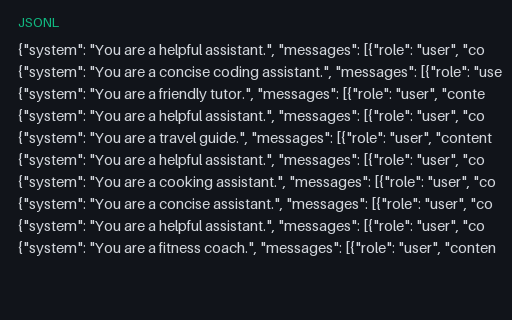
- jsonlChat Fine-tuning Dataset — Anthropic Format (JSONL)The same synthetic conversations in the Anthropic Messages JSONL shape — a top-level system prompt plus a messages array of user and assistant turns. The format twin of the OpenAI file, for testing chat-format conversion.
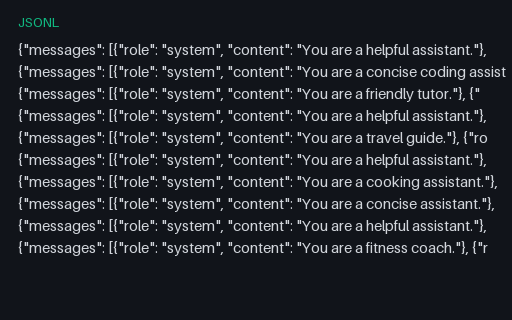
- jsonlChat Fine-tuning Dataset — OpenAI Format (JSONL)A chat fine-tuning dataset in the OpenAI JSONL format — one conversation per line as a messages array with system, user, and assistant turns. Synthetic Q&A content. Paired with an Anthropic-format twin for testing format converters.
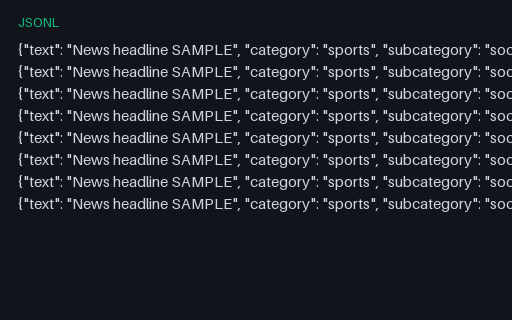
- jsonlClassification Dataset — Hierarchical (JSONL)Hierarchical category labels for taxonomy-aware classifiers.
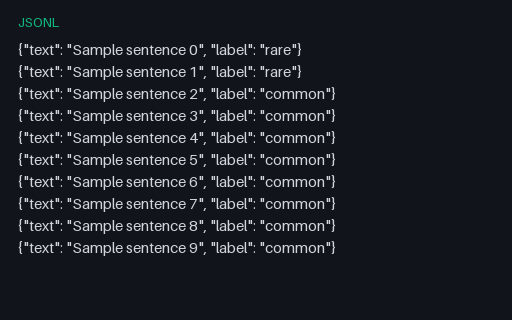
- jsonlClassification Dataset — Imbalanced (JSONL)Imbalanced label distribution — 2 rare vs 8 common rows.
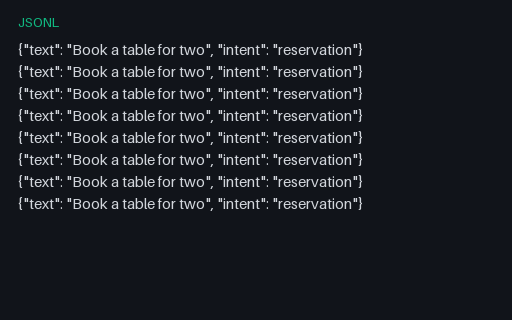
- jsonlClassification Dataset — Intent (JSONL)Intent classification JSONL for dialog systems.
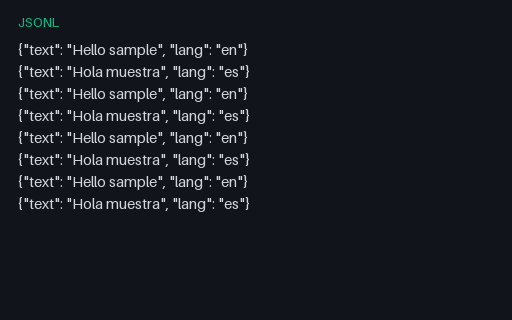
- jsonlClassification Dataset — Language Id (JSONL)Language identification JSONL with EN/ES pairs.
Generated by generation/ai_datasets.py. Free for any use, no attribution required — license.