
X12 EDI 850 Purchase Order
An ANSI X12 850 purchase order — ISA/GS/ST envelope with BEG, N1, and PO1 line items. A fixture for testing EDI parsers and translators. Paired with the 810 invoice for the same order.
ISA*00*          *00*          *ZZ*NOVUSBUYER      *ZZ*EXAMPLESUPPLIER *260115*0930*U*00401*000000001*0*P*>~
GS*PO*NOVUSBUYER*EXAMPLESUPPLIER*20260115*0930*1*X*004010~
ST*850*0001~
BEG*00*SA*PO-2026-0042**20260115~
REF*DP*DEPT-14~
N1*ST*Novus Buyer Ltd*92*BUYER-001~
PO1*1*10*EA*12.50**BP*SKU-0001*VP*Wireless Mouse~
PO1*2*5*EA*79.99**BP*SKU-0006*VP*Noise-cancelling Headphones~
PO1*3*20*EA*3.20**BP*SKU-0011*VP*Cable Organiser~
CTT*3~
SE*10*0001~
GE*1*1~
IEA*1*000000001~
Specifications
- Standard
- ANSI X12 004010
- Transaction
- 850 (Purchase Order)
- Note
- synthetic trading partners
What is a .edi file?
EDI (Electronic Data Interchange), in the ANSI X12 family, is a structured plain-text format for exchanging business documents like purchase orders (850) and invoices (810) between trading partners. It is built from segments (ISA, GS, ST, …) separated by delimiters, with tightly specified element positions. It underpins much of B2B supply-chain and retail commerce.
How to use this file
Use an example X12 EDI file to test EDI parsers and translators, segment/element extraction, and mapping from EDI to JSON or XML. The parties and values here are synthetic.
How to use this file for testing
“X12 EDI 850 Purchase Order” is a deterministic Novus Examples fixture for Data import, Conversion testing. Realistic faker-generated datasets with documented schemas for testing import and ETL flows.
Documented properties for this file: EDI · 486 bytes. Compare results against paired or grouped companions on this page when present (clean↔damaged, searchable↔scanned, or format twins) so scores stay reproducible across runs.
Download the file once, keep the path stable in CI or local scripts, and treat the spec table as the contract: dimensions, seeds, field lists, and roles are intentional. Corrupt or invalid samples are labelled as such — expect parsers to fail loudly rather than silently accept them.
Document fixtures list their internal structure (pages, fields, tracked changes, embedded objects) in the spec table. Test extractors, converters, and OCR against that known structure, and compare searchable↔scanned or format-twin companions when present.
Code examples
from pydifact.segmentcollection import Interchange  # EDIFACT

inter = Interchange.from_file("purchase-order-850.edi")
for seg in inter.segments:
    print(seg.tag, seg.elements)
Related files
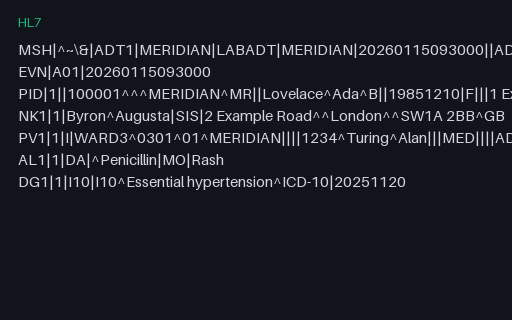
- hl7HL7 v2 ADT^A01 Admission MessageAn HL7 v2.5 ADT^A01 patient-admission message — pipe/caret-delimited segments (MSH, EVN, PID, PV1, allergies, diagnosis). A fixture for testing healthcare integration engines and HL7 parsers. The patient is fictional.
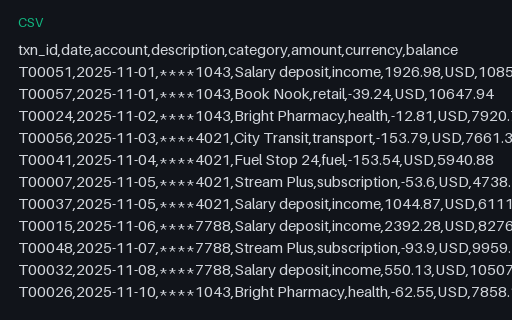
- csvBank Transactions (CSV, 60 rows)A bank-transaction statement — 60 debits and credits across three accounts (masked numbers) with running balances, categories, and merchants. Synthetic data for testing statement parsers, categorisation, and reconciliation.
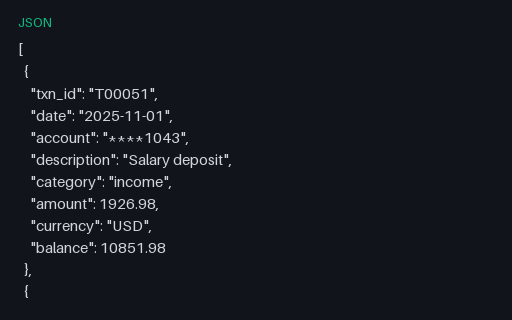
- jsonBank Transactions (JSON, 60 records)The bank transactions as a JSON array — the format twin of the CSV, for import and reconciliation testing.
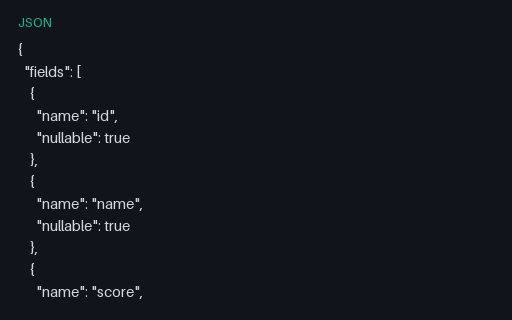
- jsonColumnar Nulls Schema (JSON)JSON description of nullable columns in the null-heavy columnar fixtures.
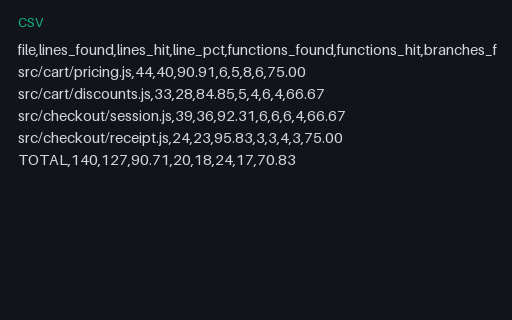
- csvCoverage — Per-File Table (CSV)The same coverage as a flat table with a TOTAL row, for spreadsheets, trend charts and diffing two runs without an XML parser. The TOTAL row is the arithmetic sum of the four file rows, so it doubles as a checksum on any tool that regenerates it. Every file in this group describes the same four-file source tree and reports 127/140 lines, 17/24 branch outcomes and 18/20 functions, so a converter can be diffed against a known answer.
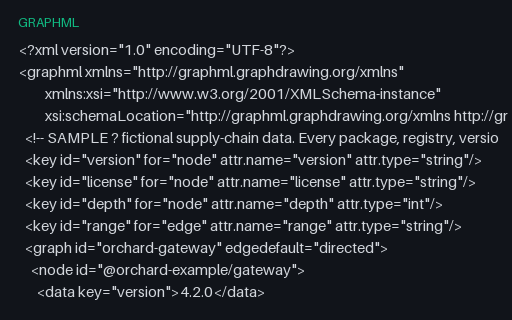
- graphmlDependency Graph (GraphML)The dependency graph in GraphML, with typed attribute keys for node version, licence and depth and for edge range — the interchange format graph databases and analysis tools import. Every package, version, hash and licence is fictional — the tree describes nothing real.
Generated by generation/docs_realworld.py. Free for any use, no attribution required — license.