
Semicolon-Delimited CSV
A CSV that uses semicolons as the delimiter (common in European locales) — for testing delimiter detection.
id;name;city;amount
1;Grace;Paris;516.7
2;Alan;Berlin;950.96
3;Katherine;Toronto;152.72
4;Linus;Austin;949.16
5;Radia;Oslo;318.71
6;Tim;Tokyo;429.09
7;Barbara;Nairobi;829.43
8;Dennis;London;415.11
9;Margaret;Paris;554.1
10;Ada;Berlin;37.28
11;Grace;Toronto;755.98
12;Alan;Austin;542.76
13;Katherine;Oslo;336.43
14;Linus;Tokyo;790.54
15;Radia;Nairobi;310.16
16;Tim;London;458.96
17;Barbara;Paris;142.7
18;Dennis;Berlin;409.08
19;Margaret;Toronto;211.42
20;Ada;Austin;269.69
Specifications
- Rows
- 20
- Columns
- 4
- Delimiter
- semicolon
- Encoding
- UTF-8
What is a .csv file?
CSV (Comma-Separated Values) is a plain-text tabular format where rows are lines and fields are separated by commas, with quoting rules for values that contain delimiters, quotes, or newlines. It has no formal type system and depends on encoding and dialect conventions. It is the most portable format for tabular data exchange.
How to use this file
Use an example CSV to test parsers against quoting and embedded-delimiter edge cases, header handling, encoding detection, and import pipelines into databases or spreadsheets.
How to use this file for testing
“Semicolon-Delimited CSV” is a deterministic Novus Examples fixture for CSV parsing. Clean and deliberately messy CSVs — quoted commas, embedded newlines, ragged rows, odd delimiters, and encodings.
Documented properties for this file: 20 rows · 4 columns · UTF-8. Compare results against paired or grouped companions on this page when present (clean↔damaged, searchable↔scanned, or format twins) so scores stay reproducible across runs.
Download the file once, keep the path stable in CI or local scripts, and treat the spec table as the contract: dimensions, seeds, field lists, and roles are intentional. Corrupt or invalid samples are labelled as such — expect parsers to fail loudly rather than silently accept them.
Data fixtures document their exact quirks — delimiters, encodings, null handling, schema, and row counts — in the spec table. Point your parser or importer at the file and assert it handles the documented edge cases; clean and deliberately-messy siblings make before/after diffs straightforward.
Feed the file to your parser and assert it handles the documented quirks — quoted delimiters, embedded newlines, ragged rows, or invalid syntax; the valid↔invalid distinction is labelled in the title.
Code examples
import pandas as pd

df = pd.read_csv("semicolon.csv")
print(df.head())
print(df.dtypes)
Related files
- csv10,000-Row CSVA CSV with 10,000 data rows — for testing streaming parsers, memory handling, and import performance.
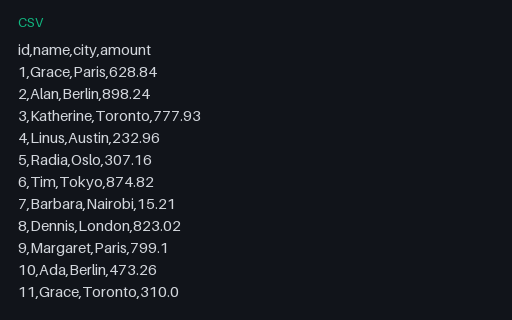
- csvClean CSVA clean, well-formed CSV with a header and 20 rows — the baseline case for CSV parser testing.
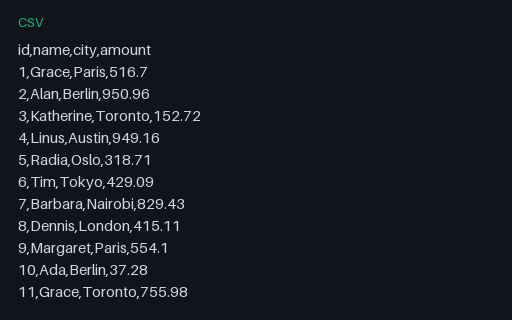
- csvCSV Edge — Empty FieldsTiny SAMPLE CSV (empty-fields) exercising delimiter/quoting edge behaviour.
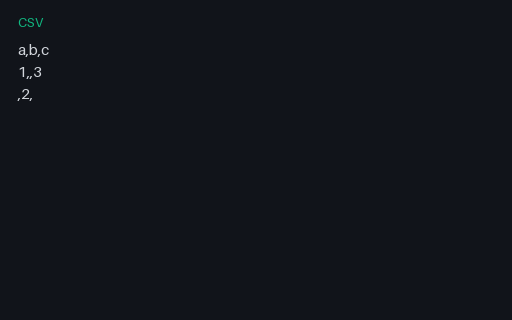
- csvCSV Edge — Hash CommentedTiny SAMPLE CSV (hash-commented) exercising delimiter/quoting edge behaviour.
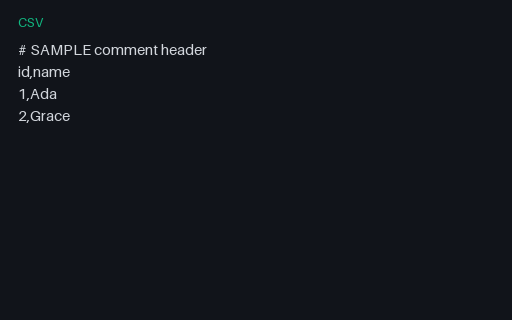
- csvCSV Edge — Header OnlyTiny SAMPLE CSV (header-only) exercising delimiter/quoting edge behaviour.

- csvCSV Edge — Mixed QuotingTiny SAMPLE CSV (mixed-quoting) exercising delimiter/quoting edge behaviour.
Generated by generation/data_tabular.py. Free for any use, no attribution required — license.